Dining room cabinet: the piece that makes or breaks how a room feels when guests arrive
Walk into a dining room where the storage is wrong and you feel it immediately, even if you can’t name it. A sideboard that’s too small for the wall. A china cabinet that looks like it came from a different house. Open shelving that’s supposed to look curated but just looks cluttered. The dining room cabinet is one of those pieces where getting it right makes the entire room feel considered, and getting it wrong makes the entire room feel unfinished — regardless of how good the table and chairs are.
The challenge is that dining room storage has to do several things at once. It has to hold things — dishes, glassware, serving pieces, wine, linens — while looking like it’s not primarily about holding things. It has to work with the scale of the room without dominating it. And in most contemporary homes, it has to bridge the visual gap between the dining area and the living area, because those two spaces are increasingly sharing the same open floor plan. Ornare’s Bookshelves & Multimedia collection addresses all three of these problems through wall systems that treat storage as architecture rather than furniture.
Why a custom wall system outperforms a standalone dining cabinet every time
The standard dining room cabinet — a freestanding sideboard or hutch — has a built-in limitation: it ends. The wall continues on both sides, and whatever you put there (art, a mirror, nothing) has to work alongside the cabinet instead of with it. In rooms with high ceilings or long walls, this creates a scale problem that’s very difficult to solve with freestanding pieces alone.
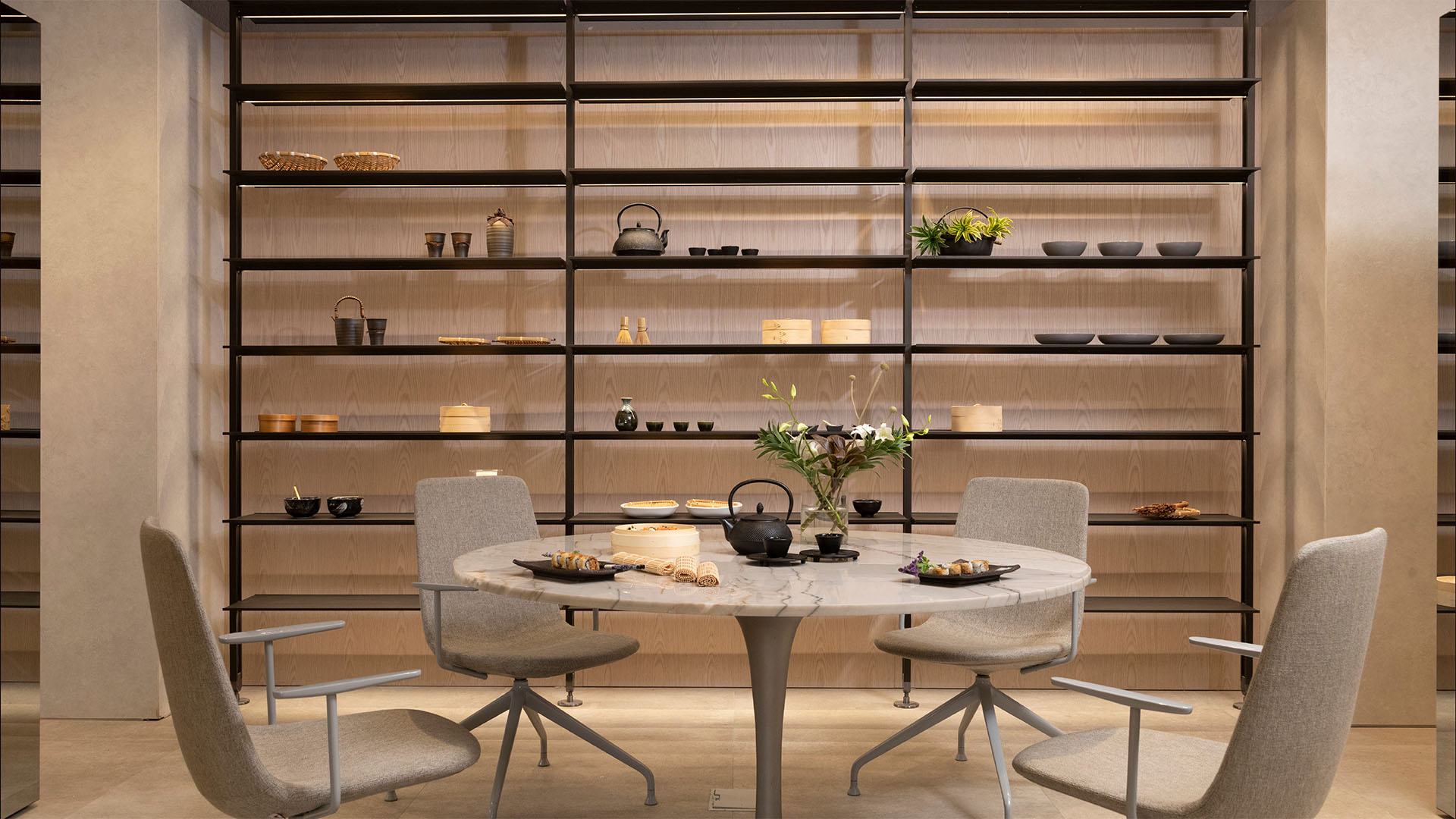
A wall system changes the equation entirely. When storage runs from wall to wall and floor to ceiling, the room reads as designed rather than decorated. The proportions become part of the architecture. The eye moves across the surface as a composition rather than registering individual pieces. And the storage capacity increases dramatically — which matters in a dining room, where the list of things that need a home (serving dishes, bar equipment, table linens, extra glassware) tends to be longer than the available surface area of a standard sideboard.
Ornare builds these systems to the exact dimensions of the room, which is particularly important in dining spaces where the wall often has to work around windows, doors, or architectural details. The Ornare showroom at the A&D Building in New York and the Miami Design District location both have full-scale installations that show what this level of custom fit looks like in a finished room — worth seeing in person before committing to any design direction.
Bar cabinets and display storage: how Ornare integrates function without sacrificing form
One of the more interesting design problems in a dining room wall cabinet is the bar question. In most homes, the bar — bottles, glassware, a decanter or two — ends up either on the kitchen counter, on a cart that gets moved around, or in a dedicated piece that doesn’t quite match anything else in the room. None of these solutions are particularly elegant, and all of them involve some level of compromise.
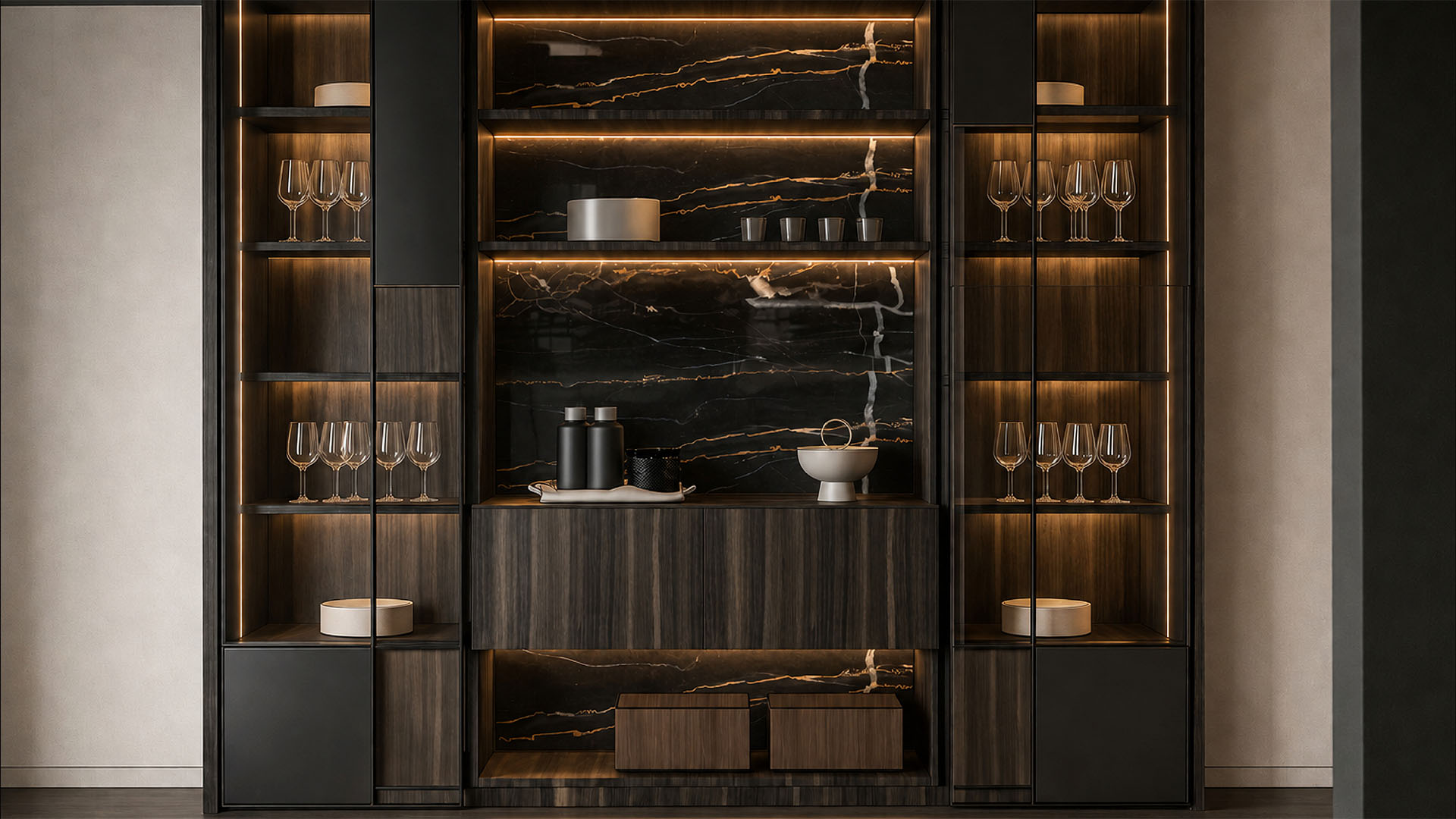
Ornare’s Shaker Wall Bar and Timeless Bar collections solve this by integrating bar storage directly into the wall system, at the same level of design quality as everything else in the composition.
The bar section can include dedicated wine storage, display space for glassware, closed cabinets for spirits, and work surface for mixing — all within a unit that reads as part of the wall rather than as a separate piece of furniture that happens to be nearby. In open-plan homes where the dining area flows directly into the living room, this integration is particularly valuable: the bar becomes a feature of the shared space rather than something that needs to be explained or justified.
Timeless Bar takes a more formal approach, with proportions and finishes suited to rooms where entertaining has a certain ceremony to it. Shaker Wall Bar interprets the same function through a warmer, more craft-oriented lens that works well in spaces that mix contemporary and traditional references. The choice between them is less about style preference and more about the specific room and how it gets used.
Finish and material decisions for a dining room cabinet: what holds up and what photographs well
There’s a gap between what looks good in photos and what holds up in a room that gets used for actual dinner parties. High-gloss lacquer is dramatic in images; it also shows fingerprints, watermarks, and micro-scratches in ways that matter when you’re standing next to it rather than looking at it on a screen. Matte lacquer is more forgiving in daily use and tends to read as more architectural — closer to a painted wall than a piece of furniture — which works well in rooms where the goal is integration rather than statement.
Wood veneer sits in a different register entirely: warmer, more material-rich, more variable in the way it responds to light. In a dining room with warm artificial lighting — which describes most dining rooms used primarily in the evening — wood veneer creates a quality that lacquer can’t replicate. The grain catches the light differently as you move around the room, giving the wall surface a sense of depth and life that flat color doesn’t have.
Ornare works with all of these options and can combine them within a single system — lacquered closed cabinets with open shelves in wood veneer, for instance, or a matte body with a contrasting material on the bar section. These decisions are best made with physical samples in the actual light conditions of the room. Ornare consultants at the Dallas Design District, the West Hollywood location, the Hamptons showroom in Southampton, and the Greenwich location in Connecticut all work with clients through this process using real materials rather than digital representations.
Dining room cabinet design for open-plan spaces: making storage work across two rooms at once
The most common context for a dining room wall cabinet today isn’t a separate dining room — it’s a wall in an open-plan space that’s shared between dining, living, and sometimes kitchen functions. This changes the design requirements significantly, because the cabinet has to work visually from multiple angles and from greater distances than it would in an enclosed room.
In these situations, Ornare’s Wall System Living is often the most effective solution: a configurable system that can run the full length of a wall and integrate dining storage, living room shelving, media components, and display niches into a single continuous composition. The dining section might include closed cabinets at a lower height for serving pieces and linens, with open shelving above for books and objects.
The living section might transition into a media wall or a bar area. The whole thing reads as one piece of architecture rather than a collection of furniture pushed against a wall. For anyone working on a home in Houston, New Jersey, Palm Beach, or Washington D.C. where open-plan living is the norm, this kind of integrated approach is worth exploring with an Ornare consultant before defaulting to the freestanding sideboard that seemed like the obvious answer.