Furniture tables kitchen: how Ornare integrates dining into the kitchen design itself
When people search for furniture tables kitchen, they’re usually solving the same problem: a kitchen that needs a place to eat, and no obvious answer for where that place should be. The standalone kitchen table is the default solution — practical, familiar, easy to shop for. But in a well-designed kitchen, especially one that’s part of an open-plan space, a freestanding table often creates more problems than it solves. It floats in the room without connecting to anything. It competes with the kitchen for visual attention. And in smaller spaces, it occupies square footage that a more integrated solution would use far more efficiently.
Ornare’s kitchen collections address the dining question as part of the kitchen design itself — not as a separate furniture problem to be solved after the cabinets are done. The island, the peninsula, and the extended countertop are the tools, and when they’re designed correctly, they make the freestanding kitchen table feel like a workaround rather than a solution.
Kitchen island with seating: the most versatile integrated dining solution
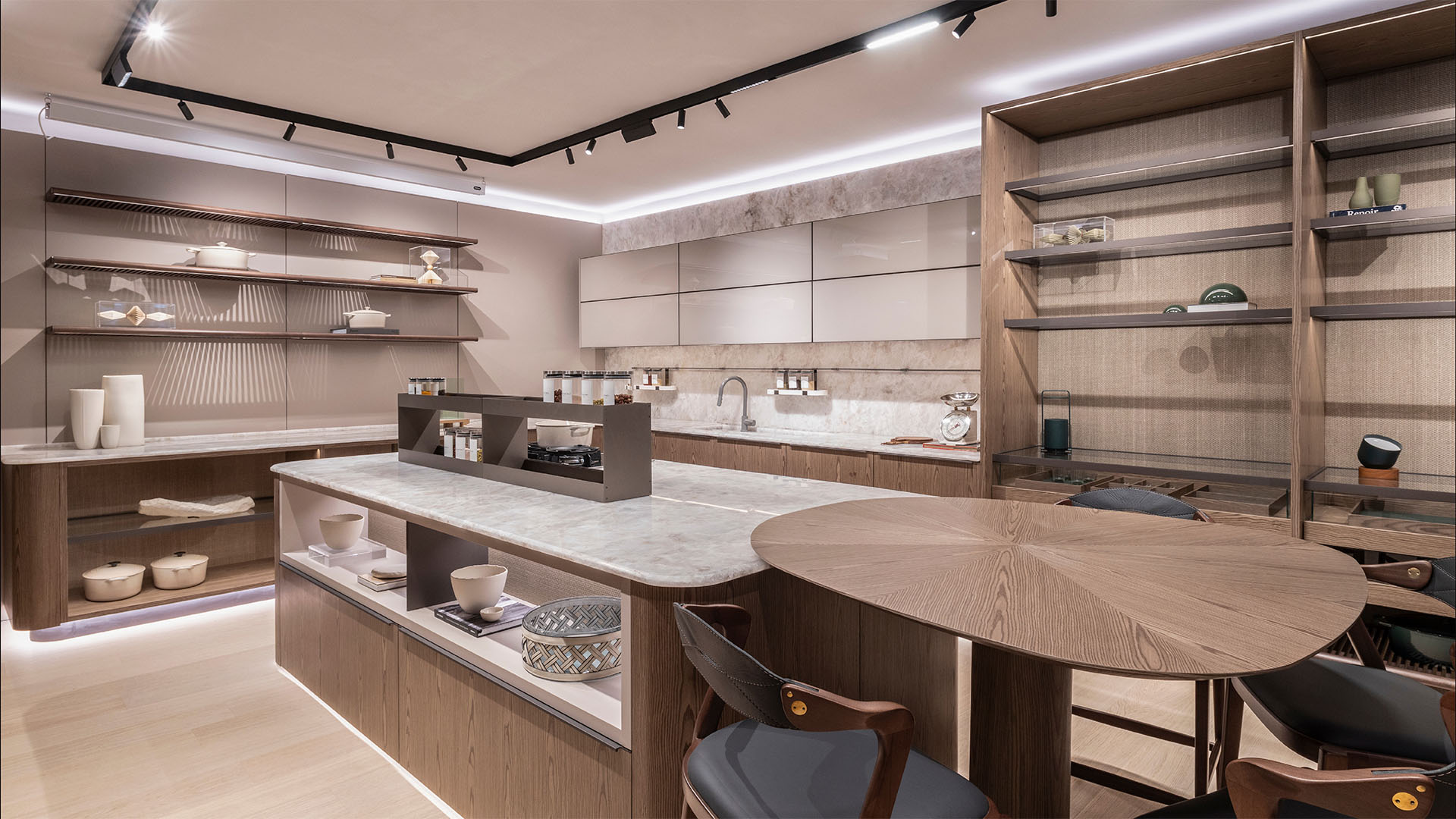
The kitchen island with integrated seating is the most direct replacement for a kitchen table in an open-plan context. On the cooking side, it’s a work surface — additional prep space, storage below, possibly a cooktop or sink. On the opposite side, it’s a dining surface: stools pull up, people sit, food gets served from one side to the other without carrying anything across the room. The social dynamic is completely different from a table in the corner: whoever is cooking is part of the conversation instead of facing a wall.
In an Ornare kitchen, the island is designed as an integral component of the composition — same materials, same finishes, same proportions as the surrounding cabinetry — rather than a separate piece of kitchen furniture placed in the center of the room. The countertop material on the island often becomes the dominant design statement of the entire kitchen: a slab of marble or stone that runs the full length of the island, with the seating side cantilevered at the right height for bar stools, creates a piece that functions as a dining surface, a work surface, and a design focal point simultaneously. The Timeless, Colette, and Minimal collections all lend themselves particularly well to this kind of island-centered composition.
Peninsula seating: integrated dining for kitchens where a full island doesn’t fit
Not every kitchen has the floor area for a freestanding island with clearance on all four sides. The peninsula solves this by connecting one end of the island to the existing cabinetry, freeing up one side of the circulation requirement while maintaining most of the functional and social benefits. In a kitchen that’s ten or eleven feet wide — common in New York apartments, townhouses in Washington D.C., and many homes in the New Jersey and Greenwich markets — the peninsula often makes the difference between a kitchen that has an integrated dining area and one that relies on a separate table.
Ornare designs peninsulas as extensions of the kitchen system rather than as additions to it. The connection between the peninsula and the main cabinetry run is resolved cleanly, with consistent countertop material and cabinet finish across both elements. The seating side can be set at counter height — 36 inches, with standard bar stools — or at a slightly lower height for more comfortable extended dining. The overhang on the seating side is specified to allow adequate knee clearance, which is a dimension that gets compromised in generic configurations but is always correct in a custom design.
The Timeless Edge Desk: when kitchen furniture extends to a workspace
One of the more interesting solutions in the Ornare accessories catalog is the Timeless Edge Desk — a workspace component designed to integrate directly into the Timeless kitchen system. In households where the kitchen doubles as a home office, homework station, or planning space, this integrated desk element provides a dedicated surface without requiring a separate piece of kitchen furniture to be added to the room.
The Edge Desk is designed to sit flush with the kitchen composition, at a height and depth calibrated for seated work rather than standing food preparation. It reads as part of the kitchen rather than as an intrusion from a different room — which matters in open-plan spaces where visual consistency across functions is what makes the space feel designed rather than assembled. For anyone outfitting a kitchen in Houston, Los Angeles, or Palm Beach where the kitchen is also a family hub, this kind of multi-function integration is worth exploring as part of the initial design rather than as an afterthought.
How kitchen furniture works differently when it’s part of a custom system
The fundamental difference between kitchen furniture chosen from a catalog and kitchen furniture designed as part of an Ornare project is the same difference that runs through every aspect of custom design: one starts with standard dimensions and asks the space to accommodate them, the other starts with the space and designs around it. An island that’s the right length for the room, at the right height for the people using it, with the right overhang for the seating configuration and the right material for the way the kitchen gets used — this is what custom design produces, and it’s what makes the result feel like it was always there rather than placed there.
Ornare showrooms across the US — in New York, Miami, Dallas, Los Angeles, the Hamptons in Southampton, and elsewhere — have full kitchen installations where the dining integration can be seen and experienced at full scale. Running your hand along an island countertop, sitting at the seating side to check the height, looking at how the island relates to the surrounding cabinets from across the room: these are the evaluations that determine whether a design actually works, and they can only happen in person.