Modern TV stand or integrated media wall: which one fits your living room
A new living room, a 14-foot wall facing the sofa and a 65-inch television waiting to go up. It’s a situation almost every homeowner faces at some point, and it usually comes down to one choice: a modern TV stand, a single low piece placed under the screen, or an integrated media wall, where the TV, storage, shelving and lighting are designed as one system that covers most or all of the wall.
Both are valid. They solve different problems, cost a different amount of planning and commit you to different things. The right answer depends less on style than on how much you need to store, how the room is used and how long you plan to stay in the house.
Modern TV stand: when a single piece is the right answer
A standalone TV unit makes sense when the wall has to stay flexible. If the living room has a window, a fireplace or a door breaking the wall, a full composition can become complicated, and a well-proportioned low piece under the screen is often cleaner. The same goes for rooms that might be rearranged in a few years, or for homes where the TV wall is not the main focus and the storage should stay quiet.
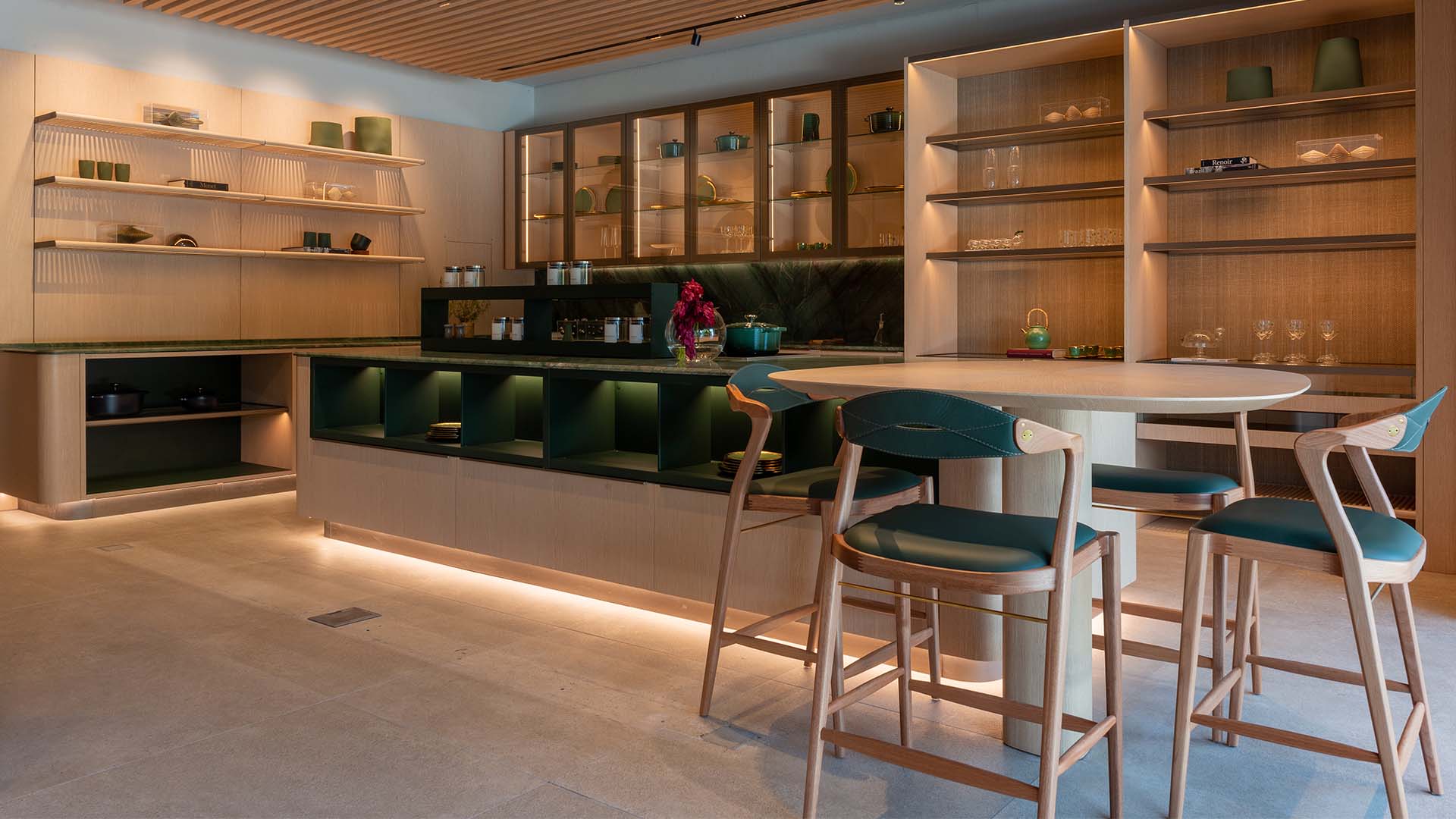
The key is to treat the piece as something worth looking at. A wood TV stand with a continuous grain across the doors, a lacquered unit in a color close to the wall, or a low console with a stone top all bring the material quality that a single element needs when it stands alone. What a stand can’t do is solve storage beyond its own footprint: once books, games, vinyl, photo albums and decorative objects start accumulating, the surface fills up and the wall around the screen stays empty.
Integrated media wall: what changes when screen, storage and shelving become one system
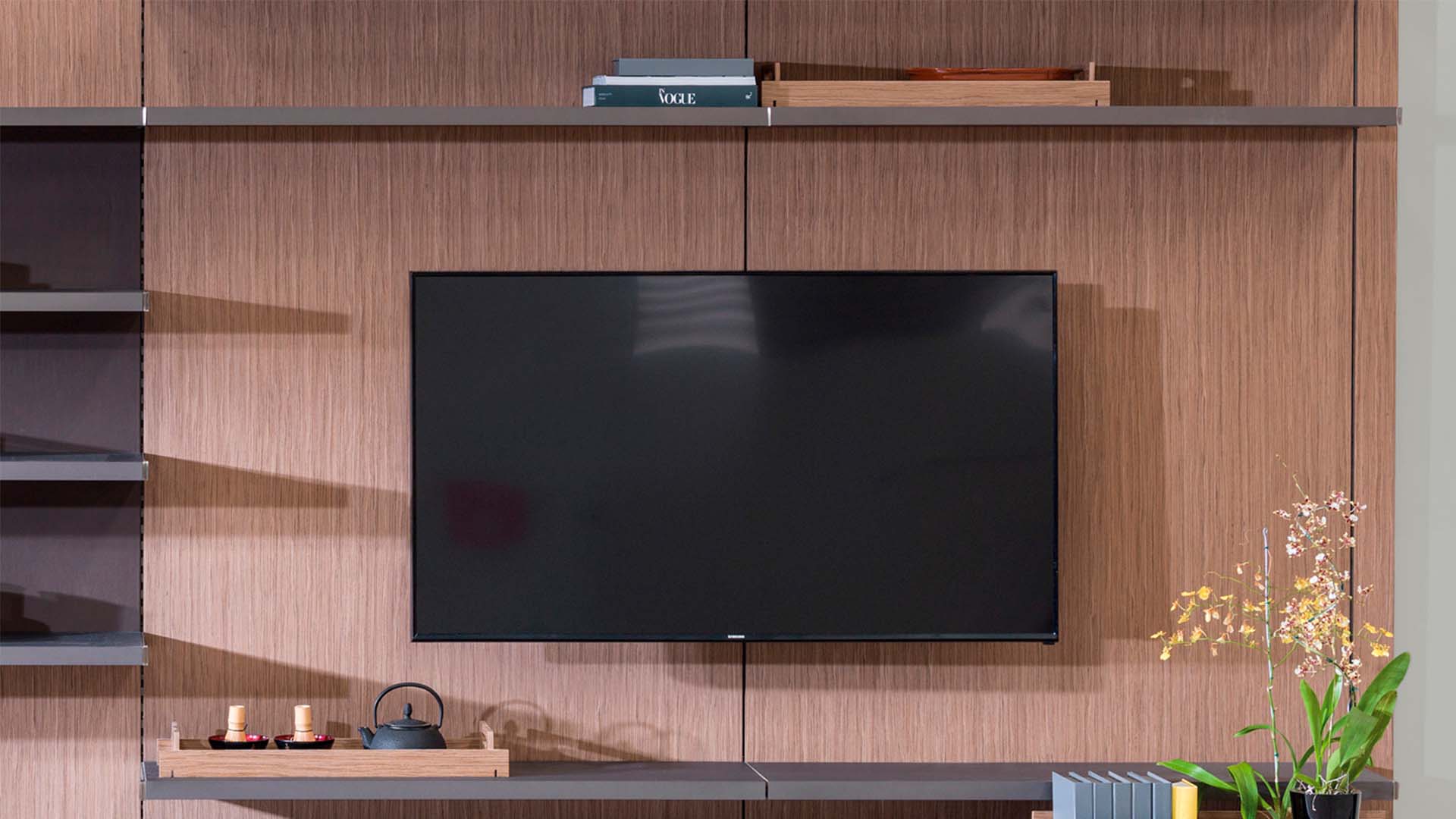
A media wall starts from the opposite principle: the wall itself becomes the storage. On a 14-foot wall, a floor-to-ceiling composition can offer five to six times the capacity of a single TV console, combining closed cabinets at the bottom, open shelving on the sides and display niches at eye level. Everything that would otherwise be spread around the living room finds a precise place.
The other advantage is visual control. In a media wall, the TV is framed by the composition instead of floating on an empty surface, which makes even a large black screen read as part of the design. Speakers can be built into the structure, cables run inside the panels, and integrated lighting turns the shelving into a soft light source in the evening. Some systems also allow sliding panels that cover the shelves, or the screen itself, when the TV is off, so the wall can look like a calm surface for most of the day.
The trade-off is commitment. A media wall has to be designed before it’s built: the position of the screen, the depth of the cabinets, the electrical outlets, the cable routes and the lighting are all fixed in the drawing. It takes more planning than buying a single freestanding piece, and changing it later is not a matter of moving it to another room. For many homeowners that is exactly the point, since the wall is solved once and stays solved, but it’s a decision to make with the room’s long-term use in mind.
Four questions to decide between a living room TV stand and a media wall
Before choosing between a living room TV stand and a full wall system, it helps to answer four practical questions honestly.
How much do you actually need to store?
Make a list of everything that should live on or near the TV wall: media equipment, books, games, records, display objects, blankets. If it fits in two or three closed compartments, a TV stand with storage is enough. If the list keeps growing, a single piece will be overloaded within months, and a wall system is the more realistic choice.
How long will you live in the house?
A media wall is designed for a specific room and becomes part of it. In a home you plan to stay in for many years, that permanence is an asset. In a home you expect to leave within two or three years, a freestanding piece that can move with you is often more sensible.
What else happens on that wall?
Windows, doors, radiators, a fireplace or an awkward corner change the equation. A custom-designed wall can wrap around these elements and turn them into part of the composition, while a standard stand simply sits in front of them. If the wall is complicated, the integrated solution usually gives the cleaner result.
How visible is the wall from the rest of the house?
In an open-plan home, the TV wall is often seen from the kitchen, the dining area and the entrance. A small stand on a large wall can look lost from a distance, while a media wall gives the whole space a clear focal point that holds together across rooms.
How Ornare designs media walls around the way a room is used
Ornare designs its living room systems to the measurements of the actual wall, so the TV area, the closed storage and the shelving are resolved in one drawing. The starting point is what the wall needs to do, and the collections answer that in different ways.
When the priority is hiding things, Ikigai combines slim vertical metal profiles with shelves that have integrated LED lighting and can be closed with wooden sliding panels, so objects can be shown or covered as needed. When the priority is warmth and a sense of permanence, Ornare’s Timeless line builds the wall in solid wood and natural leather, with modules that include doors, drawers, niches and worktops. And when the wall itself should become a three-dimensional surface, Square Wall combines vertical and horizontal panels with steel square shelves and integrated cabinetry elements arranged around the screen.
One practical detail is worth keeping in mind whichever way you go: decide the size of the TV before the wall is designed, not after. A media wall built around a 65-inch screen leaves little room for a 77-inch one later, while a frame designed with a few extra inches on each side can absorb the next upgrade without changing anything else.