Oval dining table: when the shape solves problems rectangles and rounds can't
A dining room 11 feet wide, a family of four that regularly hosts eight, and a table that has to work for both. A rectangle long enough for eight leaves sharp corners right where people walk behind the chairs. A round table big enough for eight is too wide for the room. This is exactly the situation where an oval dining table earns its place: it has the length of a rectangle and the soft edges of a round, and in many American dining rooms that combination solves problems neither of the other shapes can.
Oval dining table vs. rectangular and round: what the curved ends change
The first difference is circulation. In a narrow dining room, the corners of a rectangular table are the points where hips, chairs and serving trays collide. An oval removes them, and that small change makes the passage around the table feel wider than the measurements suggest. In open-plan homes, where the dining area often sits on the main path between kitchen and living room, the effect is even more noticeable.
The second difference is conversation. At a long rectangular table, the people at the ends are cut off from the middle, and those seated on the same side can barely see each other. The curve of an oval brings the end seats slightly inward, so more guests face each other, a quality usually associated with round tables but here available at a length that seats eight or ten.
The third difference is flexibility. With no corners to block a place setting, an oval absorbs an extra chair at each end far more easily than a rectangle does. For households where the number of people at dinner changes from week to week, that tolerance is one of the most practical reasons to choose the shape.
Oval dining room table sizes: how many people each length really seats
Seating capacity depends on length, but also on width and base. As a working guide, allow about 24 inches of table edge per person, and keep in mind that the curved ends seat one person comfortably rather than two.
An oval table for 6 typically measures 72 inches long and 40 to 42 inches wide. At 84 inches, it seats six with generous space or eight in a tighter arrangement. A 96-inch oval seats eight comfortably and up to ten for occasional dinners, and at that size a width of 44 to 48 inches keeps the center of the table usable for serving dishes. Below 40 inches wide, an oval starts to feel narrow; beyond 48 inches, it becomes hard to pass food across.
Clearance completes the calculation. Leave at least 36 inches between the table edge and the nearest wall or cabinet, and 42 to 48 inches where people need to walk behind seated guests. In an 11-foot-wide room, that means a table no wider than about 44 inches. For an oval dining room table in a room 13 feet wide or more, the full 48 inches becomes possible.
Pedestal, double pedestal or legs: the base decides comfort
With an oval dining table, the base matters as much as the top. A central pedestal frees the entire perimeter, so chairs can be placed anywhere along the curve, and it’s the most forgiving option when the number of guests varies. On longer ovals, from about 84 inches, a single pedestal is often replaced by two, set far enough apart to leave knee room at the ends.
Four legs give a lighter, more architectural look, but they fix the seating positions. If you choose legs, check where they fall in relation to the chairs: on an oval, legs set too close to the ends can make the end seats awkward. Whatever the base, the apron under the top should leave at least 24 to 25 inches of clearance from the floor, so armchairs and taller guests fit comfortably.
Materials for a modern dining table with an oval top
Because an oval top has no straight edge to hide behind, the material and the edge profile are fully visible. Solid wood shows its grain along the length of the curve and ages well with daily use. Stone gives a modern dining table a strong, sculptural presence, but a 96-inch oval in marble can weigh several hundred pounds, which affects both the base design and the floor beneath it. Lacquered tops in matte finishes offer a quieter look and a wide range of colors, at the cost of more care with scratches.
The edge profile changes the perception of thickness. A thin, beveled edge makes even a large oval look light, while a full, rounded edge emphasizes solidity. In a dining room with a lot of built-in storage, a lighter profile usually keeps the table from competing with the walls.
Designing the dining room around an oval table with Ornare
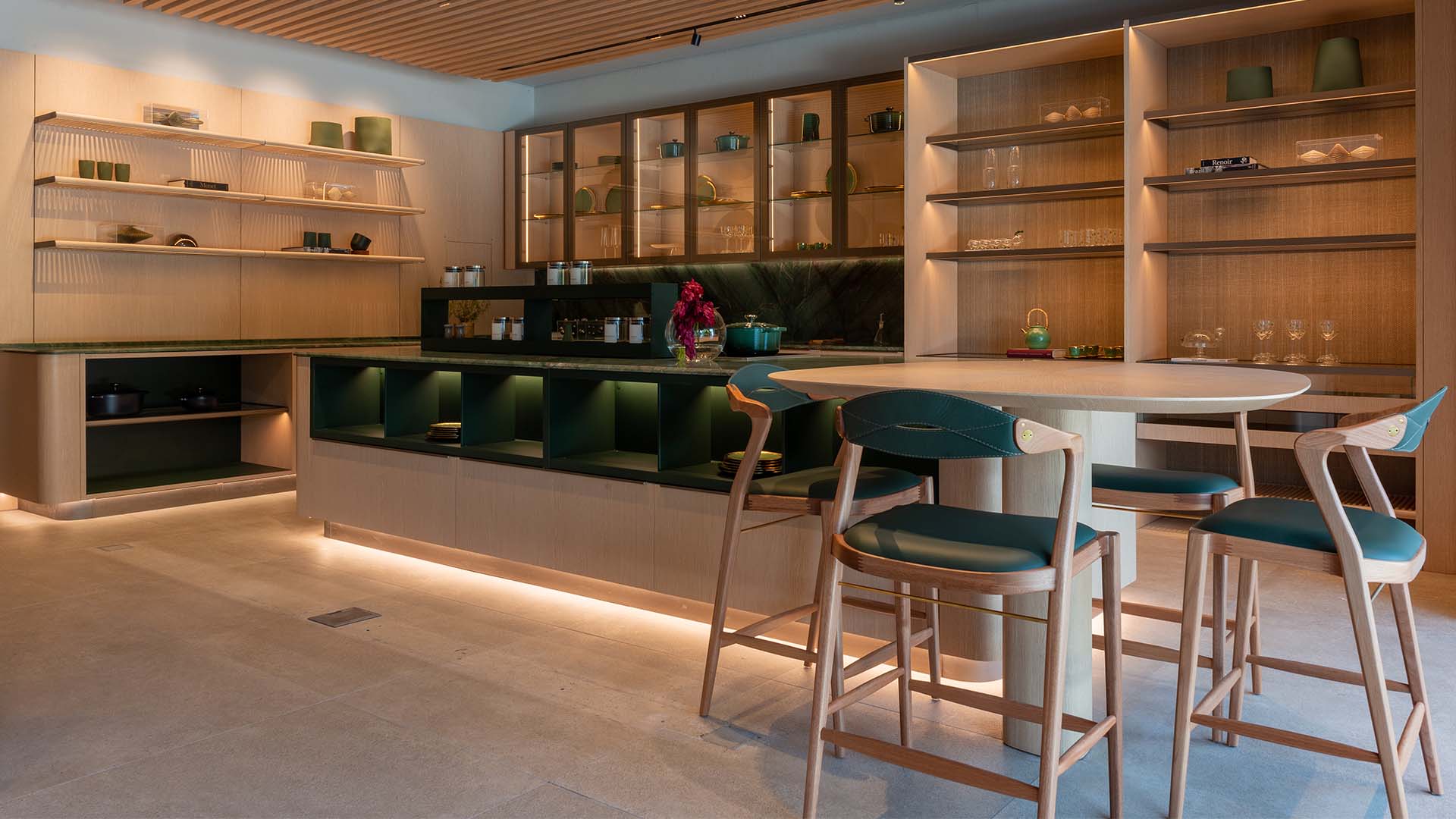
An oval table changes the geometry of the whole room, and the cabinetry around it should respond. Ornare designs dining room storage to the exact measurements of the walls, which makes it possible to align a sideboard wall or a display cabinet with the length of the table and the position of the light fixture above it.
Among all dining table shapes, the oval is the one that most benefits from echoing its curve somewhere else in the room. The Round line introduces curved details and rounded corners inspired by the golden ratio, softening the straight lines of the cabinetry. For a more classic, contemporary interior, Ornare’s Colette collection includes components such as table tops and legs, doors with carved frames inspired by French boiseries and an illuminated crystal cabinet for porcelain and glassware. And where solid wood should be the dominant material, the Timeless line brings the same warmth to the storage that a wood oval brings to the center of the room.
One detail is often overlooked: the rug. An oval table on a rug that’s too small makes chairs catch on the edge every time someone sits down. The rug should extend at least 24 to 30 inches beyond the table on every side, so chairs stay fully on it even when pulled out, and an oval or softly rounded rug repeats the shape without forcing it.