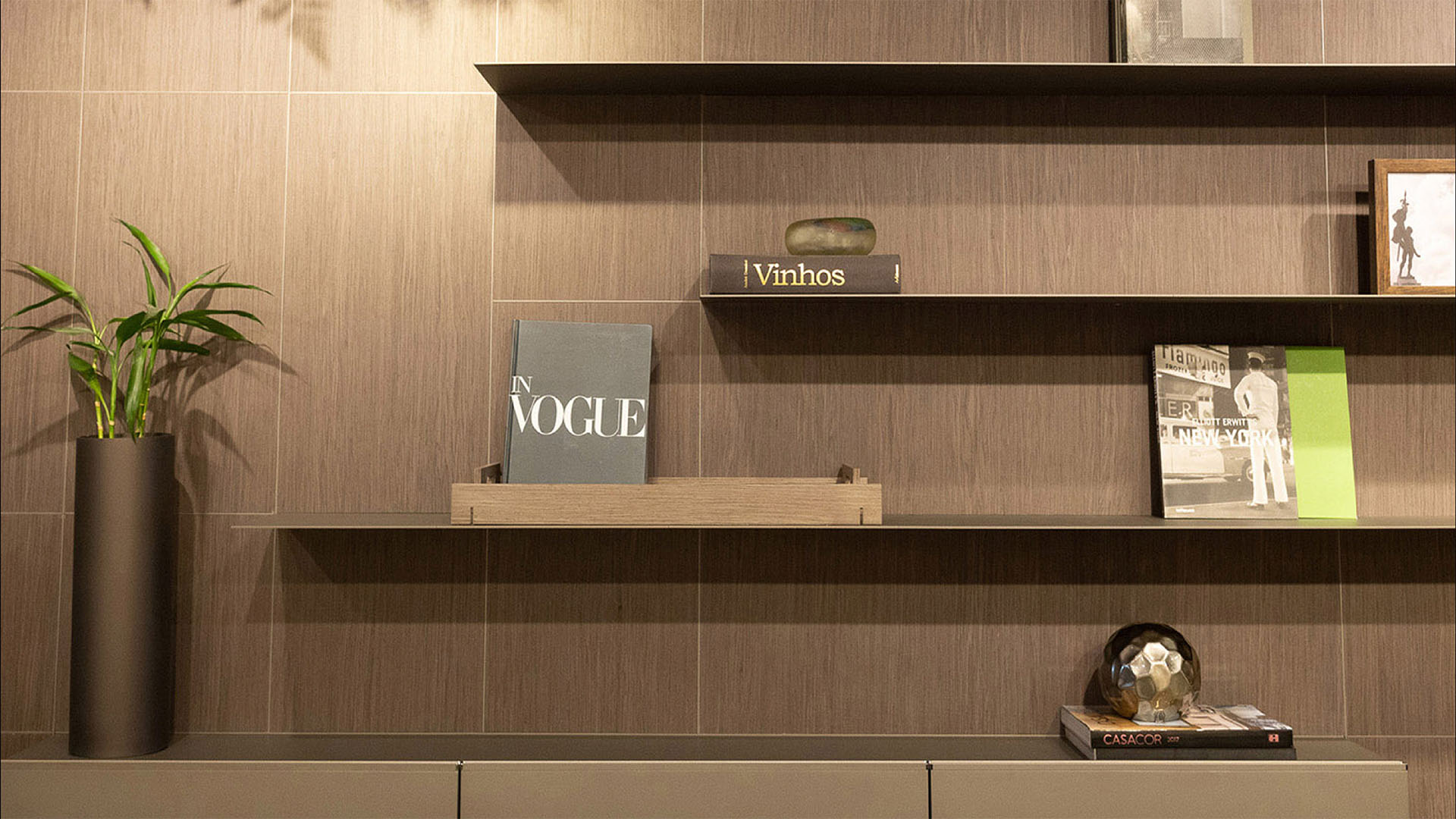
Book shelf cabinet: why a wall system beats a standalone unit every time
There’s a moment in most living room projects when the bookshelf question comes up and immediately gets complicated. A single freestanding unit feels insufficient — too small, too generic, impossible to make look intentional in a large room. Multiple units pushed together look like exactly what they are: separate pieces pretending to be a system. And a built-in feels like a commitment that most people aren’t sure how to start.
The book shelf cabinet problem is really a wall problem: how do you turn a flat surface into something that’s organized, beautiful, and genuinely useful without it looking like an afterthought or a furniture store floor display?
Ornare’s Bookshelves & Multimedia collection answers that question with wall systems designed from the ground up to treat the entire wall as the unit of design — not the individual cabinet. The result is something fundamentally different from anything that ships in a box.
What makes a book shelf cabinet system work: the case for wall-to-wall design
A bookshelf cabinet that runs from wall to wall and floor to ceiling does something that no freestanding piece can: it makes the room feel intentional. The eye reads the wall as a complete composition instead of registering individual elements and the gaps between them. Proportions that would look arbitrary on a standalone unit become part of a larger rhythm. The ceiling feels higher. The room feels more resolved.
Ornare builds wall systems to the exact dimensions of the space — not to the nearest available module size. This means no filler strips, no awkward gaps at the sides, no shelves that end six inches short of the wall because that’s where the standard unit stops. In a New York apartment where walls are rarely perfectly square or perfectly plumb, this matters more than almost anywhere else. The Ornare showroom at the A&D Building on East 58th Street has full-scale installations that demonstrate what this level of fit actually looks like in a real room.
The Ornare bookshelf cabinet collections: six systems, six completely different results
The Bookshelves & Multimedia catalog at Ornare covers a range of approaches that share a commitment to quality construction but produce very different visual results. Rather than walking through each one in sequence, it’s worth thinking about them in terms of what problem each one is best suited to solve.
If the goal is maximum visual impact — a wall that reads as a designed object rather than storage — Square Wall is the answer. Its modular system creates a three-dimensional surface of varying depths that catches light differently at different times of day, making the wall itself the focal point of the room. If the goal is lightness — a bookshelf that doesn’t close off the room or compete with other design elements — Ikigai Bookshelf works in the opposite direction, with an exposed metal structure that filters the wall rather than covering it. Wall System Living sits in the middle: the most flexible of the collection, it can be configured with open shelving, closed cabinets, bar elements, and display niches in any combination, making it the right choice when the wall needs to do multiple things at once.
For rooms that call for warmth and a more traditional reference point, Timeless Bookshelf brings proportions and finishes that feel grounded and permanent without being heavy. Shaker Wall Bar introduces a functional layer — integrated bar storage — alongside the shelving, which works particularly well in open-plan spaces where the living room and entertaining areas overlap. And Timeless Bar takes that idea further, treating the bar cabinet as a design statement in its own right rather than a secondary element tucked into a corner.
Custom book shelf cabinets with integrated lighting: what the right light does to a wall system
Lighting is where most bookshelf cabinet projects either succeed or fall short, and it’s almost always an afterthought. The standard approach — a floor lamp nearby or overhead recessed lights — leaves shelves in shadow and makes it difficult to see what’s on them without walking up close. Integrated lighting, positioned inside the system rather than outside it, changes the entire dynamic.
Ornare builds lighting into its wall systems as part of the design rather than an add-on. LED strips positioned under shelves illuminate the surface below and the objects on it without creating glare or casting shadows in the wrong direction. In a room that gets used in the evening, this transforms the bookshelf cabinet from a daytime feature into a nighttime focal point — the lit wall becomes the visual anchor of the room in a way that no amount of overhead lighting can replicate. In the Dallas Design District showroom and the Los Angeles location in West Hollywood, the evening lighting scenarios are set up specifically to show how this works in practice.
Choosing the right book shelf cabinet finish: wood, lacquer and everything in between
The finish decision on a wall shelf cabinet system has more impact on the character of a room than almost any other single choice, because the surface area involved is large enough that the material reads as architecture rather than furniture. A full wall in matte white lacquer reads as built-in millwork — clean, architectural, recessive.
The same wall in natural wood veneer reads as warm and material-rich, bringing the texture of the wood grain into a room at a scale that changes the entire atmosphere.
Ornare works with both approaches and everything between them, with a range of lacquer colors, wood veneer species, and mixed-material options that allow the finish to be calibrated to the specific room. The decision should be made with physical samples in the actual light of the space — not from a photo or a digital swatch.
Ornare consultants at any US location, from the Miami Design District to Greenwich to Palm Beach to Washington D.C., work with clients through this process using real material samples evaluated in conditions that reflect the actual room as closely as possible. It’s the only reliable way to make a finish decision at this scale without second-guessing it after installation.