Buffet cabinet with glass doors: display storage for the dining wall
Quality tableware has a display problem. Stored in closed cabinets, it’s protected and organized but invisible — the visual contribution of fine glassware, collected ceramics, or inherited china is zero when it’s behind an opaque door. Displayed on open shelves, it’s visible but unprotected — dust accumulates, items need washing before every use, and the casual disorder of a shelf that gets touched regularly undermines the presentation that open display is supposed to provide.
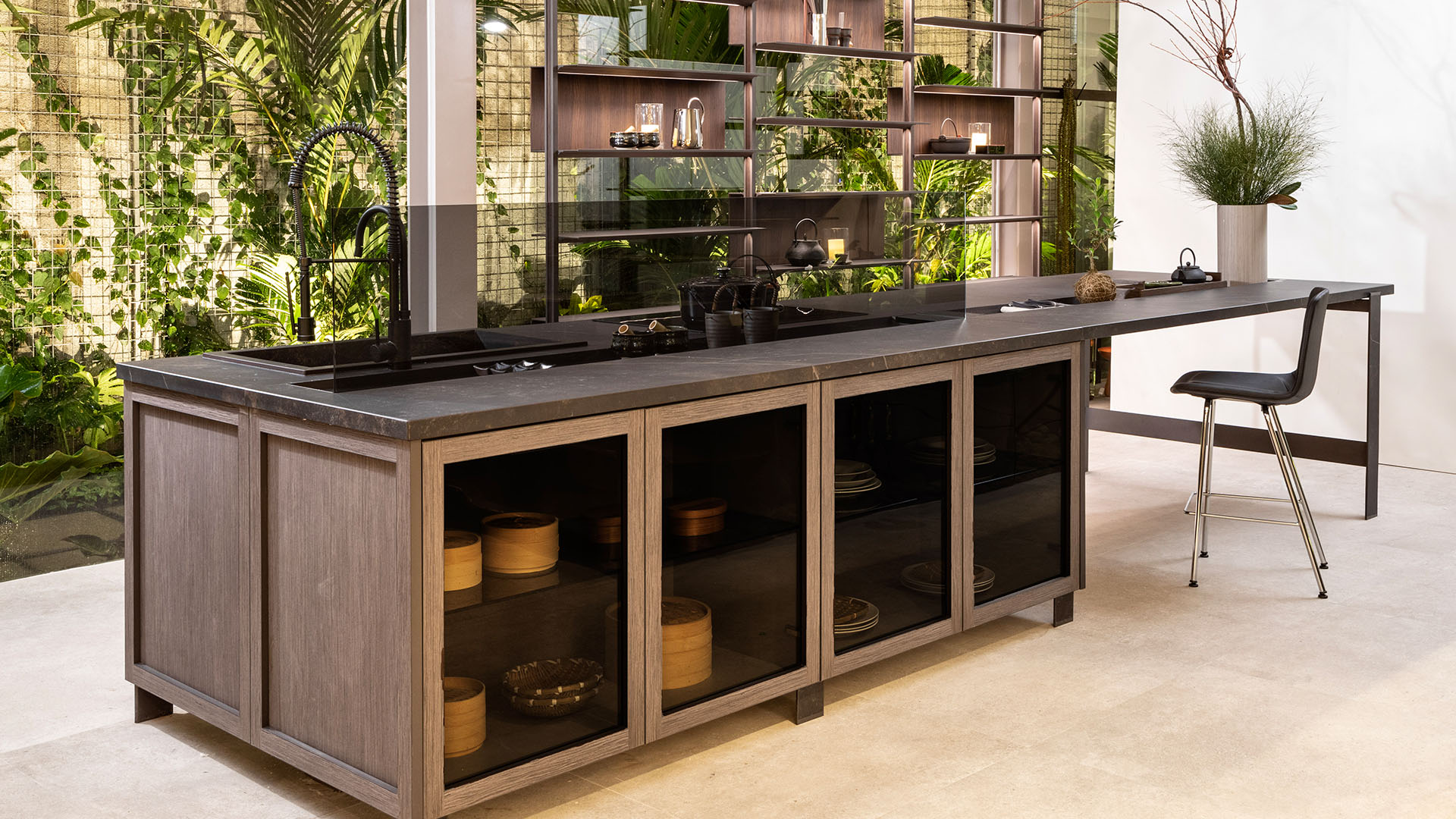
A buffet cabinet with glass doors resolves both sides of this problem. The contents are visible — contributing their aesthetic value to the dining room — and protected from dust behind the glass. Items stored inside stay ready to use without preparation. The glass itself becomes a design element: a surface that reflects light, frames its contents, and adds visual depth to the dining wall in a way that neither open shelving nor opaque doors achieves.
What glass doors actually change in a dining room wall system
The effect of glass doors on a dining room buffet goes beyond the practical storage question. In a dining room where the wall opposite or adjacent to the table is a designed feature — in homes in Greenwich, the Hamptons, or Palm Beach where entertaining is a consistent part of how the house functions — a wall system with glass-door sections produces a fundamentally different visual result than the same system with all opaque doors.
Glass introduces transparency, reflection, and depth. A glass-front cabinet section in a dining wall reflects the light source on the opposite side of the room — a window, a chandelier, sconces on an adjacent wall. This reflection multiplies the perceived light in the room in a way that an opaque surface can’t. The depth of the cabinet interior becomes visible through the glass, adding a three-dimensional quality to the wall that reads as more designed than a flat surface of cabinet fronts. And at night, with integrated lighting inside the glass-front sections, the effect reverses: the cabinet becomes a light source, glowing with the illuminated contents behind the glass.
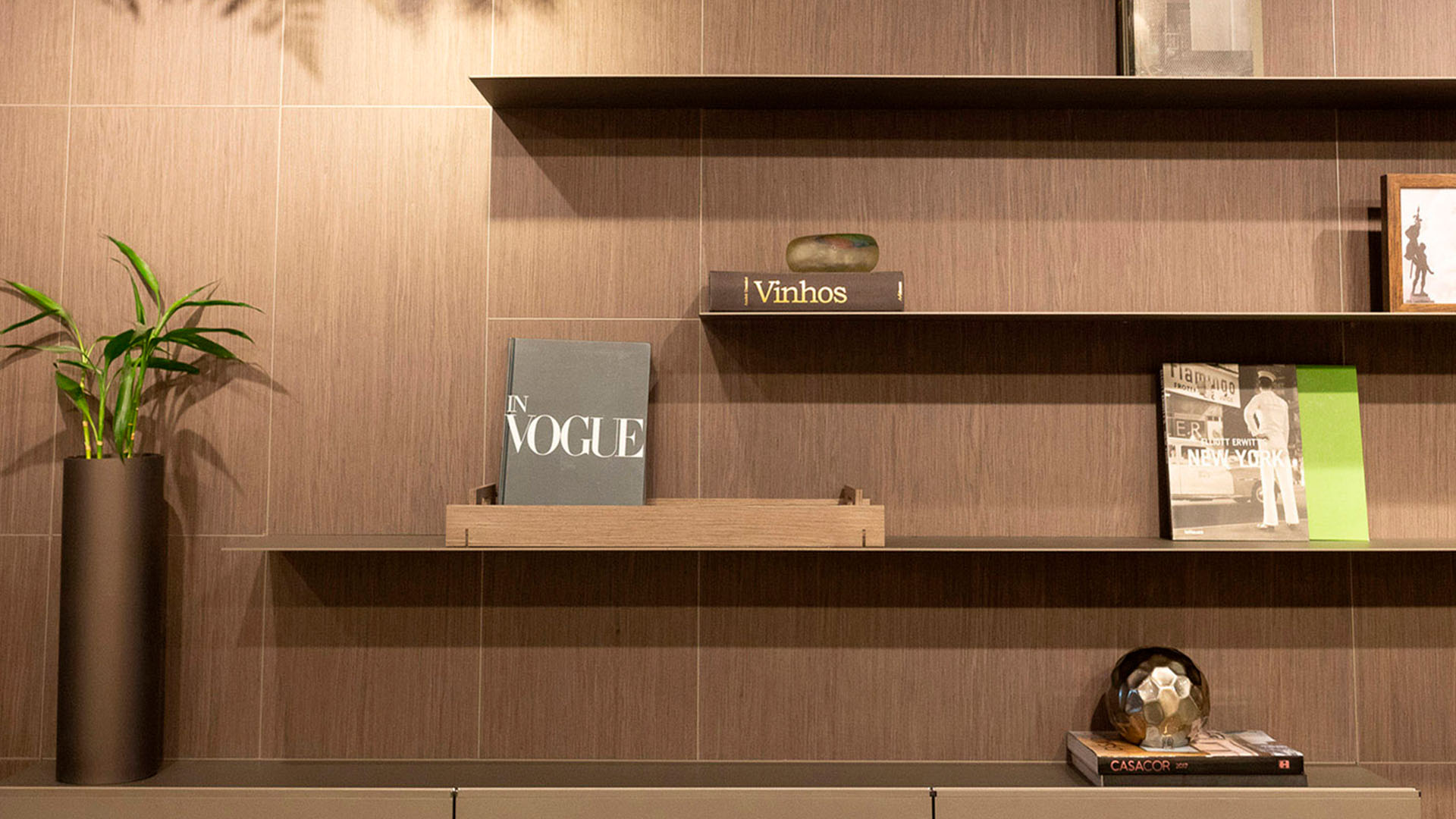
The Ornare Timeless Bookshelf collection is particularly well suited to dining room wall applications with glass-front sections. The proportions of the Timeless system — settled, scaled for rooms that are used formally — allow glass-front sections to be positioned at eye level, where the contents are visible from across the dining table, with closed lower sections handling the storage that doesn’t benefit from display visibility. This upper/lower configuration is visible in the Ornare showroom in New York, where the installation demonstrates how glass and opaque sections work together within the same wall composition.
Glass type selection for a dining room buffet: clear versus seeded versus frosted
The choice of glass in a buffet cabinet with glass doors is a design decision with functional implications, not just an aesthetic preference. Clear glass is the default — it maximizes visibility, puts the contents in the foreground, and adds the strongest reflective quality to the wall. It’s the right choice when the contents are genuinely curated: a consistent set of glassware, a collection of ceramics organized by color or form, items that look good under examination from across the room.
Seeded glass — with small air bubbles distributed through its thickness — softens the view of the contents into an impressionistic version of what’s there. The silhouettes and colors read, but the specific items don’t. This works well in a dining room where the glass-front sections hold a mix of display-worthy and functional items — the seeded glass reduces the visual noise of mixed contents while maintaining the light-filtering and depth quality of a glass door. It also adds texture to the cabinet surface itself, which contributes to the wall’s visual interest independently of what’s stored behind it.
Frosted or acid-etched glass is the most obscuring option — contents read as silhouette only. It’s most appropriate in a buffet cabinet where the glass-front section is used for storage rather than display, or where the dining room’s overall design language calls for maximum surface continuity without full transparency. In an Ornare wall system that combines frosted glass sections with adjacent open shelving, the frosted sections create a visual intermediate between the open display and the fully closed sections — unifying the composition while handling storage that doesn’t need to be fully visible.
Integrated lighting inside glass-front buffet sections: how it changes the dining room at night
A buffet cabinet with glass doors and no interior lighting looks entirely different after dark than it does during the day. Without lighting inside the cabinet, the glass becomes a reflective surface at night — the room’s artificial light bounces off the glass rather than illuminating the contents, and the display function of the glass-front section effectively disappears. With integrated LED lighting inside the section, the relationship inverts: the illuminated contents become visible through the glass, and the cabinet section becomes a warm light source that contributes to the dining room’s evening atmosphere.
This is one of the most underspecified elements in dining room storage design, and one of the decisions with the highest return on attention. The electrical routing for interior cabinet lighting needs to be specified before production — it’s not something that can be added easily after installation. The light temperature matters too: warm white LEDs at 2700 to 3000K complement the warm tones of a dining room intended for candlelit or lamp-lit evening use, while cooler LEDs create an institutional quality that undermines the atmosphere most dining rooms are trying to achieve. Ornare specifies interior lighting as part of the production design rather than as an afterthought, which is why the lighting effect in an Ornare dining wall system is consistent and intentional rather than approximate.
Proportion and placement of glass-front sections within the dining wall
The position of the glass-front sections within a dining room buffet wall determines how the display function integrates with the overall composition. Eye level — between 48 and 72 inches from the floor — is the zone where glass-front sections have the most impact: the contents are visible from across the dining table and from a standing position at the wall without looking up or down. Below 48 inches, the viewing angle for a seated person is downward and the display value diminishes. Above 72 inches, the glass-front section is visible but the specific contents are difficult to read from a distance.
The width of the glass-front sections relative to the closed sections is a proportion that should be decided based on the ratio of display-worthy to functional storage, not on a default configuration. A dining room in a Palm Beach home that primarily entertains formally — with consistent, curated tableware and a dedicated bar section — can carry a higher proportion of glass-front sections than a dining room in a Houston or Dallas property that doubles as a family room and holds a broader range of items. Ornare sizes and positions each section within the wall system in relation to the actual contents and the specific entertaining patterns of the household, which is why the resulting proportions feel considered rather than defaulted.