Wall bookcase: the size question that determines everything else
Before choosing a collection, a finish, or a configuration, anyone planning a wall bookcase needs to answer one question honestly: how many books do you actually own, and how many more will you acquire? It’s a question most people underestimate in both directions — either planning for a collection that’s smaller than the one they actually have, or designing an elaborate floor-to-ceiling system for forty books and a few objects. The answer drives every subsequent decision: how much linear footage of shelving is required, what proportion of that should be open versus closed, how deep the shelves need to be for the specific volumes involved.
Ornare designs wall bookcase systems from this starting point — the actual contents, in the actual room — rather than from a standard configuration applied to a new context. The result is a bookcase that’s exactly the right size for what it needs to hold, in a room that looks like it was designed around the bookcase rather than furnished with it.
Wall-to-wall versus partial wall: how the scale of the bookcase changes the room
The decision between a wall bookcase that runs the full width of a room and one that occupies a portion of it isn’t just a storage question — it’s an architectural one. A full-width bookcase, built from wall to wall at the exact room dimensions, turns the entire surface into a designed element. The room reads differently: more resolved, more intentional, more like a space that was thought through rather than assembled over time. A partial bookcase, however well designed, always leaves the question of what’s on either side of it, and the answer is almost always less satisfying than the bookcase itself.
Ornare builds to actual wall dimensions for exactly this reason. In a New York apartment where the living room wall might be eleven feet wide with a door interrupting one end, a custom system can accommodate that door within the composition — treating it as a panel that matches the adjacent cabinet fronts rather than as an awkward break in the bookcase. In a Houston home with a fourteen-foot wall and ten-foot ceilings, the system can run the full width and height without any of the compromises that standard module sizing forces. The Ornare showrooms in both cities — at the A&D Building on East 58th Street in New York and at 3951 San Felipe in Houston — have full-scale wall installations that demonstrate what this level of custom fit looks like in a finished room.
Six collections, six different ideas about what a wall bookcase should be
The Ornare Bookshelves & Multimedia catalog represents genuinely different positions on what a wall bookcase should do in a room, and choosing between them requires thinking about the room as much as about personal preference.
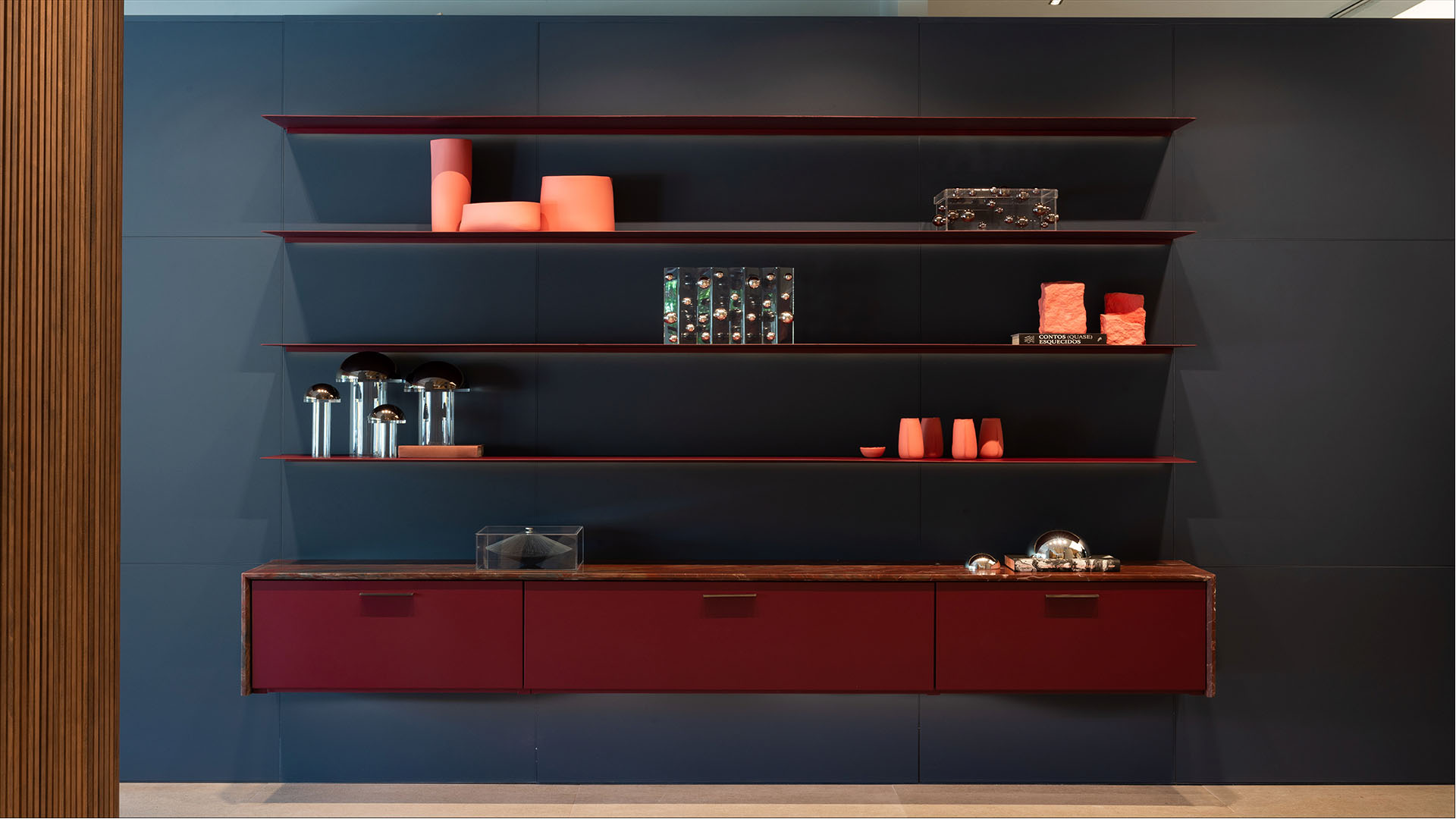
Square Wall is for rooms where the bookcase is the focal point — a three-dimensional modular surface that creates depth, shadow, and visual movement across the wall. It’s as much sculpture as storage. Ikigai Bookshelf takes the opposite position: an exposed metal structure that filters the wall without covering it, light and transparent enough to coexist with strong architectural features rather than competing with them. Timeless Bookshelf is for rooms that need permanence — proportions and finishes that read as architectural millwork rather than furniture, the kind of bookcase that looks like it was always there. Wall System Living is the most versatile, configurable to combine open shelving, closed cabinets, display niches, bar elements, and media storage in whatever proportion the room requires. Shaker Wall Bar and Timeless Bar add a dedicated bar function to the bookcase wall, which in a living room context means the entertaining and storage functions are handled by a single composed system rather than separate pieces.
Open shelving versus closed storage: calibrating the ratio for how you actually live
Every wall bookcase involves a fundamental trade-off between open shelving and closed storage, and the right ratio depends on the specific household more than on any design principle. Open shelving is more visually generous — it shows books, objects, and the personality of the person who lives there — but it requires permanent curation. Everything on an open shelf is always visible, which means the bookcase only looks good when everything on it looks deliberate. Closed storage solves the curation problem but produces a wall of cabinet fronts that can feel heavy and undifferentiated if the ratio tilts too far in that direction.
Ornare designs the open/closed balance into the wall system from the beginning of the project, informed by the actual contents and habits of the household.
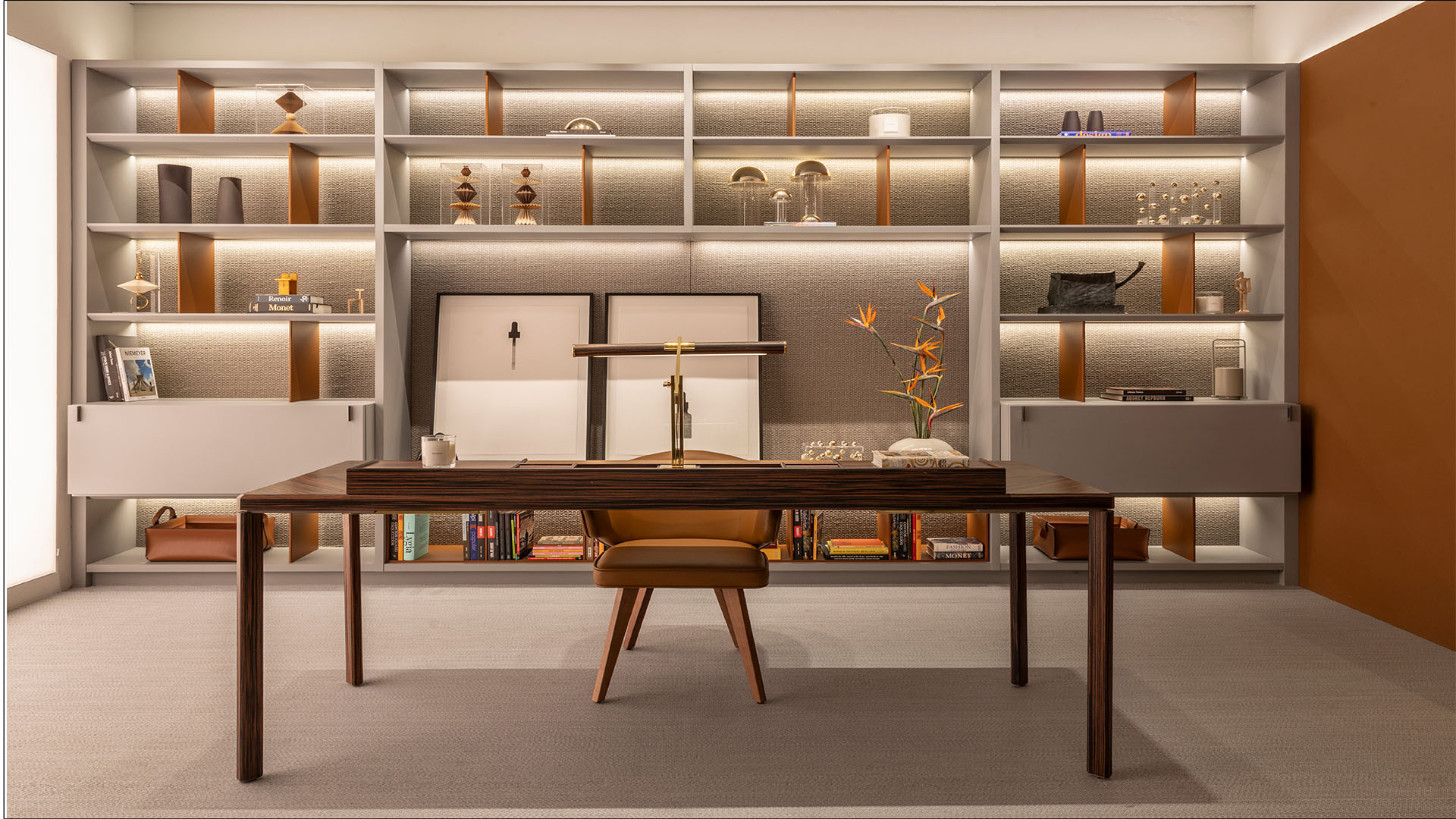
A client in the Hamptons or Greenwich who maintains a curated collection of art books and objects can lean heavily toward open shelving. A client in a busy family home in Dallas or New Jersey who needs the bookcase to absorb a wide range of items — some display-worthy, many not — benefits from a higher proportion of closed storage with open sections reserved for the things worth showing. Integrated lighting positioned under shelves and within open sections ensures that the displayed contents read well in the evening, when the bookcase shifts from a daytime storage solution to a nighttime light source that anchors the room.
Material and finish decisions for a wall bookcase: what works at room scale
A wall bookcase covers a significant amount of surface area — often more than any other single piece in the room — which means the finish choice reads as architecture rather than furniture. Matte white lacquer creates a clean, recessive surface that puts the books and objects in the foreground and lets the wall disappear. Natural wood veneer brings warmth and material richness that changes character throughout the day as light moves across the grain. A combination of lacquered lower sections and wood-veneered upper shelving creates visual layering that adds depth to a large wall without making it feel heavy.
These decisions are best made with physical samples in the actual room, or evaluated in showroom conditions that approximate the room’s light quality as closely as possible.
Ornare showrooms in Miami, Los Angeles, Dallas, Palm Beach, and Washington D.C. are set up specifically for this kind of material evaluation — with samples available for handling and wall installations visible in different lighting conditions — because the difference between how a finish reads on a small swatch and how it reads across twelve feet of wall is significant enough that no amount of digital visualization reliably bridges it.