Luxury kitchen cabinets: what separates the real thing from expensive imitations
Pull up any real estate listing for a high-end home in Miami, Dallas, or the Hamptons and the kitchen description will almost certainly include the phrase “luxury cabinets.” It’s become as generic as “gourmet kitchen” — a signal of aspirational quality that no longer reliably indicates actual quality. The problem is that luxury kitchen cabinets as a category covers an enormous range: from genuinely custom, precision-built cabinetry that will perform flawlessly for twenty years, to high-gloss doors on standard boxes that look impressive for two years and start showing their limitations after three.
Telling the difference requires knowing where to look. Not at the doors — those are the easiest part to make look good. At the boxes, the hardware, the edge treatment, and the way the cabinets fit the room. These are the components that determine whether a kitchen ages well or ages badly, and they’re the components that Ornare has been specifying to the same standard since 1986.
Luxury kitchen cabinet construction: the specifications that matter after installation
The cabinet box is the foundation of every kitchen. In a genuinely luxury kitchen cabinet, the box is built from materials selected for structural integrity and dimensional stability — materials that don’t warp, swell, or contract as humidity levels change through cooking, cleaning, and seasonal variation. In a kitchen that gets real use, this stability is what keeps doors aligned, drawers tracking smoothly, and the overall composition looking as precise after five years as it did on the day it was installed.
Edge treatment is the second indicator of construction quality, and it’s one of the first places where lower-quality cabinets fail visibly. The edge of every door and drawer front — where the substrate meets the finished surface — is the point of highest contact in a kitchen. In a well-built cabinet, this edge is sealed, finished, and treated as part of the production process. In a poorly built one, it’s the first place chips appear, and once chipping starts it’s difficult to stop. Ornare’s edge finishing is part of the production specification, not an afterthought — which is why the doors on an Ornare kitchen still look sharp at the edges years into daily use.
Hardware is the third construction variable that separates luxury cabinets from cabinets that look luxurious. The hinge that holds door alignment through thousands of open-and-close cycles, the drawer guide that maintains smooth, controlled action over years of use, the soft-close mechanism that decelerates silently rather than producing a mechanical thud — these are components that don’t photograph well but that define the tactile experience of using the kitchen every day. Ornare specifies hardware to match the longevity of the cabinetry itself, which means the kitchen performs consistently rather than deteriorating in the parts you touch most.
Luxury kitchen cabinet collections: twelve design positions, one quality standard
The Ornare kitchen catalog covers twelve collections, each representing a distinct design position rather than a cosmetic variation. What they share is the same construction and material standard; what distinguishes them is the design language they speak and the room contexts they suit best.
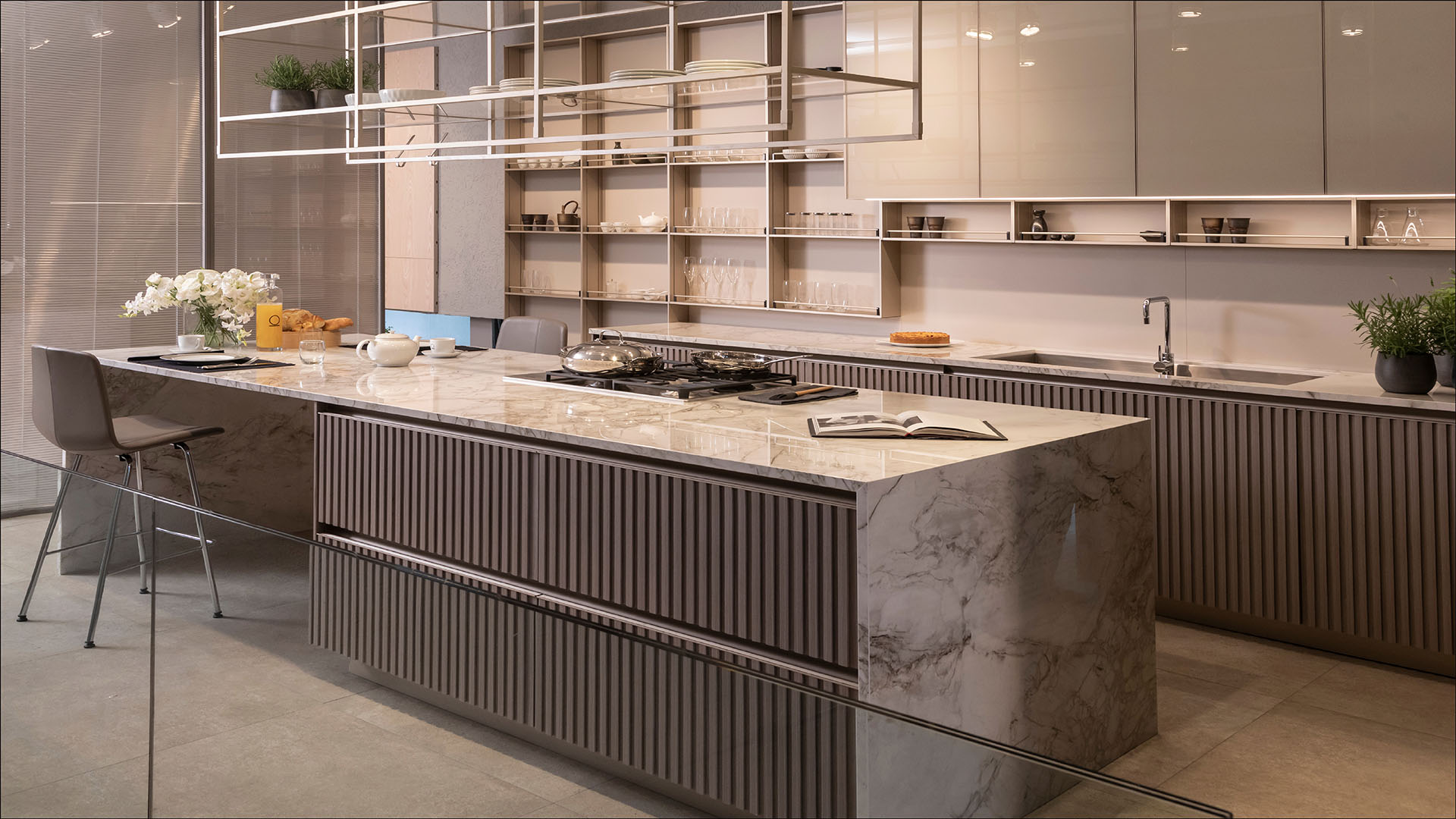
Minimal and Timeless represent the two poles of the contemporary luxury kitchen spectrum — one radical in its reduction of surface and hardware, the other assured in its proportions and material presence. Between them, Round introduces curves that soften the geometry; Ikigai brings a Japanese-influenced structural transparency with exposed metal frames; Colette and Breeze offer warmth and personality suited to primary residences where the kitchen is a daily living space rather than a showpiece; Sky emphasizes verticality for rooms with significant ceiling height; Shaker and Slatted reference craft traditions without reproducing them literally; Stripe and Stow address specific textural and organizational priorities; Infinite prioritizes the continuous vertical surface; Wall System provides the most configurable platform for complex kitchen layouts. The collection that’s right for a specific project depends on the room as much as on preference — ceiling height, light conditions, the relationship to adjacent living areas, and the habits of the household all inform the recommendation.
Custom sizing in luxury kitchen cabinets: why it changes the result
Standard module sizing is the most visible limitation of non-custom kitchen cabinetry, even at the luxury end of the market. When cabinet widths are fixed at standard increments, the kitchen layout is constrained by what’s available rather than by what’s optimal for the space. Filler strips hide the gaps. Corner solutions sacrifice storage. Upper cabinets stop short of the ceiling. None of these compromises are fatal — but none of them belong in a kitchen where the design is the point.
Ornare builds to actual dimensions. The cabinet widths, heights, and depths are specified for the specific room, which means every linear inch of wall is used efficiently and every transition — wall to cabinet, cabinet to ceiling, cabinet to cabinet — is resolved cleanly. In the Hamptons, where kitchens in older homes often have non-standard ceiling heights and out-of-square walls, this matters significantly. In Greenwich and Palm Beach, where primary residence kitchens are frequently large and architecturally complex, custom sizing is what allows the kitchen layout to respond to the architecture rather than imposing a generic configuration onto it.
Ornare showrooms in both markets — and in New York, Miami, Dallas, Los Angeles, Houston, New Jersey, and Washington D.C. — have full kitchen installations built to exact dimensions, which is the most direct way to understand what genuinely custom cabinetry looks like at full scale.
Luxury kitchen cabinets and the long view: designing for decades, not years
The most practical argument for luxury kitchen cabinets built to Ornare’s standard is durability — not in the abstract sense, but in the concrete sense of a kitchen that requires no significant intervention for fifteen to twenty years of daily use. The construction quality that keeps boxes stable, edges intact, and hardware performing is also the construction quality that makes refinishing, touch-up, or component replacement unnecessary within any reasonable ownership horizon.
This durability has direct financial implications. A kitchen that needs to be replaced or substantially renovated after eight years costs more over a twenty-year period than a kitchen built once to a standard that holds.
For clients in New York, Los Angeles and Miami who are renovating properties they intend to hold long-term — or who are designing primary residences where the kitchen will be used intensively for decades — this long-view calculation is worth making explicitly before deciding how much to invest in cabinetry quality at the outset.