Kitchen hutch and cabinet: the Ornare approach to upper and lower storage
A kitchen hutch combines two storage typologies in a single unit: closed cabinets below, open display shelving or glass-front sections above. It’s a format that has existed for centuries because it works — the lower section handles everyday storage, the upper section handles display and the things you want accessible but visible. The problem with most kitchen hutch and cabinet solutions available today is that they were designed as furniture, not as architecture. They sit against the wall rather than belonging to it. They end where the unit ends, leaving the wall on either side unresolved.
Ornare builds the hutch logic into its kitchen wall systems from the start, treating the combination of lower closed storage and upper open or glass-front sections as a design composition calibrated to the entire wall rather than to a standard unit width. The result looks like the kitchen was designed to have that configuration — because it was.
How Ornare interprets the kitchen hutch in a modern context
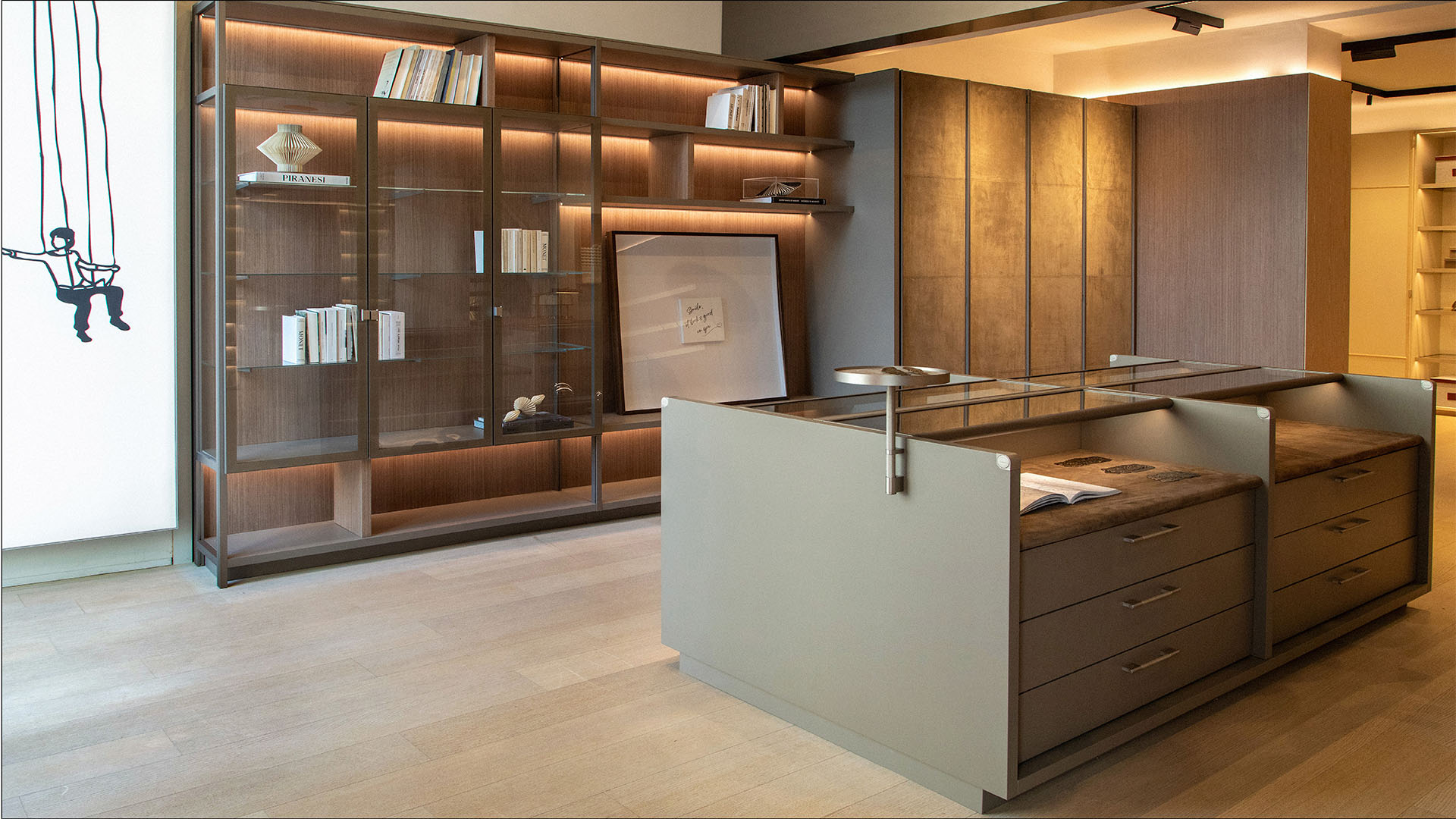
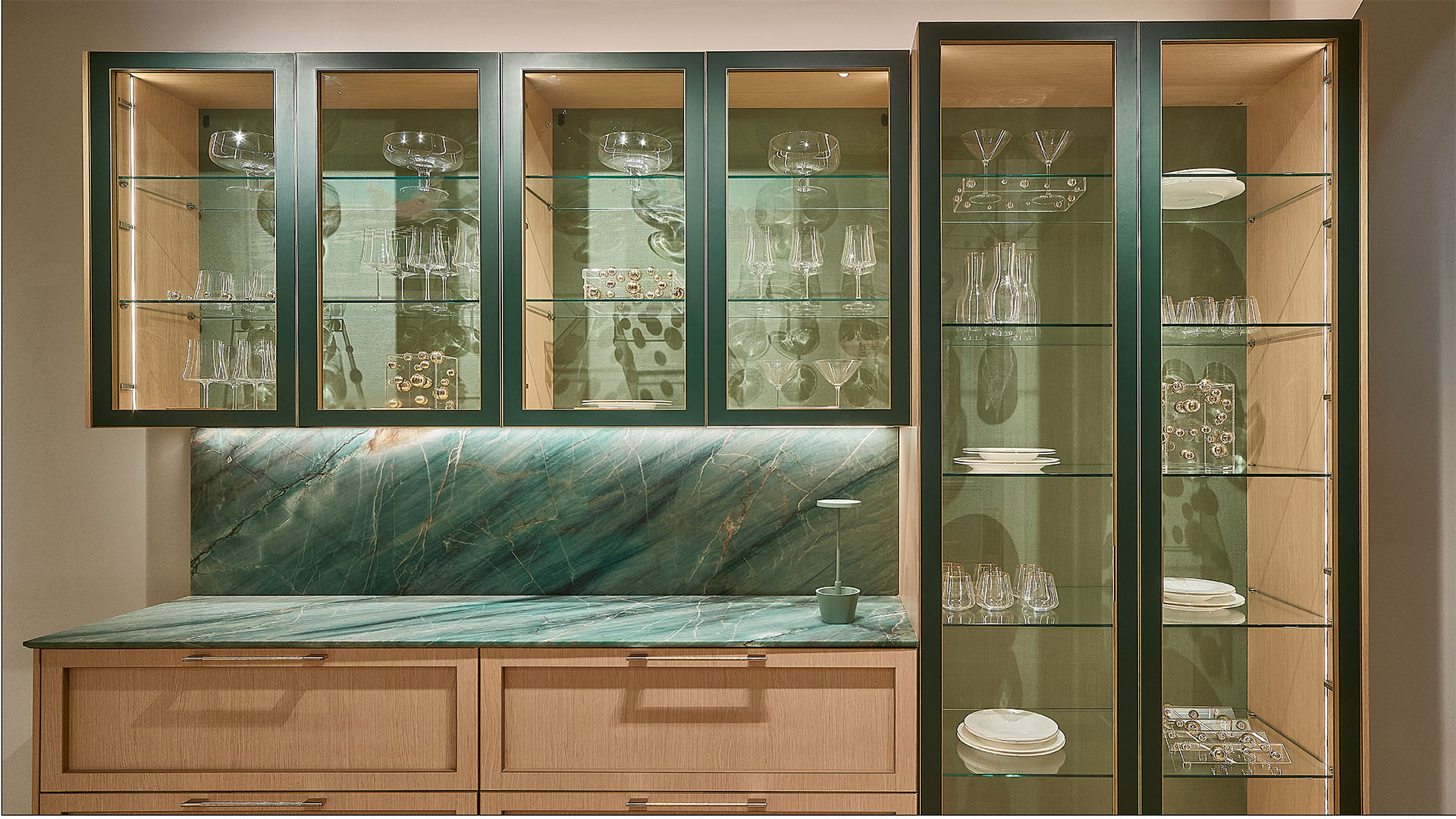
The traditional hutch placed upper shelving directly above lower cabinets, with a slight setback at the transition to create a display ledge. In contemporary kitchen design, this relationship gets reinterpreted in several ways depending on the collection and the room. In Ornare’s Timeless kitchen line, the upper section can include glass-front panels that create a showcase quality — visible storage that frames its contents the way a display case does, with integrated lighting that makes the section a nighttime focal point as well as a daytime storage solution. In the Minimal collection, the same upper/lower relationship is expressed through continuous surfaces without hardware, where the transition between lower cabinets and upper shelving is handled with the same geometric precision as everything else in the composition.
The Shaker line brings a warmer, more craft-oriented interpretation: upper sections with panel detailing that references traditional cabinet making without reproducing it literally, combined with lower cabinets that have the kind of solidity and material presence that makes a kitchen cabinet feel like it was built to last rather than assembled from components. Sky takes a vertical approach, with tall upper sections that draw the eye upward and make the most of high ceiling heights — particularly relevant in homes in Houston, Dallas, and Los Angeles where kitchen ceiling heights frequently exceed nine feet. Each of these represents a genuinely different answer to the same organizational question: how to handle the relationship between lower storage and upper display in a kitchen that’s also a designed room.
Upper kitchen cabinets and open shelving: the balance that determines how the room feels
The decision about what goes above the lower cabinets — closed upper cabinets, open shelving, glass-front sections, or some combination — is one of the most consequential in any kitchen hutch and cabinet design. Fully closed upper cabinets maximize storage and keep everything hidden, but in a large kitchen they can create a wall of cabinet fronts that feels heavy and undifferentiated. Fully open shelving requires the kind of permanent curation that most kitchens can’t sustain — every item on every shelf is always visible, and the display only works when every item looks deliberate.
The most successful kitchen wall compositions combine all three: closed sections for everyday items that don’t need to be seen, open shelving for objects and cookbooks that benefit from visibility, and glass-front sections for the things that fall between — quality dishware, glassware, items that look good behind glass but would collect dust on an open shelf.
Ornare designs this balance into the wall from the beginning, with proportions and transitions between section types that read as intentional rather than assembled. The lower cabinet run — typically the deeper, more storage-intensive section — anchors the composition, while the upper section handles the visual work of making the kitchen feel complete rather than functional.
The Timeless Edge Desk: when the kitchen hutch becomes a workspace
One of the more interesting evolutions of the kitchen cabinet typology in Ornare’s accessories catalog is the Timeless Edge Desk — a workspace component that integrates directly into the Timeless kitchen system. In homes where the kitchen is also a homework station, a planning desk, or a secondary office, this element adds a seated work surface within the kitchen composition without requiring a separate piece of furniture.
The Edge Desk sits at desk height rather than counter height, creating a dedicated zone within the kitchen wall that signals a different use without visually separating from the overall composition. In open-plan homes in New York, New Jersey, and Washington D.C. where the kitchen often serves multiple functions simultaneously, this kind of integrated solution is more elegant than adding a table or a freestanding desk that doesn’t belong to the room. It’s also more space-efficient: the desk surface folds into the composition when not in use, returning the wall to its kitchen identity.
Seeing kitchen hutch and cabinet designs at Ornare showrooms across the US
The relationship between upper and lower kitchen storage is one of those design decisions that reads very differently at full scale than it does in a photograph or a floor plan. The height of the upper section relative to the lower, the depth of the display ledge at the transition, the way light falls on the upper shelving from a window or from integrated fixtures — these are spatial qualities that only reveal themselves in person.
Ornare showrooms in Miami’s Design District, the Dallas Design District, West Hollywood, the Hamptons in Southampton, Greenwich, and Palm Beach all have full kitchen installations where the upper/lower storage relationship can be evaluated at actual scale, with real finishes and real lighting conditions. For anyone designing a kitchen where the wall storage is a significant design element — which describes most Ornare projects — a showroom visit before finalizing the upper cabinet configuration is the most reliable way to get that decision right.