Bookcase with glass doors: the design decision that changes what your living room says about you
There’s a specific moment in a living room project when the bookcase question gets interesting: when someone decides that not everything on the wall should be equally visible. A fully open bookcase puts everything on display — books, objects, cables, the things you meant to put away and didn’t. A fully closed cabinet hides everything, which solves the clutter problem but produces a wall of opaque fronts that contributes nothing visually to the room. The bookcase with glass doors sits between these two positions and, when it’s designed well, makes both problems disappear simultaneously.
Glass in a bookcase front does several things at once. It keeps dust off the contents without hiding them. It creates a visual layer — a surface that reflects light and interacts with the room — while still allowing what’s behind it to read as part of the composition. And it signals a deliberate curatorial choice: what’s behind glass is there because it’s worth seeing, not because it’s waiting to be organized. In an Ornare wall system, glass door sections are designed as part of the overall composition from the start — not added after the fact — which is why they integrate so naturally into the finished result.
How glass door sections work within the Ornare wall system
The Wall System Living collection is the most flexible platform in the Ornare Bookshelves & Multimedia catalog for incorporating glass door elements. Because it’s a configurable system rather than a fixed design, the ratio of glass-front sections to open shelving to closed opaque storage can be calibrated precisely to the room and the collection it needs to house.
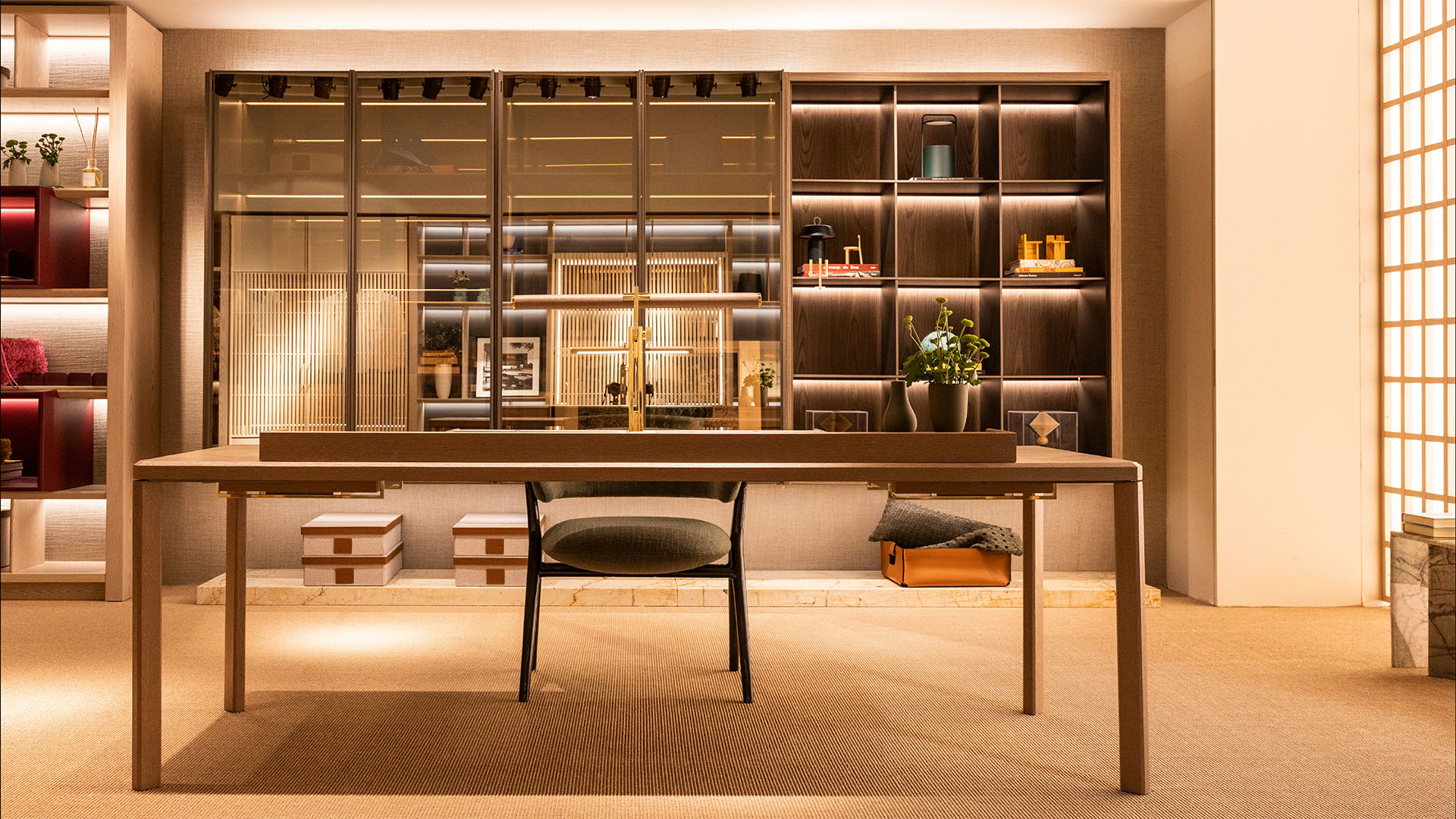
A section of glass-front cabinets at eye level — for art books, collected objects, or curated display pieces — flanked by open shelving above and closed storage below creates a composition with visual hierarchy: the glass section becomes the focal point, the open shelving provides breathing room, and the closed lower cabinets handle everything that doesn’t need to be seen.
The glass itself is not a single decision. Clear glass maximizes visibility and works best when the contents are genuinely display-worthy — books with interesting spines, objects collected with care, glassware that benefits from being seen. Frosted or satin glass softens the contents into silhouette, which works well when the storage behind the doors is functional rather than curated, or when the goal is to add texture to the wall surface without fully exposing what’s inside. Ornare works with both, and the choice between them is often best made by looking at the actual contents planned for each section rather than by aesthetic preference alone.
Timeless Bookshelf with glass: display storage that reads as permanent
The Timeless Bookshelf collection takes the glass door bookcase in a more formal direction. The proportions are settled and classical — cabinets that feel like they’ve always been there, which is one of the most valuable qualities in a piece that anchors an entire room. Glass-front sections within the Timeless Bookshelf composition create display areas that have the quality of a museum vitrine: contained, lit from within or above, presenting their contents as objects worthy of attention rather than books waiting to be read.
This kind of display storage works particularly well in rooms where the living area is also used for entertaining — homes in the Hamptons, Greenwich, Palm Beach, and similar markets where the living room is a space for reception as much as daily use. A wall that includes Timeless Bookshelf sections with glass fronts, integrated lighting, and carefully selected objects communicates a level of intention and care that influences how the entire room is experienced.
The difference between this and a generic glass-front cabinet from a catalog is the same as the difference between a tailored suit and something off the rack: the proportions, the finish, and the construction quality all tell a different story.
The Crystal Case closet system: glass doors applied to wardrobe storage
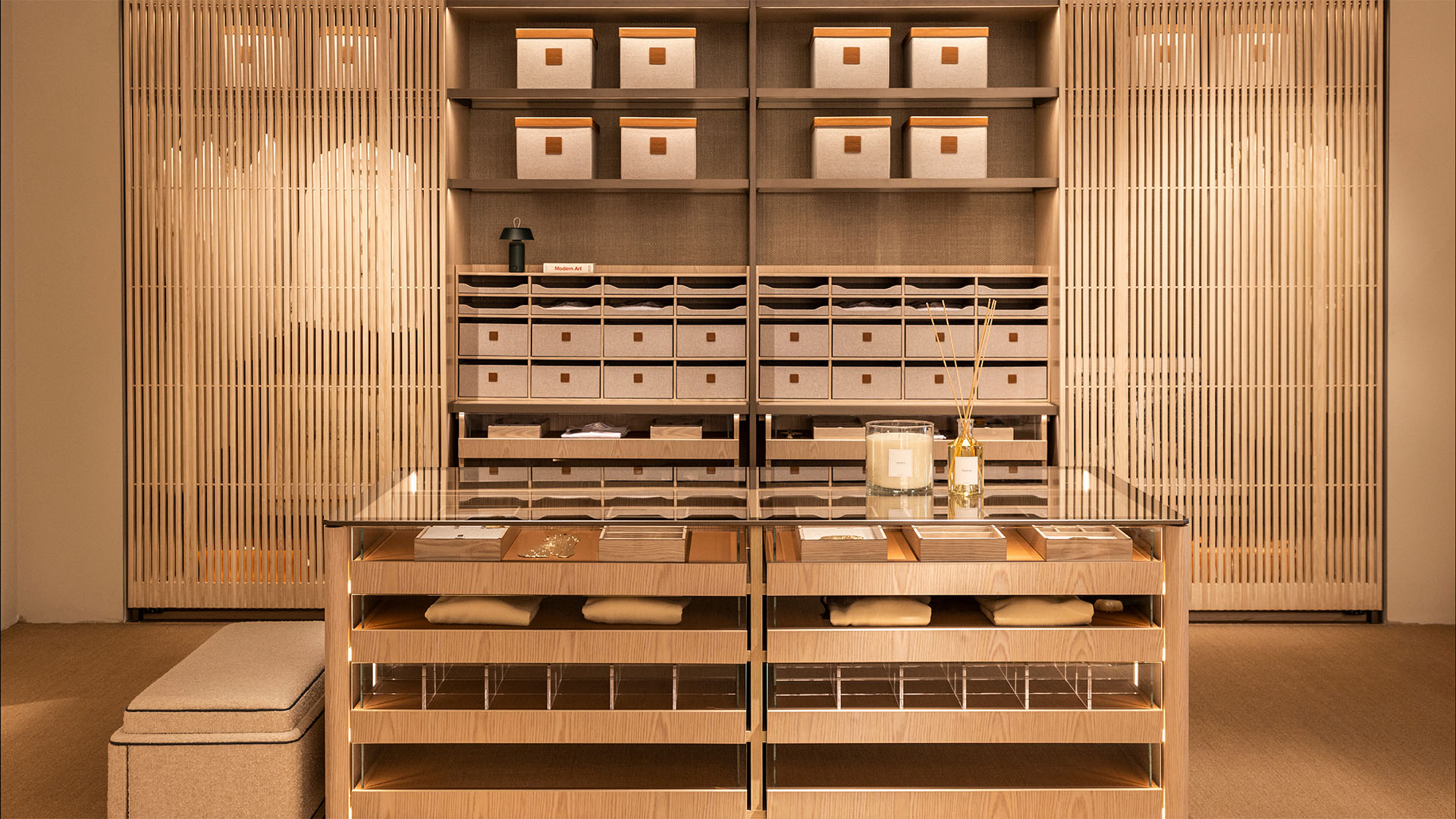
The glass door principle extends beyond the living room in the Ornare catalog. The Crystal Case closet collection applies the showcase logic to wardrobe storage — glass-front panels that turn the closet into a display environment, where clothes and accessories are organized and presented rather than simply stored. The effect is closer to a high-end retail display than to conventional wardrobe storage, which suits clients who want their dressing routine to feel considered from the moment the closet opens.
Crystal Case works best in dedicated dressing rooms or walk-in closets where the entire space is designed as an experience — not just a place to retrieve a shirt. The glass fronts require a higher standard of interior organization than opaque doors, because everything inside is always visible. But that constraint is also the point: it creates a discipline around how the wardrobe is maintained that most people find genuinely changes their relationship with the space. Seeing it in context at the Ornare showroom in New York, Los Angeles, or Miami is the most reliable way to understand whether this level of transparency works for a specific lifestyle and a specific collection of clothing.
Lighting inside a glass-door bookcase: the detail that makes the difference after dark
A bookcase with glass doors performs differently in daylight and after dark, and the difference is almost entirely determined by whether integrated lighting is part of the design. During the day, natural light passes through the glass and illuminates the contents from outside. After dark, without internal lighting, the glass becomes a mirror — reflecting the room back at itself and obscuring whatever is behind it.
With internal lighting, the dynamic reverses entirely: the illuminated contents become visible through the glass, the bookcase becomes a source of warm light in the room, and the wall transforms from a storage surface into a nighttime focal point.
Ornare integrates lighting into its wall systems as part of the design rather than as an accessory added after installation. LED strips positioned inside glass-front sections illuminate the contents from above or from the sides, creating an even wash of light that reveals books and objects clearly without creating glare on the glass surface.
This is a technical detail that requires planning before the system is built — the electrical routing, the fixture positioning, the control integration — which is why it’s part of the design conversation at the Ornare showrooms in Dallas, Houston, New Jersey, and Washington D.C., rather than something to figure out after the wall system is already in place.