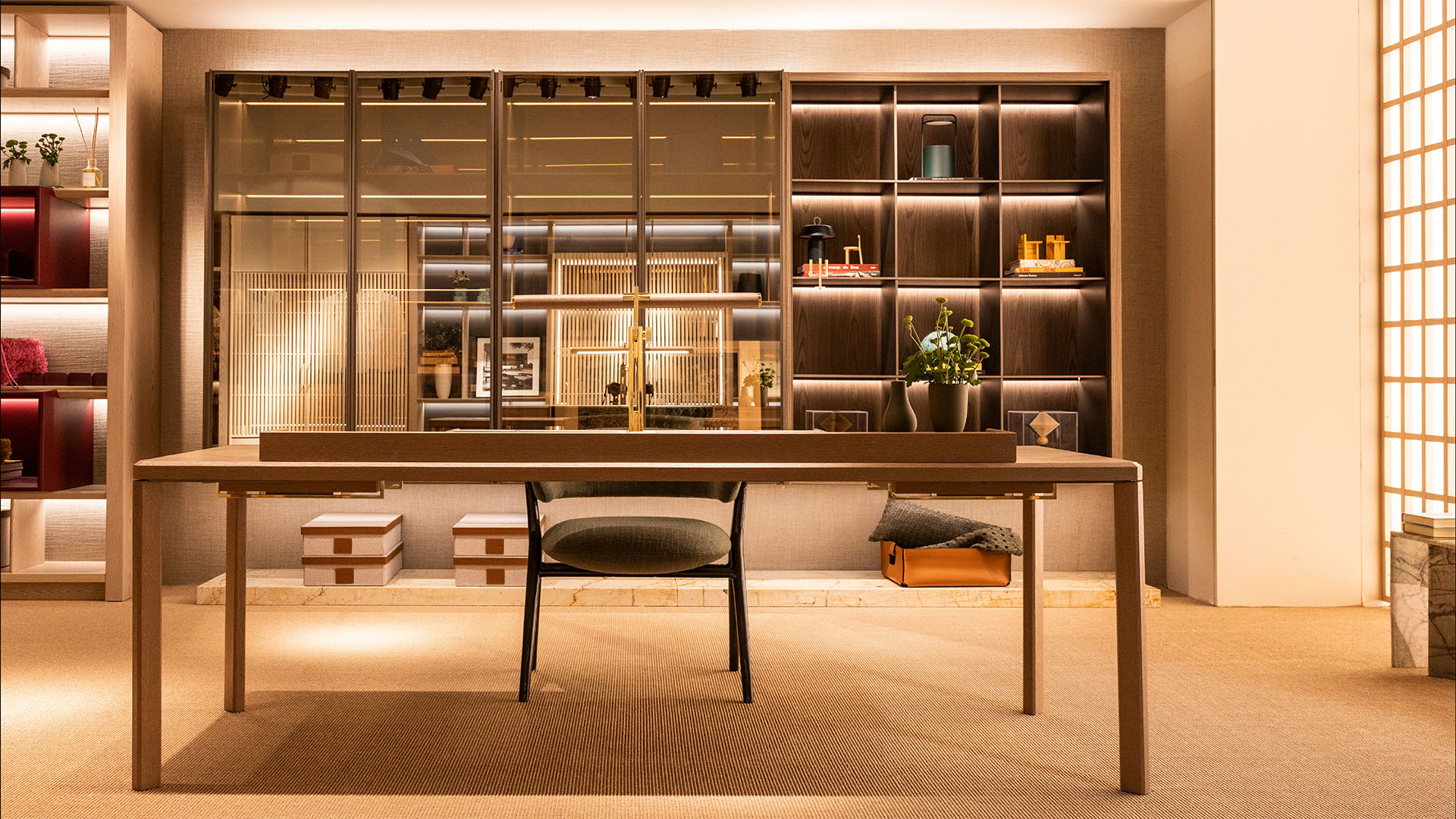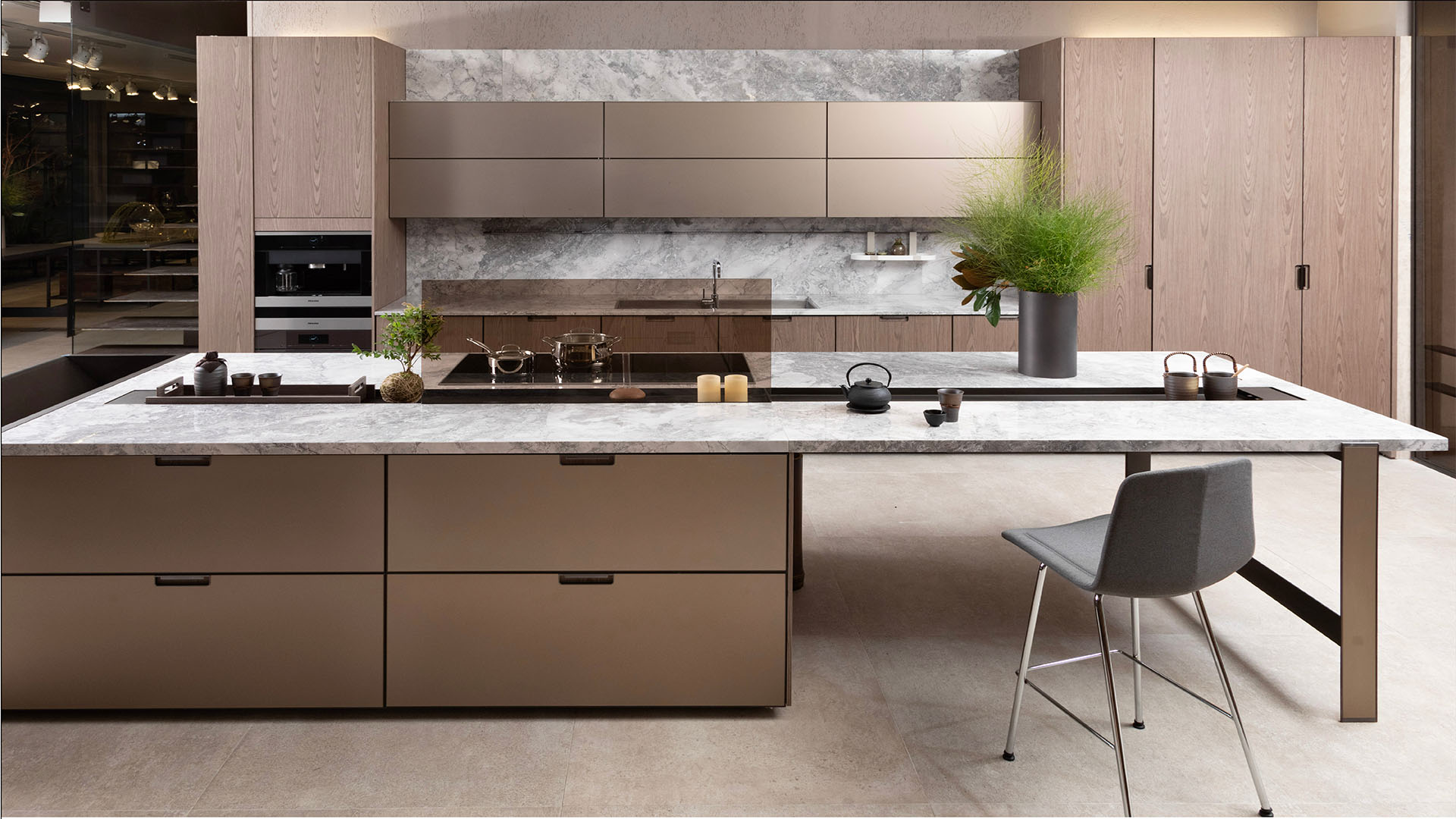
Modern kitchen cabinet design by Ornare: twelve collections, one standard of quality
Walk into any kitchen showroom in the US and you’ll see rows of modern kitchen cabinets that look roughly the same: flat fronts, integrated handles or push-to-open mechanisms, white or gray lacquer, maybe a wood accent somewhere. The aesthetic is correct — clean, contemporary, functional — but the execution varies enormously, and most of what looks identical in a display eventually diverges in quality once it’s installed and used daily. The cabinet that felt solid in the showroom starts to show edge chipping after two years. The door alignment drifts. The drawer that closed silently begins to close with a thud.
Ornare has been building custom kitchen cabinetry since 1986, and the brand’s position in the market is defined by a simple proposition: the quality you experience in the showroom is the quality you live with ten years later. That consistency is built into the material specifications, the production process, and the hardware selection — not just into the design.
What makes a modern kitchen cabinet truly modern: design principles that hold up over time
The word “modern” applied to kitchen cabinets has been stretched to cover almost everything — and as a result, it covers almost nothing. In Ornare’s terms, a modern kitchen cabinet is one where every design decision has a reason, where nothing is decorative for its own sake, and where the form follows the function so closely that the two become indistinguishable. This is a harder standard to meet than it sounds, because it requires discipline at every level of the design process: the proportion of the door relative to the cabinet box, the reveal between adjacent doors, the way the cabinet meets the floor and the ceiling, the transition between the upper and lower runs.
Ornare’s kitchen collections represent different interpretations of this standard rather than variations on a single template. Minimal takes the most rigorous position: handleless doors, continuous surfaces, no visual interruption between adjacent cabinets. The result is a kitchen that reads as a single architectural surface rather than a collection of individual units. Timeless works with more traditional proportions updated for contemporary use — cabinets that have visual weight and presence without heaviness, finishes that read as refined rather than stark. Round introduces curves into the cabinet vocabulary through radiused corners and edges, producing a modern kitchen that feels approachable rather than cold. Ikigai brings an entirely different cultural reference — Japanese design philosophy expressed through exposed metal structure and doors that reveal the construction logic rather than concealing it.
Sky, Colette, Breeze, Shaker, Slatted, Stripe, Stow, Infinite, and Wall System each represent additional positions within the modern kitchen cabinet landscape, from the warmly textured to the architecturally minimal.
Cabinet construction quality: the specifications that determine how a kitchen performs over years of use
A modern kitchen cabinet is used hundreds of times a week. Every door opens and closes, every drawer extends and retracts, every hinge and guide bears load repeatedly through years of daily cooking. The construction quality of the cabinet — not the finish, not the design, but the structural and mechanical engineering of the piece — determines whether all of that use accumulates into deterioration or leaves the kitchen performing exactly as it did on installation day.
Ornare specifies cabinet boxes built from materials selected for dimensional stability — they don’t warp or swell with humidity changes the way lower-grade substrates do. In a kitchen, where steam and moisture are constant factors, this is a functional requirement, not a premium feature. The edge finishing on every door and drawer front is treated as part of the production process: edges are sealed and finished to prevent chipping at the transition points that take the most contact in daily use. Hinges are specified to hold door alignment without requiring periodic readjustment. Drawer guides are selected for the combination of smooth action and long-term precision that makes a drawer feel as controlled after five years as it did after five days.
These specifications don’t show up in marketing materials because they’re not visually legible in a photograph. They show up in how a kitchen feels to use — and they’re the reason that Ornare showrooms in New York, Miami, Dallas, and Los Angeles are set up specifically to be touched and operated, not just observed.
Custom cabinet sizing versus modular systems: why the distinction matters in a real kitchen
Most modern kitchen cabinets sold in the US are modular: standard widths, standard heights, standard depths, assembled into configurations that approximate a custom result. The compromise is always present — filler strips where the cabinets don’t quite meet the wall, upper cabinets that stop short of the ceiling, corner solutions that sacrifice storage to accommodate the junction between two runs. In a kitchen where the design is the point, these compromises are visible, and they accumulate into an overall impression that the kitchen was fitted rather than designed.
Ornare builds to the actual dimensions of the space. Cabinet widths are specified to the millimeter, heights are set to the exact ceiling height, and corners are resolved with solutions designed for that specific corner rather than adapted from a standard module. In a New York apartment where no two walls are perfectly parallel, in a Houston home where ceiling heights vary across an open plan, in a Hamptons kitchen where architectural details create constraints that standard modules can’t accommodate — custom sizing is the difference between a kitchen that fits and one that makes do.
The Ornare showroom at the A&D Building on East 58th Street in New York and the Miami Design District location both have full kitchen installations built to exact dimensions, which is the most direct way to understand what this level of fit looks like in a finished room.
Modern kitchen cabinet finishes: making the right choice for the way your kitchen actually gets used
The finish on a modern kitchen cabinet is the most visible element of the entire kitchen — and the one most likely to be chosen based on how it looks in a showroom rather than how it performs in a home. Matte lacquer looks sophisticated and architectural; it also shows cleaning marks more readily than gloss and is more susceptible to surface scuffing in high-traffic areas. Gloss lacquer amplifies light and makes spaces feel larger; it shows fingerprints and watermarks on every surface that gets touched. Wood veneer brings warmth and material richness that no synthetic finish replicates; it requires stable humidity conditions and appropriate cleaning products to maintain its appearance.
None of these trade-offs make any finish wrong — they make each finish right for specific conditions and wrong for others. A kitchen used intensively by a family with young children has different requirements than a kitchen in a Hamptons weekend home or a Washington D.C. pied-à-terre.
Ornare’s consultants work through these conditions with clients using physical material samples evaluated in the light conditions of the actual space, because the appearance of a finish in showroom lighting and its appearance in the kitchen it will actually live in are rarely the same thing. Getting this right at the beginning — rather than discovering the mismatch after installation — is one of the most practical reasons to work with a consultant rather than making finish decisions from a catalog.