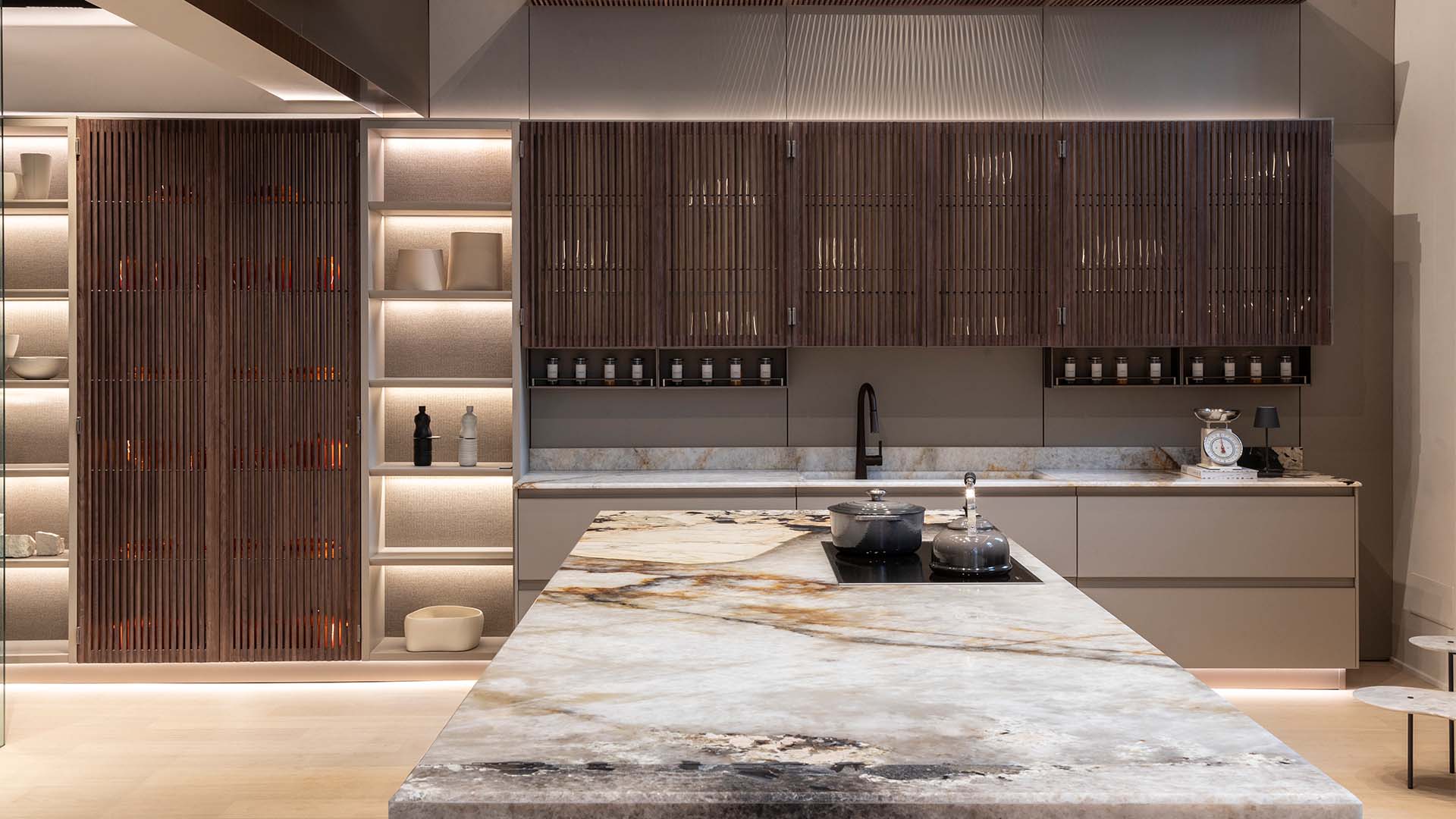
Marble dining table: what to know about stone, finishes and daily care before choosing
Marble is a metamorphic rock made mostly of calcite, a mineral that rates about 3 on the Mohs hardness scale and reacts with acids. Those two facts explain almost everything about living with a marble dining table: why it develops a soft patina over the years, why a squeeze of lemon can leave a dull mark in seconds, and why the choice of stone and finish matters as much as the choice of shape. None of this is a reason to avoid marble. It’s a reason to choose it knowing exactly how it behaves.
Why a marble dining table stains and etches
Two different things can happen to a marble top, and they’re often confused. A stain is a liquid that soaks into the stone and changes its color: red wine, coffee, oil. Etching is a chemical reaction: an acid such as lemon juice, vinegar, tomato sauce or wine dissolves a microscopic layer of the surface and leaves a dull, slightly rough spot, even when nothing has been absorbed.
Sealing protects against stains, because it slows down absorption. It does not protect against etching, because the acid reacts with the calcite at the surface before the sealer can do anything. That’s the most important thing to understand before buying: a marble top will etch over time, especially in the areas where plates and glasses are set down every day. Whether that bothers you depends on the stone, the finish and how you feel about a surface that shows its history.
Choosing the stone for a marble dining room table
Not all marble behaves the same, and the type of stone affects both the look of a marble dining room table and how visible daily wear will be.
White marbles: Carrara, Calacatta and Statuario
Classic white marbles are the most requested for dining tables. Carrara has a gray-white background with fine, soft veining and is the most forgiving of the three, because its busy pattern hides small marks. Calacatta and Statuario have whiter backgrounds and bolder veins, which makes them more dramatic and more expensive, and also more likely to show stains on the lighter areas.
Dark and colored marbles
Black marbles such as Nero Marquina, browns like Emperador and greens give a table a stronger, more graphic presence. On dark stone, stains are less visible, but etch marks can actually stand out more, appearing as lighter, matte spots on a polished black surface.
When a different stone dining table makes more sense
If the table will see heavy daily use with young children, a stone dining table in quartzite or another harder natural stone can offer a similar look with far better resistance to etching and scratches. It’s worth comparing samples side by side before deciding, because some quartzites are nearly indistinguishable from marble at first glance.
Polished, honed or leathered: marble finishes compared
The finish changes both appearance and maintenance. A polished finish is glossy and reflective, it intensifies the color and the veining, and it makes etch marks easy to see, because a dull spot on a shiny surface catches the light. A honed finish is matte and smooth to the touch; etching is far less noticeable on it, although the stone can be slightly more prone to absorbing stains, so sealing becomes more important. A leathered finish has a soft, textured surface that hides marks well and gives the stone a more tactile, natural feel.
For a dining table used every day, honed is usually the most practical choice. Polished makes sense for formal dining rooms used occasionally, where the depth of color matters more than ease of care.
Marble table care: sealing and daily habits
Good marble table care is simple once it becomes routine. Most tops benefit from a penetrating sealer every 6 to 12 months; a quick test is to leave a few drops of water on the surface for 10 to 15 minutes, and if the stone darkens, it’s time to reseal. For daily cleaning, use warm water or a pH-neutral cleaner made for stone, and avoid vinegar, citrus-based or abrasive products, which etch the surface they are meant to clean.
At the table, placemats, coasters and trivets do most of the work. Spills should be blotted rather than wiped, so the liquid doesn’t spread, and acidic food or wine should be cleaned up right away. When etching eventually appears, light marks on a honed surface can often be reduced with a stone polishing compound, while deeper ones can be refinished by a stone professional, who can restore the whole top without replacing it.
Thickness, weight and the dining room around the table
Marble table tops are usually 3/4 inch or 1 1/4 inches thick, often with a mitered edge that makes them look thicker. The weight adds up quickly: a 1 1/4-inch slab weighs roughly 18 to 20 pounds per square foot, so an 84-by-42-inch top can exceed 450 pounds before the base is even considered. That affects the structure of the base, the way the table is delivered and installed, and the floor beneath it. A round marble dining table concentrates that weight on a central pedestal, which needs to be sized and anchored accordingly.
A table of this presence also sets the tone for the rest of the room. Ornare designs dining room storage to the measurements of the walls, so a sideboard wall or display cabinet can be aligned with the table and chosen in a finish that complements its stone. With white marble, the solid wood of Ornare’s Timeless line brings warmth that balances the coolness of the stone. With a more classic setting, the Colette collection, with its doors inspired by French boiseries and an illuminated crystal cabinet for porcelain and glassware, creates a dining wall that suits the formality of a marble table.
The last step is the one most often skipped: choose the slab, not just the stone. Two slabs of the same marble can look completely different, and the way the veining runs across the table is what you’ll see every day. Viewing the actual slab before it’s cut, and agreeing on how the veins will be oriented along the length of the top, is the single decision that most influences how the finished table looks.