Kitchen cabinet organization with drawers: why deep drawers beat shelves
Open a base cabinet with shelves. Now reach for something at the back of the lower shelf. The motion required — crouching, leaning, moving items in the front row to get to items behind them — is the defining inefficiency of shelved base cabinet storage. The items at the back exist theoretically. In practice, they stay there until the cabinet is emptied for cleaning, because retrieving them is more trouble than substituting something else.
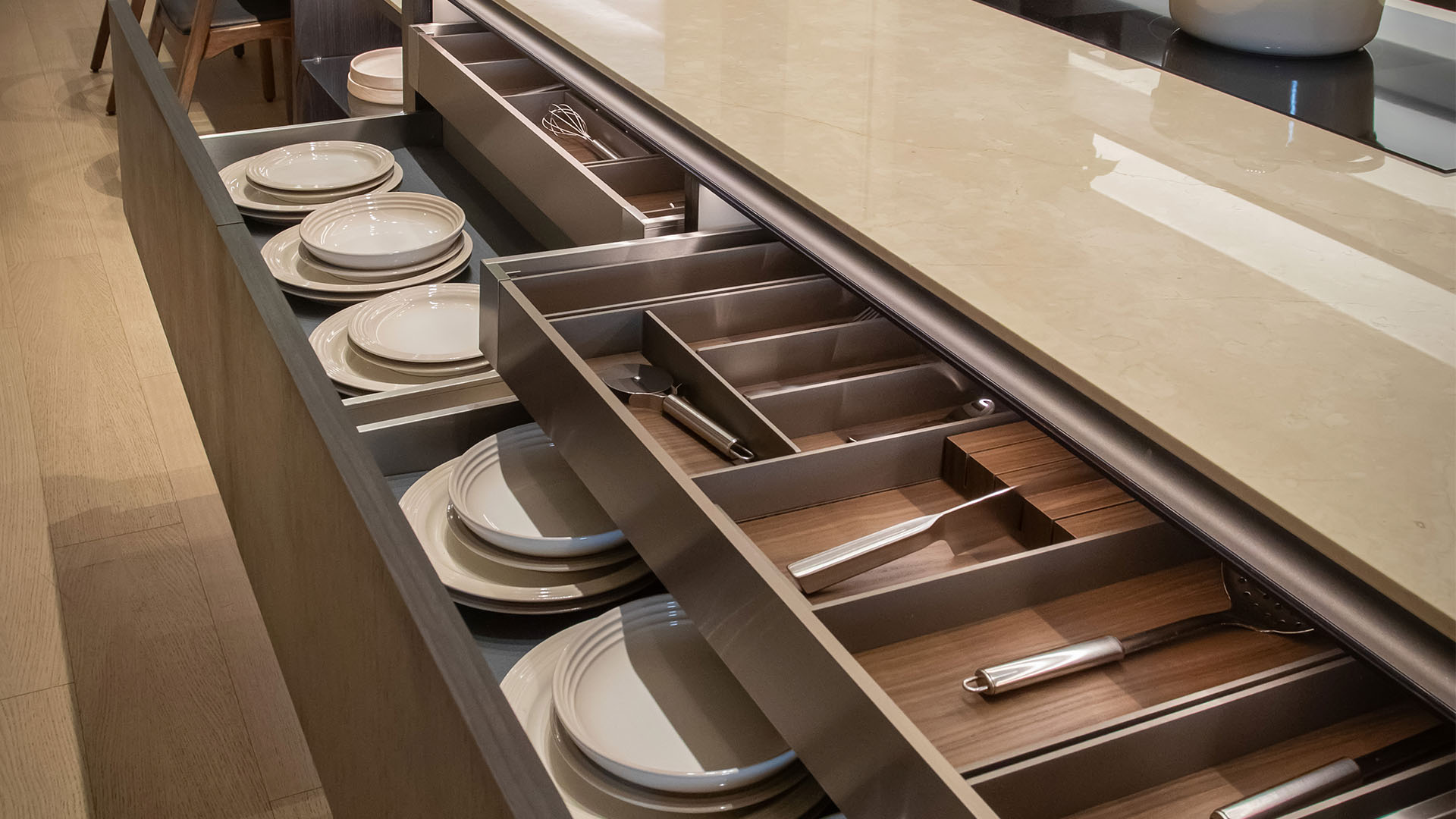
Open a deep drawer. Every item in the drawer is visible when it’s open. Everything is at the same retrieval distance. Nothing is behind anything else. The back of the drawer is as accessible as the front. This is not a marginal improvement — it’s a structural change in how base cabinet storage functions, and it’s the reason that kitchen cabinet drawers consistently outperform shelved cabinets for the majority of kitchen storage categories.
The accessibility argument: what happens at the back of a shelved cabinet
The usable depth of a shelved base cabinet is approximately the depth of the items stored in the front row. In practice, most households use the front 12 to 14 inches of a 24-inch deep cabinet effectively, and treat the remaining 10 to 12 inches as secondary storage — items that don’t need to be accessed regularly, or items that would be accessed regularly if they weren’t so difficult to reach. The result is a cabinet that’s physically 24 inches deep but functionally 12 inches deep for daily use.
A deep kitchen drawer converts the full 20 to 22 inches of drawer depth to functional storage. A pot that would have sat at the back of a shelved cabinet, requiring other pots to be moved to reach it, sits in a drawer where it’s visible and retrievable in one motion. The full depth of the drawer is used — not because the user is more organized, but because the drawer mechanism brings the back of the drawer to the front when it’s opened. No crouching, no repositioning of items, no second-best substitution.
This accessibility difference is most significant for heavy or bulky items — pots, pans, baking dishes, small appliances — where the physical effort of reaching into a low cabinet is genuinely uncomfortable and where the items’ weight makes careful extraction more important. For these categories, deep drawers aren’t a convenience feature; they’re the difference between a cabinet that works and one that accumulates items the household has effectively stopped using.
The visibility argument: why you use what you can see
There’s a consistent pattern in kitchen organization: items that are visible get used, items that aren’t don’t. A spice collection stored on a pull-out shelf at eye level gets used and replenished. The same collection stored at the back of a base cabinet accumulates expired jars. This isn’t a discipline problem — it’s a design problem. The kitchen doesn’t create visibility, so the items effectively don’t exist for the person cooking.
Deep kitchen drawers solve the visibility problem structurally. When the drawer is open, every item in it is visible from above. A drawer organized for baking supplies shows the flour, sugar, baking powder, and baking soda simultaneously — the person baking can see what they have and what they need without searching. A drawer organized for pots and lids shows every pot and its matching lid at the same time, which eliminates the separate search for lids that makes pulled-out shelves and shelved cabinets frustrating.
The visibility benefit is why drawer organization systems — inserts that divide the drawer into dedicated zones — work much better in drawers than equivalent organizers work in shelved cabinets. A drawer insert that separates utensils into categories is effective because the user can see all categories simultaneously when the drawer opens. A shelf organizer in a base cabinet doesn’t produce the same benefit because the shelf’s horizontal orientation still requires forward items to be moved to see backward items.
Which kitchen categories belong in deep drawers and which don’t
Deep drawers outperform shelves for most base cabinet storage categories, but not all. The exceptions clarify where shelves still make sense.
Pots, pans, lids, baking dishes, and mixing bowls belong in deep drawers — the weight, bulk, and difficulty of retrieval from a shelf cabinet makes the drawer advantage most pronounced for these items. Dry goods, small appliances, and food storage containers belong in drawers for the same reasons. Utensils and cooking tools belong in medium-depth drawers — shallower than pot drawers — where everything is visible and retrievable with one hand.
Shelves remain appropriate for a few specific categories. Tall items that don’t fit in a standard drawer height — a blender, a stand mixer, a tall stockpot — are better stored in a pull-out shelved section or in a cabinet with a door rather than in a drawer. Items that are used very infrequently and don’t need to be retrieved quickly — a large turkey roaster, a pasta machine, an ice cream maker — don’t benefit from drawer accessibility enough to justify the cost of the drawer configuration for that section. And items that are stored vertically — cutting boards, baking sheets, wire racks — are better handled by a vertical divider section than by a drawer, because vertical storage requires height rather than depth.
Ornare configures base cabinets with drawer systems from the beginning of the design process, not as a modification of a standard shelved configuration. The number of drawers, their depths, and their positions in the cabinet run are specified in the production drawings based on the storage categories assigned to each section of the kitchen. For a client in New York, Miami, or Dallas working through a kitchen layout where maximizing functional storage is a priority — which is most clients — the drawer configuration question is one of the first organizational decisions made, not one of the last.
Drawer quality: why the mechanism matters as much as the configuration
A deep drawer that works perfectly on day one but starts to feel imprecise after two years of daily use has failed at the core promise of kitchen cabinet organization. The mechanism — the runner system that guides the drawer in and out, the soft-close damper that decelerates the drawer at the end of its travel — determines whether the drawer continues to perform correctly over years of intensive use or gradually loses the precision that made it worth specifying.
Runner quality is the primary determinant of drawer longevity. A runner system of adequate quality maintains consistent lateral stability — the drawer doesn’t wobble side to side when extended — and consistent soft-close action — the damper decelerates smoothly and silently through the full deceleration phase — through tens of thousands of open-close cycles. A runner system of insufficient quality starts to exhibit lateral play within a few years, and the soft-close action becomes inconsistent — sometimes damping correctly, sometimes letting the drawer close with a thud — as the mechanism wears.
Ornare specifies drawer runner systems at the same quality level as the rest of the kitchen hardware. The standard isn’t defined by cost category — it’s defined by performance over the expected lifetime of the kitchen, which for a primary residence in Greenwich, the Hamptons, or Palm Beach is typically fifteen to twenty years of daily use. A drawer that performs correctly for that duration without requiring service or replacement is what the hardware specification is designed to deliver.