Bookcases contemporary: six ways to design a living room wall that works
Pick any six interior designers working in New York, Miami, or Los Angeles right now and ask them what a contemporary bookcase should look like. You’ll get six genuinely different answers — not because the question is subjective, but because “contemporary” in bookcase design covers a wide range of positions that share a rejection of the traditional without agreeing on what should replace it. No crown molding, no decorative columns, no furniture-store proportions — but beyond those negatives, the field is open. Exposed metal or concealed structure? Open shelving or closed cabinets? Floor-to-ceiling or floating sections? Wood or lacquer or both?
Ornare’s Bookshelves & Multimedia collections map this territory with six systems that each represent a distinct answer. The choice between them isn’t a matter of taste alone — it’s a design decision informed by the room, the collection it needs to hold, and the visual role the bookcase is meant to play in the space.
What makes a bookcase genuinely contemporary: design principles worth understanding
Before getting to specific collections, it helps to understand what separates a contemporary bookcase with real design integrity from one that merely looks current. The distinction comes down to whether the design decisions are motivated by something beyond appearance — by a structural logic, a material honesty, or a spatial purpose — or whether they’re purely cosmetic updates applied to a conventional format.
A bookcase with exposed metal structure isn’t contemporary because metal is fashionable. It’s contemporary because the decision to reveal the structure rather than conceal it represents a specific design position about honesty and construction. A bookcase with three-dimensional relief isn’t contemporary because texture is trending. It’s contemporary because the depth variation creates a relationship with light that a flat surface can’t have. A bookcase that runs from wall to wall and floor to ceiling isn’t contemporary because built-ins are popular. It’s contemporary because treating the entire wall as the unit of design — rather than the individual cabinet — produces a spatial result that freestanding furniture can’t achieve. These distinctions matter because they’re what makes a design decision hold up over time rather than dating quickly.
Ikigai Bookshelf and Square Wall: the two most architecturally distinctive contemporary options
Among the Ornare collections, Ikigai Bookshelf and Square Wall represent the most architecturally assertive positions in contemporary bookcase design, and they work from completely opposite principles. Ikigai is defined by transparency: an exposed metal frame creates a grid of open compartments that organizes books and objects while keeping the wall visible behind them. The bookcase filters the space rather than covering it, which makes it particularly well-suited to rooms where the architecture — a brick wall, a textured plaster surface, an interesting window configuration — is worth preserving as part of the composition.
Square Wall is defined by mass and relief: modular sections of varying depths create a three-dimensional surface that projects from the wall at different distances, catching and casting shadows that change as light moves through the room.
It’s a bookcase that reads differently at different times of day, which gives it a quality that flat surfaces — however refined their finish — simply don’t have. In rooms in Dallas, Houston, or Washington D.C. with strong directional light, this dynamic quality can become one of the most interesting visual elements in the interior.
Wall System Living and Timeless Bookshelf: contemporary bookcases built around how you actually use them
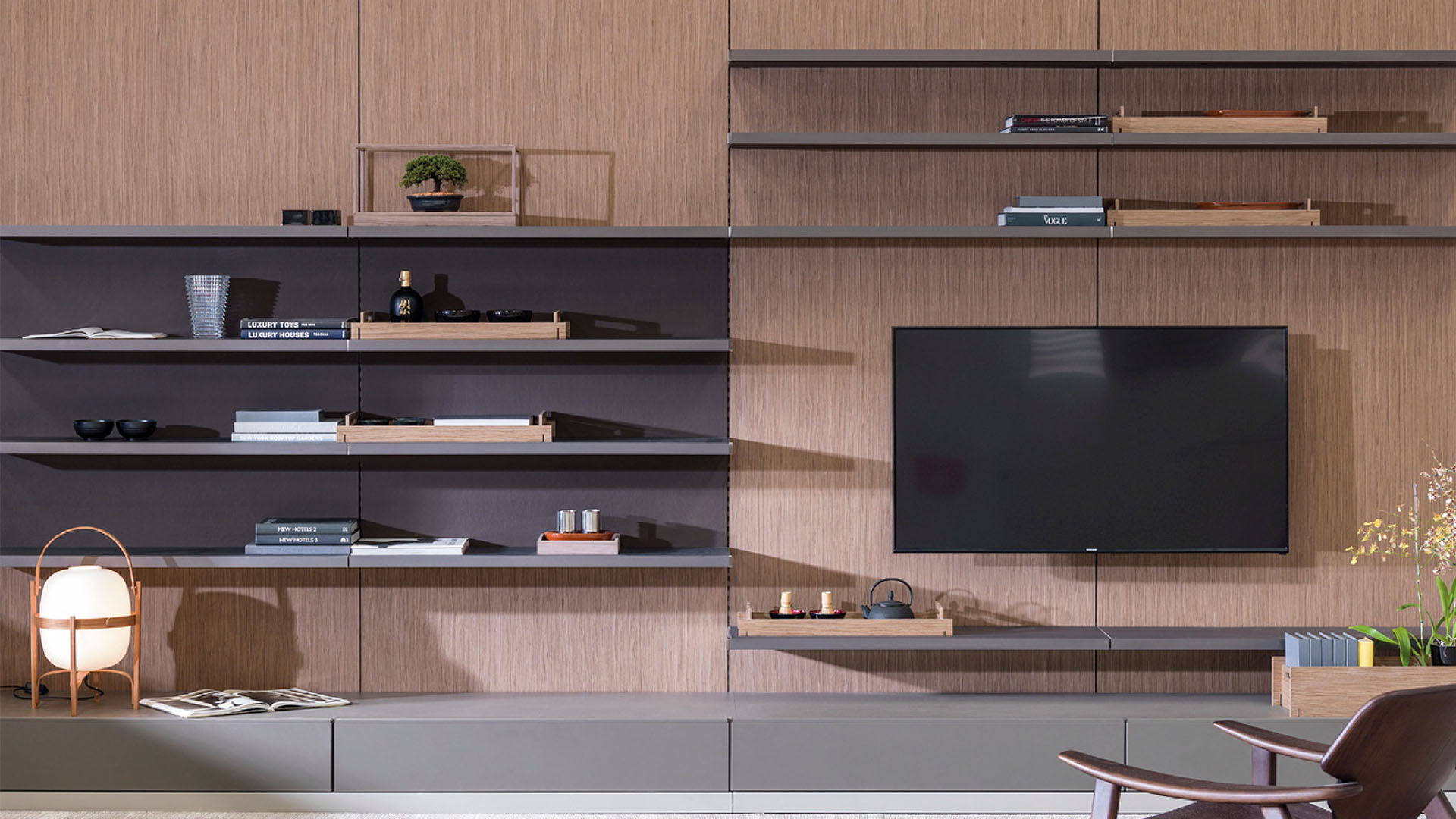
For rooms where the bookcase needs to handle a more complex range of functions — storage for books, objects, media equipment, bar accessories, and items that don’t benefit from being visible — Wall System Living and Timeless Bookshelf offer the flexibility that purely architectural systems like Ikigai and Square Wall don’t prioritize. Wall System Living is configurable to any combination of open shelving, closed cabinets, display niches, and integrated bar elements, with proportions and finish determined by the specific room rather than by a preset design. It’s the right choice when the wall needs to do many things simultaneously and the design needs to hold all of those functions together coherently.
Timeless Bookshelf occupies a different position: contemporary bookcases that feel permanent rather than fashionable, with proportions and finishes that communicate quality and intention without announcing themselves. In homes in Greenwich, Palm Beach, and the Hamptons where the living room is used for serious entertaining and the bookcase needs to read as a deliberate design investment rather than a design statement, Timeless Bookshelf provides the right register. It’s contemporary in the sense of being free from period references and unnecessary decoration, but it’s also the kind of design that could look right in the same room twenty years from now — which is a higher bar than most contemporary design actually clears.
Finish and material choices for contemporary bookcases: what works in a room that changes
The finish decision on a contemporary bookcase matters more than on most other pieces because of the surface area involved. A bookcase wall covers enough square footage that the material reads as part of the room’s architecture — not as furniture placed against it. This means the finish choice affects not just the bookcase but the entire character of the space, and it needs to be made with that in mind.
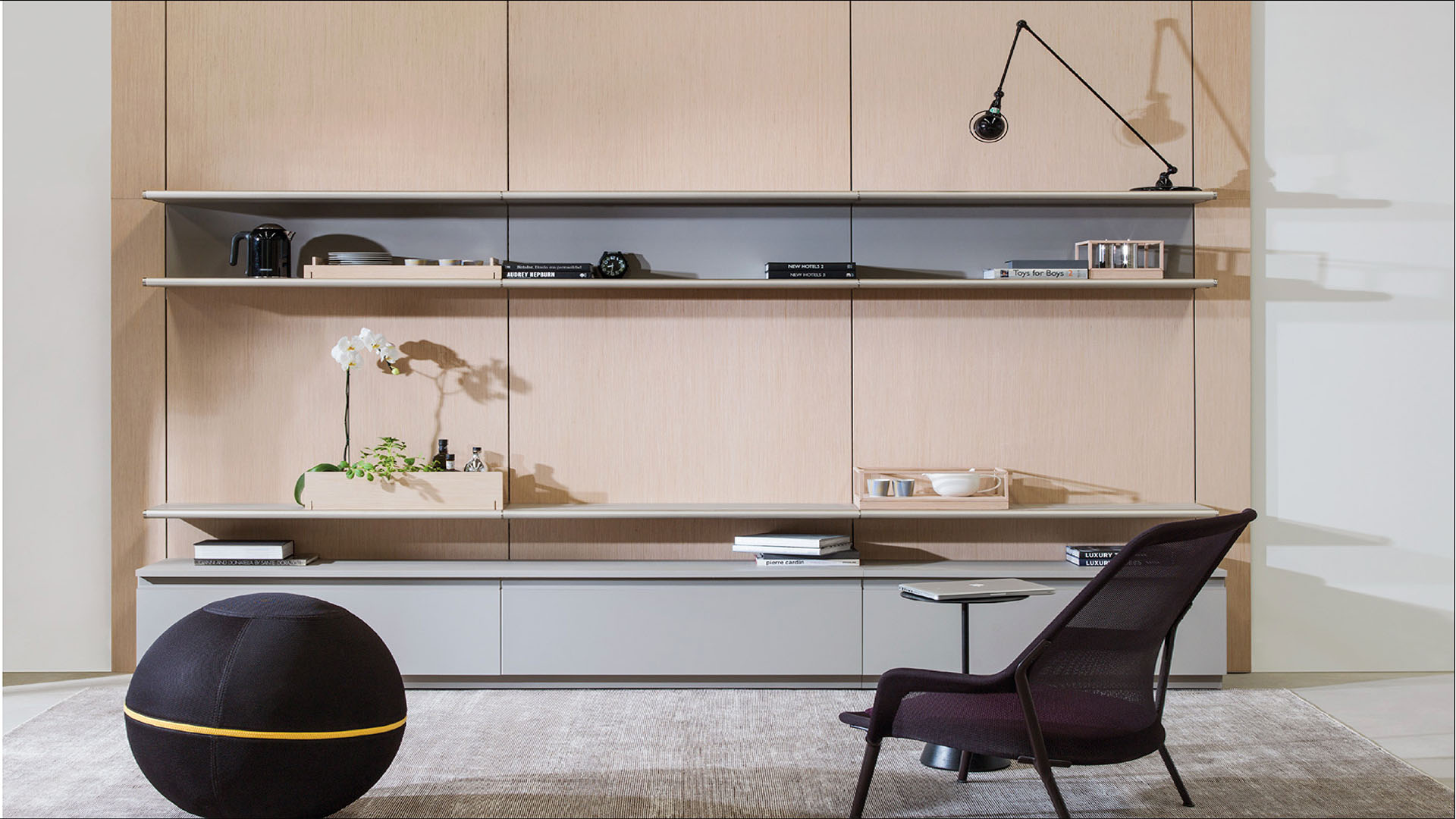
Matte lacquer in a neutral tone creates a recessive, architectural surface that puts books and objects in the foreground and lets the wall function as background. Natural wood veneer introduces warmth and material depth that changes character across different light conditions — lighter and more golden in morning sun, richer and darker in evening artificial light. A combination of lacquered lower sections with wood-veneered upper shelving, or open wood shelves within a lacquered structural frame, creates visual layering that adds sophistication to a large wall without adding visual complexity.
Ornare showrooms in New York, Miami, Los Angeles, and New Jersey are all set up for material evaluation with physical samples in conditions that approximate real rooms — because the difference between how a finish reads on a small chip and how it reads across sixteen feet of wall is significant enough that digital visualization reliably misleads.