Executive desk for the home office: size, materials and storage that support real work
A standard executive desk measures around 72 inches wide and 36 inches deep, roughly twice the surface of a typical writing desk. That extra space isn’t a status symbol; it’s what allows a laptop, a second monitor, open documents and a notebook to share the surface without stacking on top of each other. For anyone who works from home full time, the desk is the piece used for the most hours of the day, and choosing it means balancing size, layout, material and storage around the way the work actually happens.
Executive desk size: width, depth and the room it needs
Most executive desks range from 60 to 72 inches wide, and up to 84 inches for a large private office, with a depth of 30 to 36 inches. Depth is the more important number for screen work: at 30 inches, a large monitor sits too close to the eyes; at 36 inches, it can be placed at a comfortable distance with room for a keyboard and documents in front. The standard height is 29 to 30 inches, which suits most people with a properly adjusted chair.
The room has to accommodate the chair as well as the desk. Leave at least 36 inches behind the desk for the chair to move, and closer to 48 inches if there’s a credenza or bookcase behind it that needs to be opened. If the desk will host visitors, add 30 to 36 inches in front for guest chairs. In practice, a 72-inch home office executive desk with storage behind it fits comfortably in a room of about 11 by 12 feet.
Executive office desk layouts for different ways of working
The same desk can be arranged in several ways, and the right layout depends on how much surface and storage the work requires.
A freestanding desk facing the room
The classic executive office desk placement puts the desk in the middle of the room, facing the door, with a wall or window behind. It’s the most formal arrangement and the best for receiving visitors or video calls with a composed background. It does require a large room and a solution for cables that reach the desk from the floor.
An L-shaped desk with a return
Adding a return, a secondary surface 18 to 24 inches deep and 42 to 48 inches long set at a right angle, creates a working corner: the main desk for meetings and writing, the return for a printer, a second screen or reference files. It’s efficient in medium-sized rooms and keeps everything within reach without getting up.
A desk with a credenza behind
In this layout, the desk stays clean while a low credenza against the wall behind it holds files, printer and supplies. A quarter turn of the chair gives access to everything, and the top of the credenza works as an extra surface for documents in progress.
Materials for a modern executive desk: wood, leather, stone and metal
The work surface is touched for hours every day, so material matters for comfort as well as appearance. Solid wood and wood veneer are warm to the touch, age well and can be refinished over the years. A leather inlay, a traditional feature of executive desks, gives a soft, quiet writing surface that absorbs the sound of a keyboard and the pressure of a pen. Stone tops look striking but feel cold under the forearms and are heavy, while metal frames give a modern executive desk a lighter profile and allow slimmer tops.
Finish and color also influence how the office feels during long hours. Matte surfaces avoid glare from screens and windows, and mid-tone woods hide fingerprints and small marks better than very dark or very light finishes. The desk should relate to the rest of the room, especially to the bookcase or storage wall behind it, which is what appears in every video call.
Storage and technology built into the desk
A good executive desk keeps the essentials within arm’s reach. A shallow center drawer of 2 to 3 inches holds pens, cables and small items; a box drawer of 5 to 6 inches takes notebooks and devices; and a file drawer needs an interior height of about 10 to 11 inches for hanging files, with a width of 12 inches for letter size or 15 inches for legal. On a desk of 60 inches or more, a pedestal with these three drawers on one side leaves the other side free for the legs.
Technology should be integrated, not added. Power and USB outlets set flush into the top or under a discreet flap avoid chargers on the surface, cable grommets route wires from the desk down to a concealed channel, and a modesty panel at the front hides everything from view. Planning these details with the desk, rather than after it arrives, is what keeps the surface clear every day.
How Ornare designs the executive desk and the home office around it
Ornare designs home offices to the measurements of the room, so the desk, the storage and the shelving behind it are part of the same project, with power, lighting and cable routes resolved from the start.
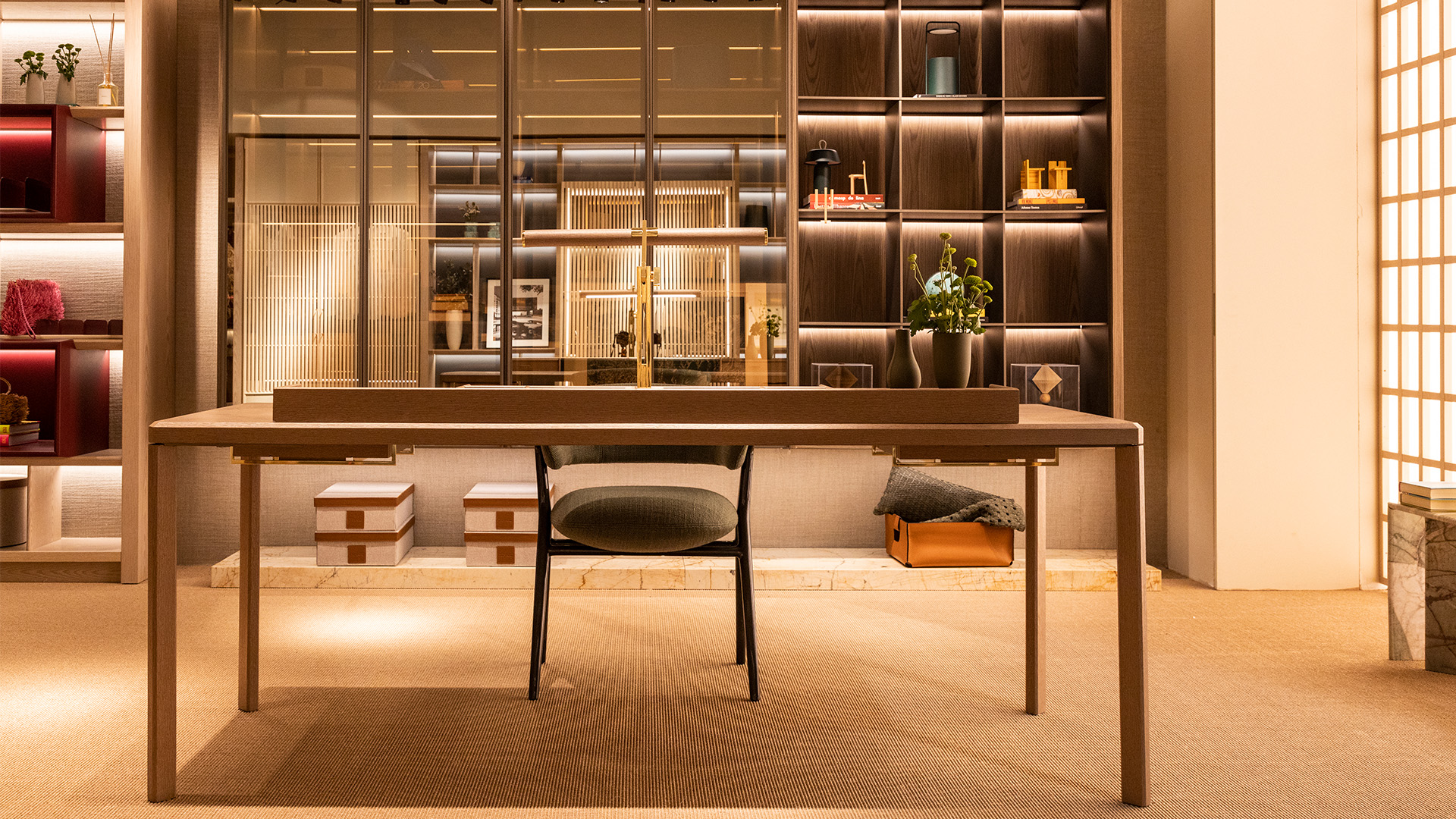
At the center of that project, the Timeless Edge Desk from the Timeless line was designed with ergonomic and functional benefits in mind and includes discreet sockets, adjustable lighting, drawers and object holders, so the essentials are built into the desk itself. Around it, Ornare’s office accessories can be suspended on metal supports that slide along a bar above the work surface, in round or rectangular versions, keeping small items organized without occupying the desk. And for the wall behind, Ikigai combines slim metal profiles with LED-lit shelves that can be closed with wooden sliding panels, turning the background of every video call into a calm, composed surface.
Before deciding the position of the desk, sit where the chair will be and look at what the camera will see. The wall behind you is the part of the office that colleagues and clients see most often, and designing it as carefully as the desk itself is one of the simplest ways to make a home office look professional.