Floating TV stand: what wall-mounted media storage changes in a living room
What happens to a living room when the media cabinet stops touching the floor? More than most people expect. A floating TV stand lifts the storage 10 to 16 inches off the ground, and that gap changes how big the room feels, how easy it is to clean, and how the whole wall reads. The floor runs uninterrupted all the way to the baseboard, the cabinet becomes a horizontal line rather than a block, and the television and its equipment finally look like they belong to the architecture instead of sitting in front of it.
The trade-off is that a floating unit asks more of the wall and of the planning. It has to be anchored properly, the cables have to disappear without a trace, and its height has to be decided in relation to the screen, the seating and everything else on that wall. Get those decisions right, and wall-mounted media storage is one of the most effective upgrades a living room can have.
Floating TV stand vs. floor-standing console: what actually changes
The visual difference comes first. A floor-standing console, even a low one, occupies floor area, and in a room of 250 to 350 square feet that footprint is noticeable. A floating media console shows the floor beneath it, and because the eye reads visible floor as available space, the room appears larger than it is. The effect is strongest in compact living rooms and in open-plan homes where the media wall is visible from the kitchen and the dining area.
The practical difference is just as concrete. With 10 inches or more of clearance, a robot vacuum or a regular one passes underneath without effort, dust has no corner to collect in, and area rugs can slide partly under the unit without interfering with doors or drawers. There’s also a design opportunity in that gap: an LED strip mounted under the cabinet washes the wall and the floor with soft light in the evening, which makes the unit seem lighter and gives the room a low, indirect glow that works well while watching TV.
Installing a wall mounted TV stand: what the wall has to carry
A loaded media unit is heavier than it looks. An 8-foot cabinet with a receiver, a soundbar, books and objects on top can weigh well over 150 pounds, and all of that load hangs on the wall. In most American homes, interior walls are drywall over wood studs set 16 inches on center, which means a wall mounted TV stand has to be fixed into the studs, ideally with a continuous steel or wood cleat that spreads the load along the full length of the cabinet. Drywall anchors alone are not an option.
The cleanest result comes when the wall is prepared before it’s closed. During a renovation or a new build, horizontal wood blocking installed between the studs at the exact height of the unit gives a solid fixing line anywhere along the wall, not only where the studs happen to fall. In masonry or concrete walls, the approach changes to chemical or heavy-duty mechanical anchors, but the principle stays the same: the structure is decided first, and the cabinetry is designed around it.
Height and depth of a floating media console
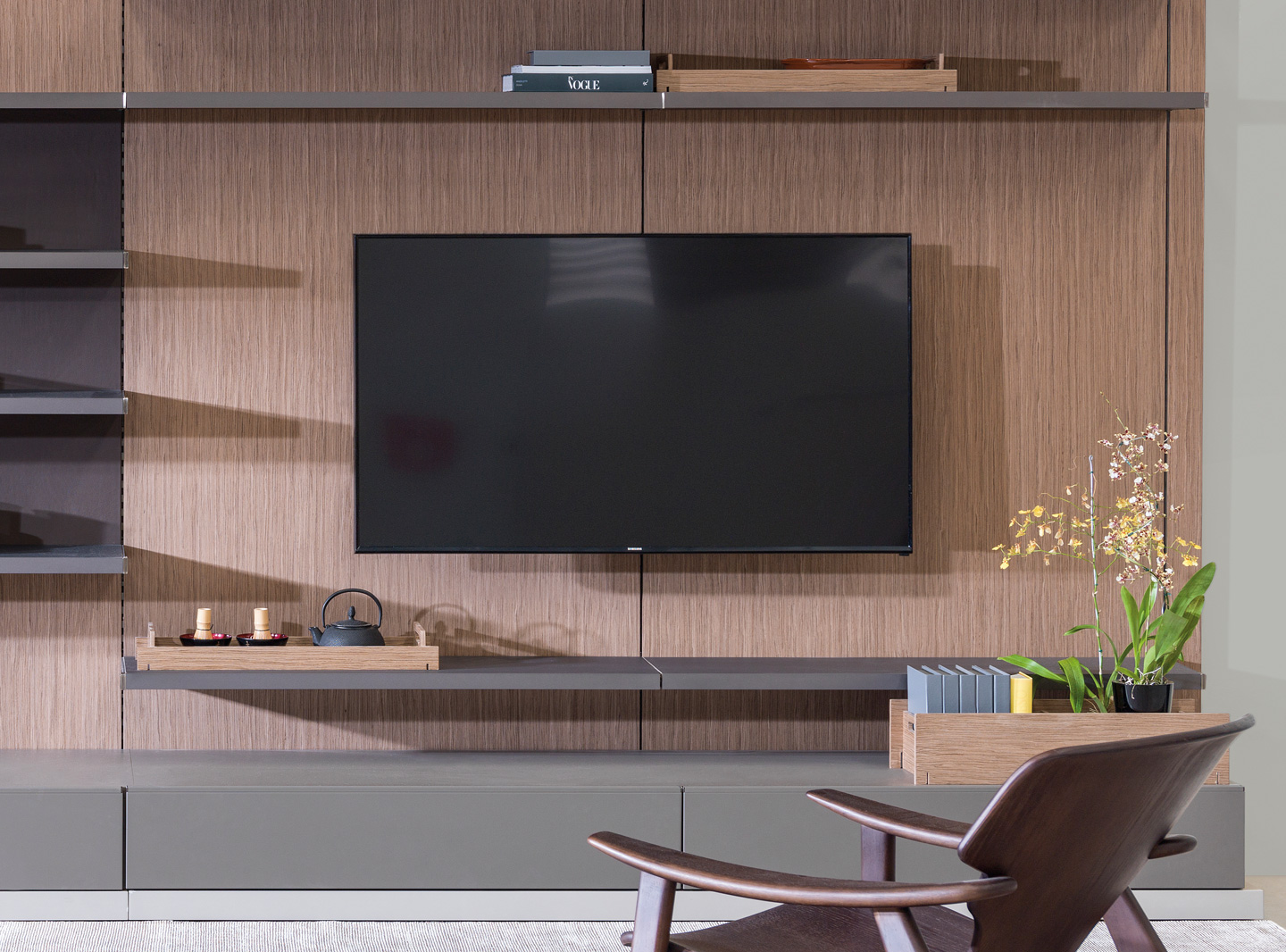
Height is the measurement that defines the composition. The underside of the unit usually sits between 10 and 16 inches from the floor, enough to read as floating without looking suspended in mid-air. The top typically lands between 20 and 26 inches, and from there the TV follows: the center of the screen should sit close to 42 inches from the floor, the eye level of an adult on a standard sofa. With a 65-inch TV, that usually leaves 4 to 8 inches between the cabinet top and the bottom of the screen, a gap that keeps the two elements visually connected.
Depth works the other way: the shallower, the lighter the effect. A floating unit between 14 and 18 inches deep holds most media equipment comfortably, while anything deeper starts to look heavy once it leaves the floor. Length should exceed the width of the screen by at least 8 to 12 inches on each side, and on a long wall the unit can extend much further, turning a TV console into a floating entertainment center that runs the full width of the room.
Cables, power and ventilation behind a floating entertainment center
Nothing gives away a poorly planned floating unit faster than a cable hanging between the cabinet and the screen. Avoiding it is a matter of sequence: the wiring is designed together with the cabinetry, not after.
Power and cable routing inside the wall
The usual solution is a recessed power and media box behind the TV, connected by an in-wall conduit to a second box hidden behind the cabinet. HDMI and speaker cables run through the conduit; power for the screen should come from a recessed outlet or an in-wall power kit rated for the purpose, since ordinary extension cords can’t be run inside a wall under electrical codes. A licensed electrician should handle that part, ideally before the drywall is finished.
Ventilation and remote signals in closed cabinets
Receivers, consoles and streaming devices produce heat, and a closed floating cabinet traps it. Openings in the back panel, a gap behind the unit or a small, quiet fan keep temperatures under control. Closed fronts also block infrared remotes, so the choice is between door panels that let signals pass through, an IR repeater, or devices controlled over Wi-Fi or Bluetooth.
How Ornare builds floating media storage into the living room wall
Ornare treats the floating unit as part of a wall system rather than as a standalone piece. Each project is made to the measurements of the actual wall, so the suspended storage, the TV area and the shelving above are drawn together, with the fixing line, the cable routes and the lighting resolved in the same design.
The collections suggest different directions. For a wall where the floating cabinet sits within a larger, layered composition, Square Wall combines vertical and horizontal panels with steel square shelves and integrated cabinetry elements, so the media storage becomes one element of a surface that can extend around the screen. For a warmer, more material look, Ornare’s Timeless line works with solid wood and natural leather, in modules with doors, drawers, niches and worktops. And where the wall above the unit should stay light, Ikigai uses slim vertical metal profiles and shelves with integrated LED lighting that can be closed with wooden sliding panels, finished in paint, wood, laminate or leather.
The most common mistake with a modern TV stand that floats is choosing it after the wall is finished. At that point, the studs are where they are, the outlets are in the wrong place and the cables have nowhere to go. Deciding the unit while the wall is still open is what turns a floating cabinet from an installation problem into the quietest, cleanest element of the room.