Extendable dining table: planning a dining room for everyday meals and holiday gatherings
For most of the year, the table seats four. On Thanksgiving, it has to seat twelve. That gap is the whole reason an extendable dining table exists, and it’s also why choosing one is more complicated than it looks. The table has to feel right at its everyday size, open smoothly when guests arrive, and fit a room that was probably not designed for a table twice as long. Planning for both versions, the daily and the holiday one, is what makes the difference between a table you extend gladly and one you avoid opening.
How an extendable dining table opens: the main mechanisms
The mechanism decides how often the extension will actually be used. If adding a leaf takes two people and ten minutes, the table stays closed except on major holidays; if it takes one person and thirty seconds, it gets opened for a Sunday lunch too.
Drop-in leaves
The classic system: the table splits in the center, slides apart on runners, and one or more separate leaves are dropped into the gap. It allows large extensions, often adding 18 to 40 inches, but the leaves must be stored somewhere else, and that’s where many households run into trouble.
Self-storing and butterfly leaves
In a self-storing table, the leaf folds and sits inside the table frame when not in use. Butterfly leaves unfold from the center in one movement. Both are faster and solve the storage problem, at the cost of slightly less extension and a deeper apron under the top, which affects knee clearance.
End extensions and pull-out tops
Some tables extend from the ends, with leaves that pull out from beneath the top on each side. The center stays intact, which suits stone or patterned tops where a visible joint in the middle would interrupt the surface.
Sizing an expandable dining table for everyday use and holidays
The useful way to choose an expandable dining table is to start from two numbers: the number of people who eat at it every day and the maximum number you host a few times a year. Allow about 24 inches of table edge per person, and closer to 28 or 30 inches for a more comfortable holiday setting with serving dishes on the table.
A table that seats six daily is usually 72 inches long; extended to 96 or 108 inches, it becomes an extendable dining table for 8 to 10 guests. Width matters as much as length: at least 40 inches, and ideally 42 to 44, keeps room for serving platters in the center when the table is full. Round tables follow the same logic, and a round extendable dining table that opens into an oval is an excellent solution for smaller rooms, compact and sociable for four, then long enough for eight.
Planning the room around the extended size
The most common sizing mistake is checking clearance only for the closed table. The room must work with the table fully open: at least 36 inches between the extended table and walls or other pieces, and 42 to 48 inches where people walk behind seated guests. In practice, a table that extends to 108 inches needs a room of roughly 16 to 17 feet in length, or an open plan where the dining area can borrow space from the adjacent living area for a few days a year.
Lighting needs the same attention. A pendant centered on the closed table will be off-center once a leaf is added at one end, so central-split tables are easier to light than end extensions. Linear fixtures of 36 to 48 inches, or two pendants spaced along the length of the table, cover both configurations better than a single fixture. And rugs should be sized for the extended table, with 24 to 30 inches beyond the edges, otherwise chairs at the ends will catch on the border just when the room is fullest.
Where the leaves, chairs and holiday tableware go the rest of the year
An extension is only half of the solution. The other half is everything that comes out with it: the leaves of a dining table with leaf extensions, four or six extra chairs, the large serving platters, the formal dinnerware and glassware, the tablecloths that only come out a few times a year. Without a dedicated place, these end up in a garage, a basement or a guest room closet, and the effort of retrieving them is often what discourages people from hosting.
The dining room itself is the best place to keep them. A built-in storage wall can include a vertical compartment for leaves, sized to their exact dimensions with protective dividers so the edges and finish don’t get damaged. Wide, shallow drawers hold tablecloths and runners flat, without folds; adjustable shelves behind closed doors hold platters and large serving bowls; and a deep lower section can house stackable or folding chairs out of sight.
How Ornare designs dining room storage for a table that changes size
Ornare designs dining room storage to the measurements of the room, which makes it possible to plan around the extended table rather than the closed one: the length of the storage wall, the position of the doors in relation to the table, the compartment for the leaves and the lighting are resolved in a single project.
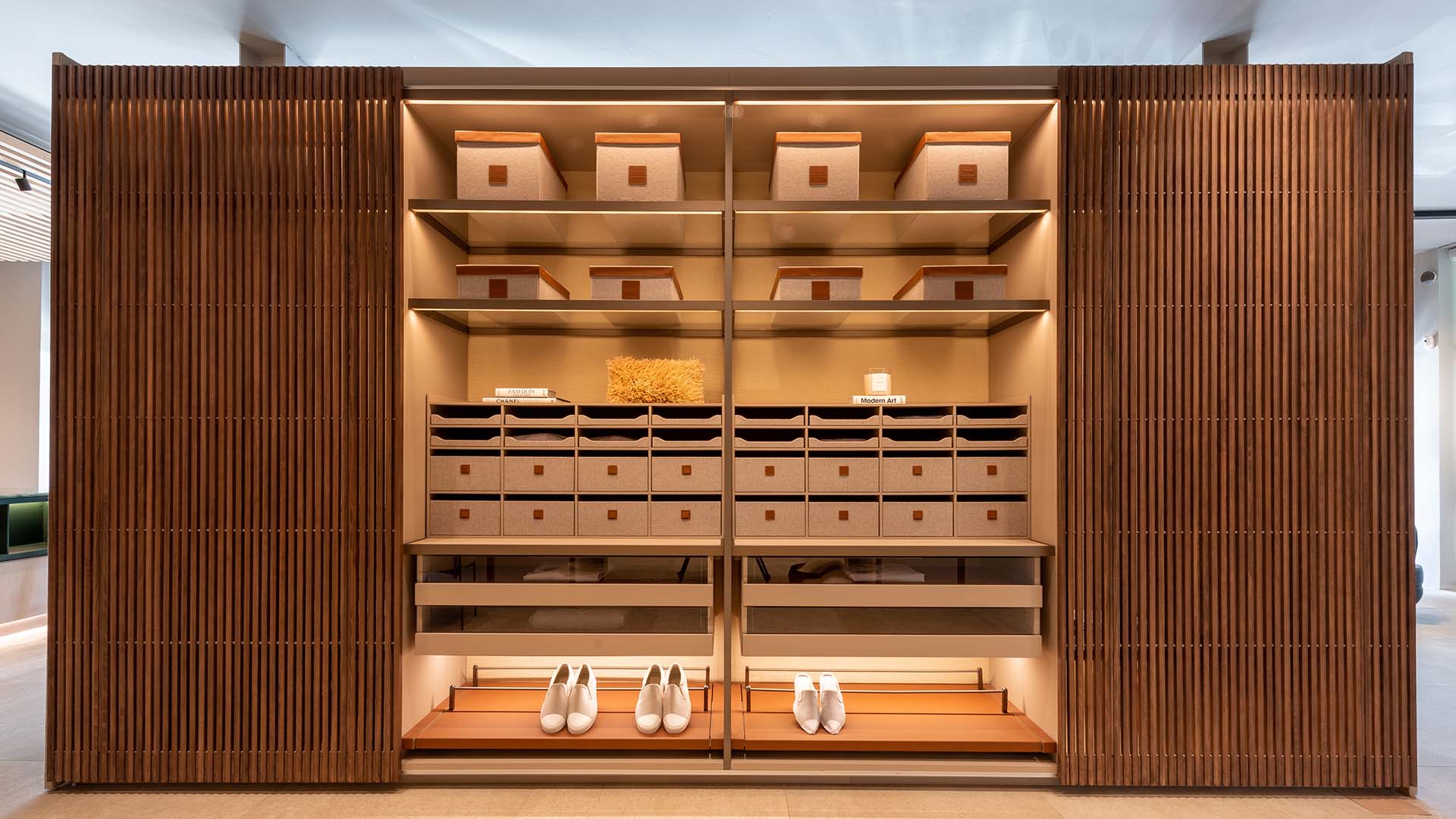
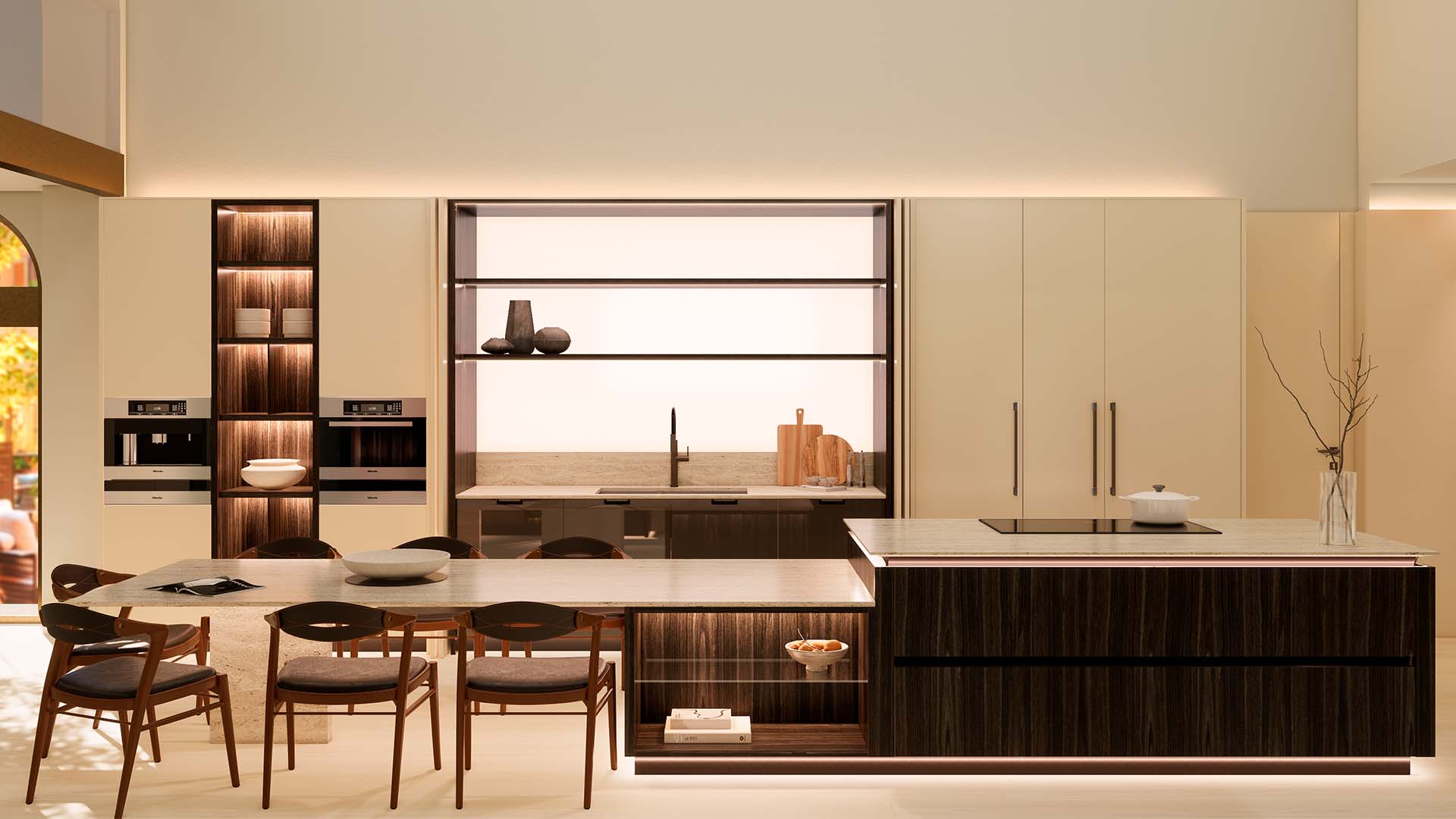
The collections offer different ways to organize that storage. For a warm, enduring dining room, Ornare’s Timeless line builds the wall in solid wood, with modules that combine doors, drawers, niches and worktops, a natural fit for linens, tableware and leaves. For a more classic setting, the Colette collection includes doors with carved frames inspired by French boiseries and an illuminated crystal cabinet for porcelain and glassware, so holiday pieces can be displayed rather than hidden. And for a contemporary room, Ikigai pairs slim metal profiles with LED-lit shelves that can be closed with wooden sliding panels, showing the serving pieces when guests are coming and covering them the rest of the year.
One practical detail is worth deciding before buying the table: measure the leaves. Their exact length, width and thickness determine the size of the storage compartment, and a compartment designed even half an inch too small turns the simplest part of hosting into a struggle.