Bookcase wall unit: choosing the right collection for your room
Six collections. One wall. The question isn’t which Ornare bookcase looks best in a photograph — it’s which one is right for a specific room, with specific light, specific proportions, and a specific set of things it needs to hold and do. The answer is different for a 14-foot living room wall in a Houston home with 10-foot ceilings than it is for a 10-foot wall in a New York apartment with 8.5-foot ceilings. Same brand, same quality standard, completely different collection choices.
The framework for making this decision has four variables: what the wall needs to hold, what role the bookcase plays in the room’s visual composition, how the room is lit, and what the room’s design language calls for. Working through these four questions in order produces a collection recommendation that’s specific to the room rather than generic to a taste preference.
Variable one: what the wall actually needs to hold
Before any collection is appropriate to discuss, the storage requirement has to be defined. A bookcase wall unit that needs to hold a significant book collection — several hundred volumes of varying formats — has different configuration requirements than one that holds a curated selection of objects and serves primarily as a display surface. A wall that needs to integrate a television, a bar section, and media equipment has different depth and configuration requirements than a wall devoted entirely to books and shelving.
This isn’t an aesthetic question — it’s a functional one. Square Wall, with its modular three-dimensional surface, is a strong display system but a limited storage system: the varying depths of its modules create interesting visual composition but don’t maximize linear shelf footage. Ikigai Bookshelf, with its open metal grid, provides excellent visibility of everything stored on it but no closed storage. Wall System Living handles the most complex functional requirements — television, bar, media, books, closed storage, open display — because it’s the most configurable. If the wall has to do multiple things simultaneously, Wall System Living is the answer regardless of any other consideration.
If the requirement is simpler — primarily books, with some display objects — Timeless Bookshelf and Square Wall are both viable depending on the other variables. Shaker Wall Bar and Timeless Bar are relevant only if the bar function is a requirement, and they work best as part of a larger wall composition that includes adjacent shelving rather than as standalone units.
Variable two: the role of the bookcase in the room’s visual composition
A bookcase wall unit can be a background or a focal point. This is a design choice, not a default — and the collection selection should reflect it explicitly. A background bookcase recedes: it holds books and objects, it contributes to the room’s sense of completion, but it doesn’t demand attention. A focal point bookcase asserts itself: it has visual qualities that make it the primary design feature of the wall, and the room is composed around it rather than with it as background.
Square Wall is a focal point collection — its three-dimensional relief and shadow make it a design statement that the room organizes itself around. It’s the right choice when the living room wall is intended to be the primary visual feature of the space, and it’s the wrong choice in a room where the bookcase is meant to support other focal points — a significant piece of art, an architectural fireplace, a view through large windows. Placing Square Wall in a room that already has a strong focal point creates visual competition rather than resolution.
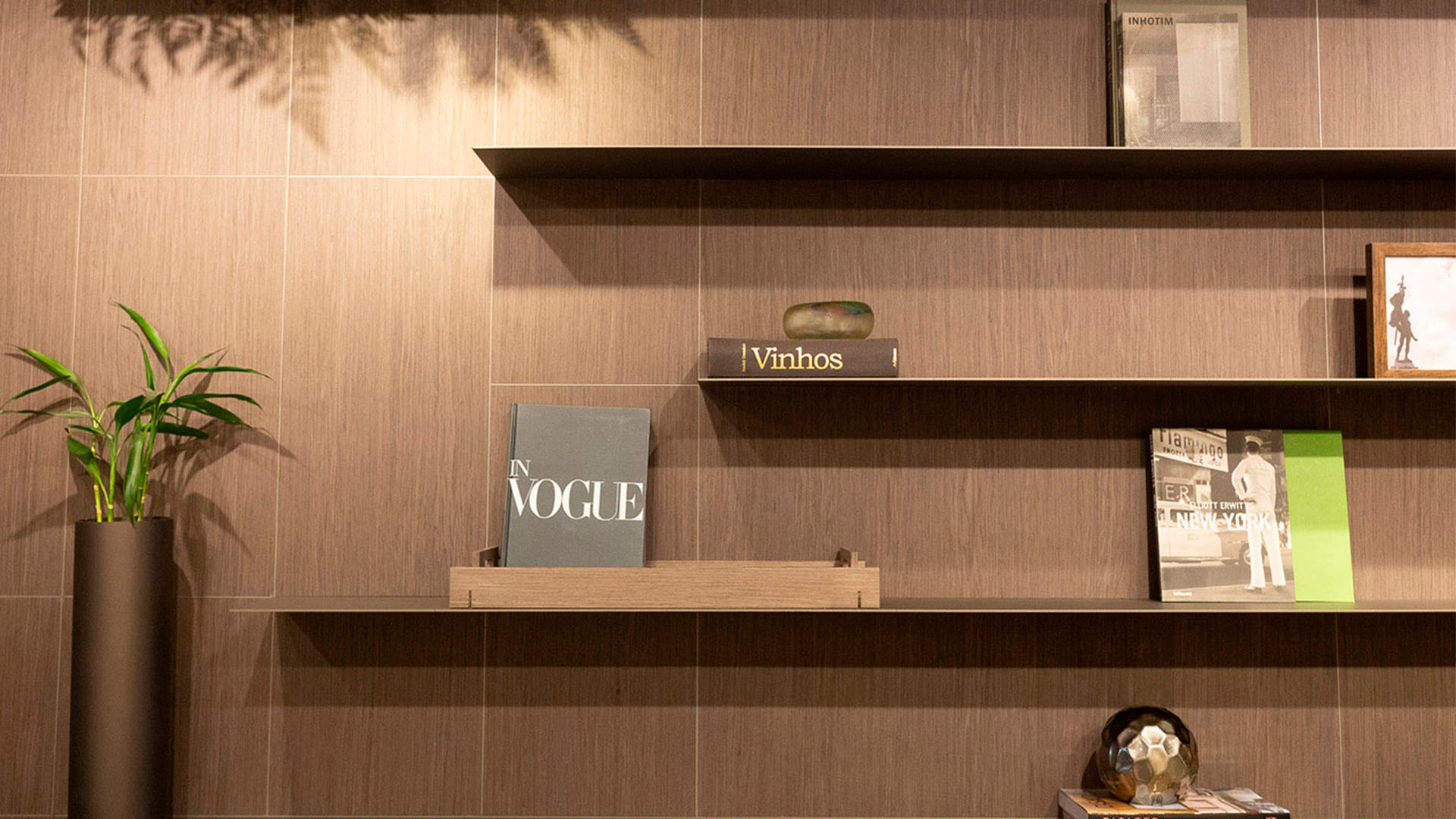
Timeless Bookshelf and Wall System Living can be either background or focal point depending on the material and finish choices. In a natural wood veneer with warm tones, either system asserts itself as a material feature. In a matte lacquer that matches or closely coordinates with the wall color, either system recedes into the architecture. Ikigai Bookshelf is always somewhere in between — its metal structure is visible and distinctive, but its transparency prevents it from dominating the wall.
Variable three: how the room is lit and what that means for the collection
Light changes the appearance of every bookcase wall unit more than any other variable — and it changes different collections differently. Square Wall’s visual effect depends on light direction: its relief and shadow require light at an angle to the surface to read correctly. In a room with flat, diffuse overhead lighting from a low ceiling, Square Wall reads as a textured surface rather than as a three-dimensional composition. In a room with directional natural light from a window at one end — common in the Hamptons and in many Miami homes — the relief reads strongly throughout the day as the light angle changes.
Ikigai Bookshelf reads best in rooms where the wall behind the shelving is worth revealing — a painted surface, an interesting plaster texture, an exposed brick or concrete wall. The system’s transparency is an asset when the background has something to contribute, and neutral when the background is a plain white wall. In rooms in Dallas or Houston where the architecture behind the bookcase wall is unexceptional, Ikigai’s transparency reveals less than it does in rooms with architectural character.
Natural wood veneer on any collection responds to light more dynamically than lacquer. In a room with morning sun from the east, a walnut veneer appears warm and rich in the early hours and more muted in the afternoon. In a room with northern exposure — consistent, diffuse light throughout the day — the same veneer is stable and even, which some people prefer and others find lacks the warmth they expected from the material. Evaluating veneer samples in the light of the specific room — at the Ornare showrooms in New York, Miami, or Los Angeles, or by bringing samples to the space — is the only reliable way to know how the collection will read before it’s installed.
Variable four: design language compatibility and long-term relevance
The final variable is whether the collection’s design language is compatible with the rest of the room — and whether that language will remain compatible as the room evolves over time. A wall bookcase unit is a significant investment intended to remain in place for many years, which means the collection choice has to work not just for the current state of the room but for the room as it’s likely to develop.
Collections with stronger individual character — Square Wall, Ikigai Bookshelf — make more specific stylistic commitments than collections with more neutral design languages. Timeless Bookshelf and Wall System Living are, by design, less period-specific: their proportions and finishes don’t rely on a particular aesthetic moment, which makes them more adaptable to changes in the surrounding room over time. For a primary residence in Greenwich, Palm Beach, or Washington D.C. where the interior is expected to evolve gradually over a decade or more, this adaptability is a practical consideration that belongs in the collection selection process alongside the more immediately visible design factors.