Walk-in closet by Ornare: how to design a space that works as hard as it looks
A walk-in closet is one of those rooms that people plan once and live with for a very long time. Get it right and it becomes one of the most functional spaces in the house — a room that makes getting dressed faster, keeps everything visible and organized, and holds up well through years of daily use. Get it wrong and it becomes a storage problem with a door: beautiful in the rendering, frustrating in practice, full of things that don’t have a proper place and corners that never get used efficiently.
The difference between a walking closet that works and one that doesn’t comes down almost entirely to how it was planned. Ornare has been designing custom closet systems since 1986, and the process starts the same way every time: with the specific dimensions of the space, the specific wardrobe of the person using it, and the specific habits that determine how the room gets used every morning.
Walk-in closet layout: how to use every square foot without wasting a single one
The layout of a walk-in closet is a geometry problem before it’s a design problem. The fundamental constraint is aisle width: you need at least 24 inches of clear space to stand and access hanging sections comfortably, and 36 inches is significantly better for a closet used by two people simultaneously. In a room that’s eight feet wide, that means roughly two feet of depth on each side for storage, with four feet of circulation in the middle — which is workable but requires precision in how hanging sections, drawers, and shelving are distributed across those two feet.
Ornare designs to the actual dimensions of the space, which means the layout is optimized for the specific room rather than adapted from a standard configuration. A closet with an irregular footprint — an alcove on one side, a sloped ceiling in the corner, a window that interrupts one wall — gets a design that incorporates those conditions rather than working around them. The result is a room where every linear foot of wall is doing something useful, and where the circulation path is calibrated to the way the space is actually used rather than the way a generic floor plan assumes it will be.
Interior organization in a custom walking closet: starting with what you own, not with the furniture
The most common mistake in walk-in closet design is planning the interior from the outside in — deciding on a configuration and then trying to fit a wardrobe into it. Ornare works in the opposite direction: the interior organization starts with an inventory of what needs to be stored, which drives every subsequent decision about hanging height, drawer depth, shelf spacing, and the allocation of space between different categories.
Most wardrobes contain a mix of long garments — dresses, coats, full-length trousers — and shorter ones: jackets, folded shirts, suits. Double-hang sections, which stack two rows of shorter garments vertically, roughly double the hanging capacity of a single-hang section in the same floor-to-ceiling height. Allocating double-hang space to the right categories can free up significant additional space for drawers, shoes, or shelving without requiring a larger room. Ornare’s closet collections — including Timeless Closet, Wall System Bedroom, Infinite, and others — are all configurable to accommodate this kind of category-specific organization, with interior layouts that are determined by the wardrobe rather than by the collection’s default settings.
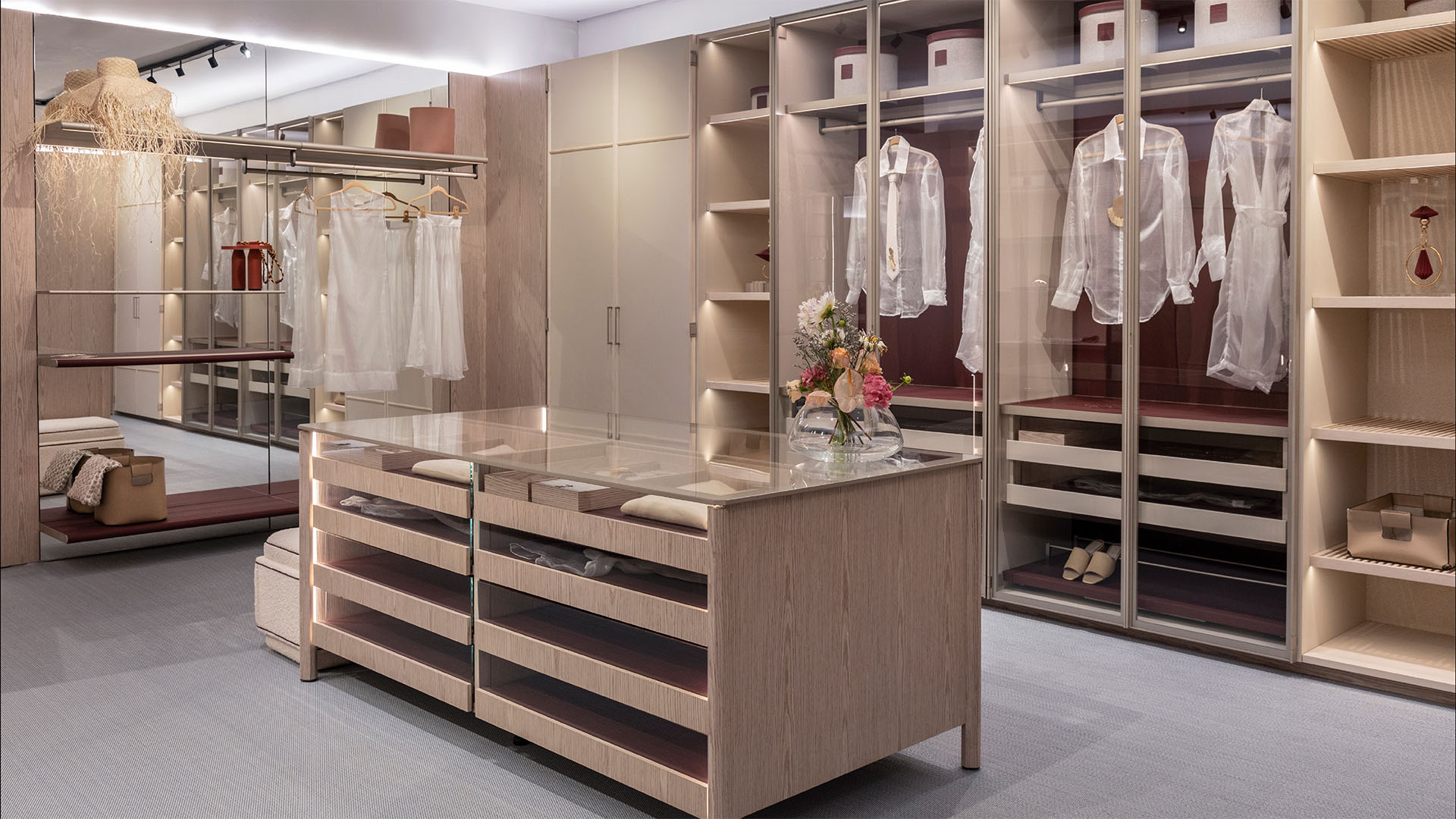
The Vanity Island and Little Luxuries complements extend the closet into a full dressing room: an island unit at the center of the space for folded items, accessories, and jewelry, with the kind of interior organization — padded trays, velvet-lined compartments, dedicated sections for watches and small accessories — that transforms the walk-in closet from a storage room into a private retail experience.
Walk-in closet finishes and materials: what holds up in a room used twice a day, every day
A walk-in closet is used more frequently than almost any other room in the house. The interior surfaces — shelf edges, drawer fronts, hanging rods, the floor of the shoe section — take more contact and more wear than equivalent surfaces in the kitchen or bathroom. Material choices that look beautiful in a showroom need to hold up under that level of daily use without showing wear, fading, or deteriorating in ways that make the closet feel less considered over time.
Ornare specifies interior materials with this in mind. Lacquered surfaces are finished to resist chipping at edges — the most vulnerable point in any frequently touched surface. Wood veneer is selected and treated to maintain its appearance in a room that typically has less natural light and ventilation than other spaces in the house. Hardware — the drawer pulls, the hanging rod brackets, the soft-close mechanisms on every drawer — is specified to maintain its performance characteristics through years of use rather than just through the warranty period.
Visiting any Ornare showroom — in New York, Miami, Dallas, Los Angeles, or Houston — and opening and closing the drawers in the closet displays is the most direct way to understand what this level of hardware specification actually feels like in practice.
Walk-in closet lighting and mirrors: the two elements that determine how the room functions in real use
Lighting in a walk-in closet is not a decorative decision — it’s a functional one. A closet with inadequate lighting is a closet where colors are misread, where the navy suit gets confused with the black one, where the detail on a fabric isn’t visible until you’re already in a different room with better light. The lighting needs to be bright enough to see colors accurately, positioned so it illuminates the interior of hanging sections and drawers rather than just the center of the room, and warm enough that it approximates the light conditions in which the clothes will actually be worn.
Ornare integrates lighting into its closet systems as part of the design — LED strips under shelves, inside hanging sections, and within drawer units — so that every section of the closet is properly illuminated regardless of where the ceiling fixtures are positioned. Mirrors are the other non-negotiable: a full-length mirror positioned within the closet itself, rather than in the bedroom, completes the dressing process in the room where it happens.
Ornare incorporates mirrors into the closet design as an integrated element — framed, positioned, and lit as part of the overall composition rather than mounted as an afterthought. The Greenwich showroom and the Hamptons location in Southampton both have walk-in closet installations that show how lighting and mirrors work together within a complete system, which is worth experiencing in person before finalizing any design decisions.