Kitchen ideas that actually start with your space, not a catalog
Most kitchen projects go wrong in the same way: someone falls in love with a photo, tries to recreate it in a completely different space, and ends up with a result that looks nothing like the inspiration. The photo was taken in a loft in SoHo. Your kitchen is in a townhouse in Houston. The ceiling heights are different, the light comes from the wrong side, and the island that looked sculptural in the image feels oversized and awkward in real life. Kitchen ideas are only useful when they’re filtered through the specific reality of your home — your dimensions, your light, your habits, and your sense of what a kitchen should feel like to live in every day.
Ornare’s approach starts exactly there. Before collections, before finishes, before anything visual, there’s a conversation about the space. That conversation happens in person at any of Ornare’s showrooms across the US — in New York at the A&D Building on East 58th Street, in Miami’s Design District, in Dallas’s Design District, in West Hollywood, in Houston, in Southampton for the Hamptons, in Greenwich, in Paramus for New Jersey, in West Palm Beach, and in Washington, D.C. Each location is staffed by consultants who work with real floor plans, real constraints, and real budgets — not with idealized versions of what a kitchen could be.
Kitchen design ideas by layout: how the shape of your space determines everything
Before choosing a single finish or collection, the layout question has to be answered: how does the kitchen sit in the space, and how does it relate to everything around it? A galley kitchen in a pre-war Manhattan apartment calls for completely different solutions than an open-plan kitchen in a new construction home in Dallas or a beach house in the Hamptons. Ornare designs across all configurations — single-wall, L-shaped, U-shaped, with island, with peninsula — and the choice between them isn’t purely aesthetic. It’s about traffic flow, the position of windows and doors, the relationship between the kitchen and the dining or living area, and how many people use the space at the same time.
The island, in particular, deserves careful thinking before it becomes a design decision. It needs at least 36 to 42 inches of clearance on each side to work comfortably. In a kitchen that’s less than 12 feet wide, that math often doesn’t add up — and forcing an island into a space that can’t support it creates a bottleneck that makes the kitchen harder to use, not easier. Ornare’s consultants work through these numbers before any design decisions are made, because a layout that doesn’t function can’t be saved by beautiful finishes.
Modern kitchen ideas from Ornare’s collections: same goal, very different results
Once the layout is established, the collection question opens up — and this is where Ornare’s catalog offers something genuinely different from most luxury kitchen brands. The collections aren’t variations on a single design language: they represent distinct approaches to what a modern kitchen can look and feel like.
Minimal takes the most uncompromising position: no hardware, continuous surfaces, volumes that read as a single mass. It’s a kitchen that disappears into the architecture of a room, which sounds like restraint but actually requires extraordinary precision to execute well. Timeless works in the opposite direction — it asserts itself with proportions and details that have enough visual weight to anchor a large space without becoming heavy.
Round introduces curves into a category that’s almost entirely defined by right angles, with radiused corners that soften the geometry in ways that feel surprising and considered at the same time. Ikigai brings an entirely different cultural reference — the essentialist philosophy of Japanese design, expressed through exposed metal structure and doors that reveal as much as they conceal. Colette, Sky, Breeze, Shaker, Slatted, Stripe, Stow, Infinite, Wall System: each collection has its own internal logic, its own reason for existing beyond aesthetic variation.
Kitchen island ideas: the element that changes how a kitchen is used
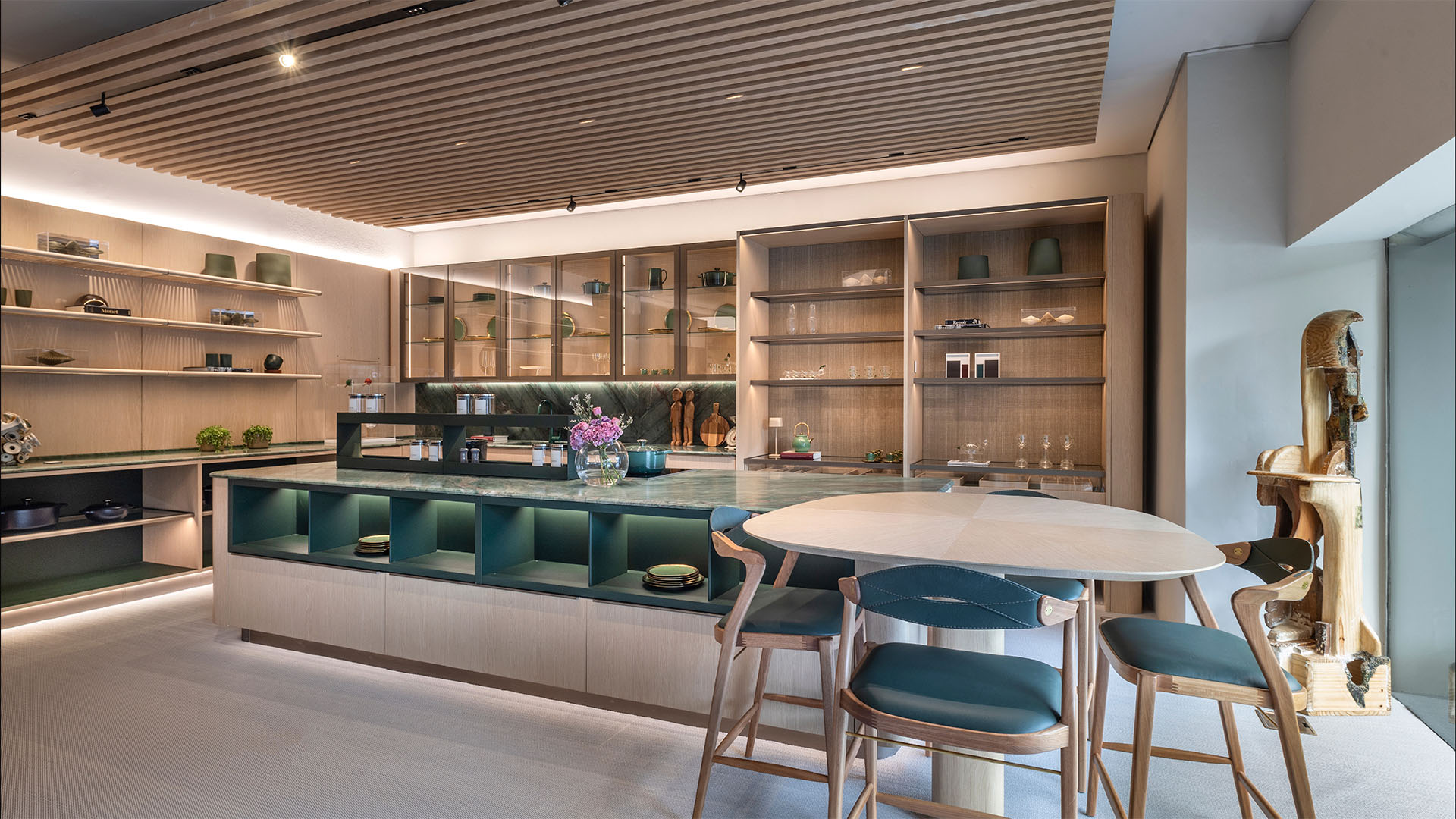
The island is where most kitchen design ideas get exciting — and where most mistakes get made. Done well, it adds work surface, storage, seating, and a social focal point that transforms the kitchen from a production space into a gathering place. Done poorly, it blocks movement, creates awkward sightlines, and makes a kitchen feel smaller than it actually is.
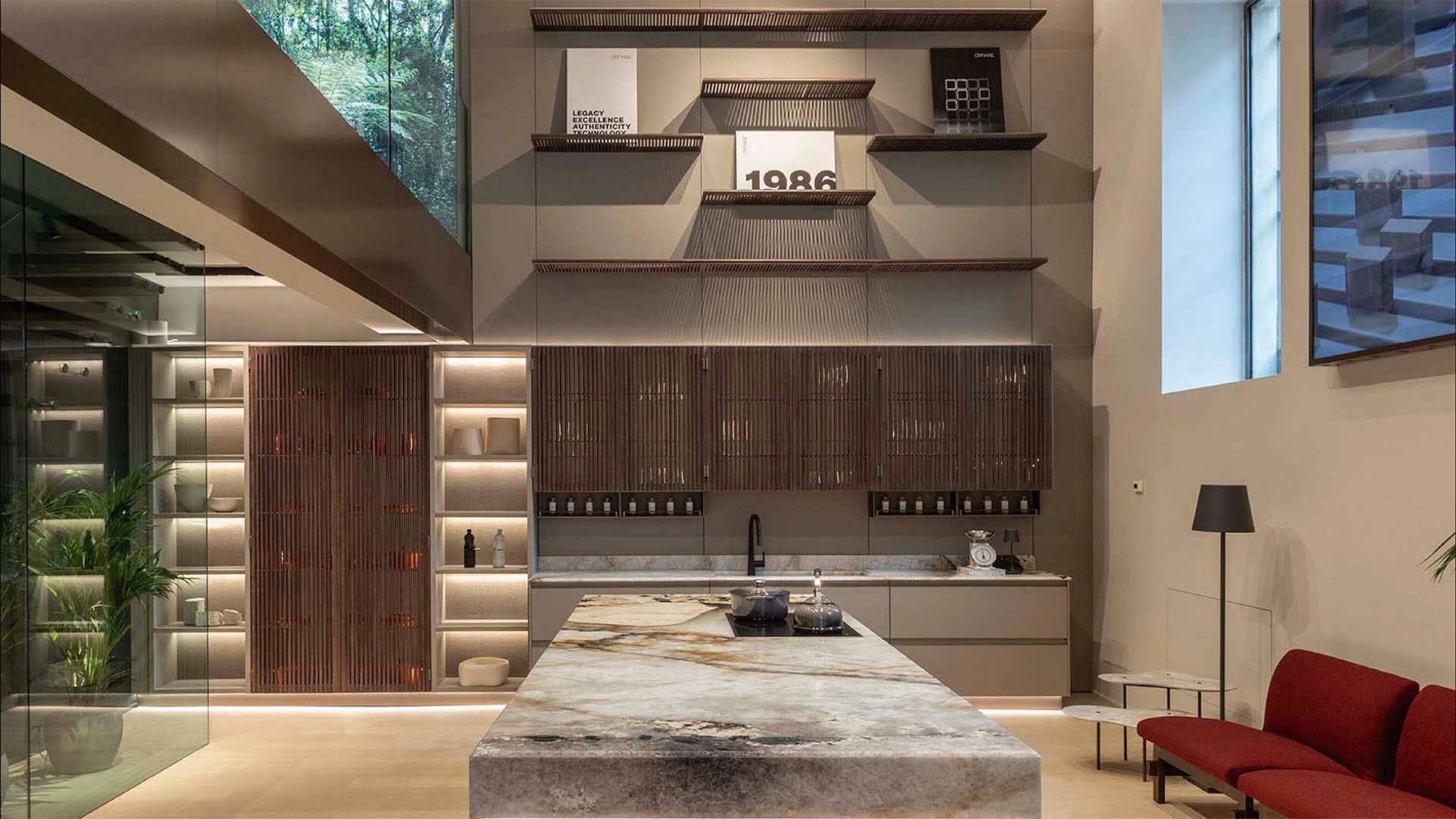
Ornare approaches the island as a design problem with specific parameters: the dimensions of the space, the location of the cooktop or sink (if either will be integrated), the desired counter height for the seating side, and the material of the surface. That last decision — what the island countertop is made of — has more impact on the overall character of the kitchen than almost any other single choice. Marble brings veining and uniqueness; no two slabs are the same, and the surface changes character in different lights throughout the day. Quartz offers uniformity and durability. Solid wood adds warmth that no synthetic material replicates. The right choice depends on how the kitchen is used, how it’s lit, and what the other surfaces in the space are doing.
Luxury kitchen ideas worth stealing: what high-end design actually looks like in practice
There’s a version of luxury kitchen design that’s about expensive materials applied to standard configurations. And then there’s the version Ornare practices, which is about making every decision — from the layout to the hardware to the interior organization of each cabinet — serve the specific person who will use that kitchen every day. The difference shows up in details that don’t photograph well but that you feel immediately when you’re in the space: the way a drawer closes, the precision of the gap between two cabinet doors, the way the light under the upper cabinets falls exactly on the work surface and nowhere else.
Visiting an Ornare showroom is the most direct way to understand what this kind of kitchen actually feels like. In New York, Miami, Dallas, Los Angeles, Houston, the Hamptons, Greenwich, New Jersey, Palm Beach, or Washington D.C., the spaces are built to show real installations — not renderings, not mood boards — so that the experience of being in a well-designed kitchen can inform the decisions that go into building one.