Storage cabinet for dining room: what it needs to hold and how to organize it
Start with an inventory. Before deciding on the size, the finish, or the configuration of a dining room storage cabinet, list what it actually needs to hold. The list is almost always longer and more varied than expected — and that variety is what makes dining room storage one of the more complex design problems in a home.
A typical dining room storage requirement in a household that entertains regularly includes: formal dinnerware (plates, bowls, serving platters) in quantities for at least eight to twelve settings; glassware in multiple types (wine glasses, water glasses, champagne flutes, rocks glasses, highballs); table linens (tablecloths, napkins, placemats) in multiple sets; serving equipment (serving bowls, tureens, platters, carving boards); candles and table accessories; and bar supplies (bottles, a bar tool set, a decanter or two, extra glassware for parties). In many households, this list also includes a collection of cookbooks, a record player or speaker, and charging cables for devices used at the table.
That inventory produces a storage requirement that no single freestanding sideboard can meet without overflow. It’s the argument for a wall system — for dining room storage that’s designed around the full list, not around what fits in a standard cabinet.
Categorizing dining room storage: what needs to be accessible and what doesn’t
The contents of a dining room storage cabinet sort naturally into two categories: items used for every meal and items used only for entertaining. How frequently something is used determines how accessible it needs to be — and that accessibility requirement determines where in the storage system it belongs.
Everyday items — the glassware used for weeknight dinners, the placemats that come out every evening, the wine opener and the bottle of olive oil that migrate to the dining table during service — need to be within easy reach, retrievable in a single motion without moving other things out of the way. They belong in sections at counter height or slightly above: drawers that open at arm level, open shelves at eye level, lower cabinets with accessible organization rather than stacked contents.
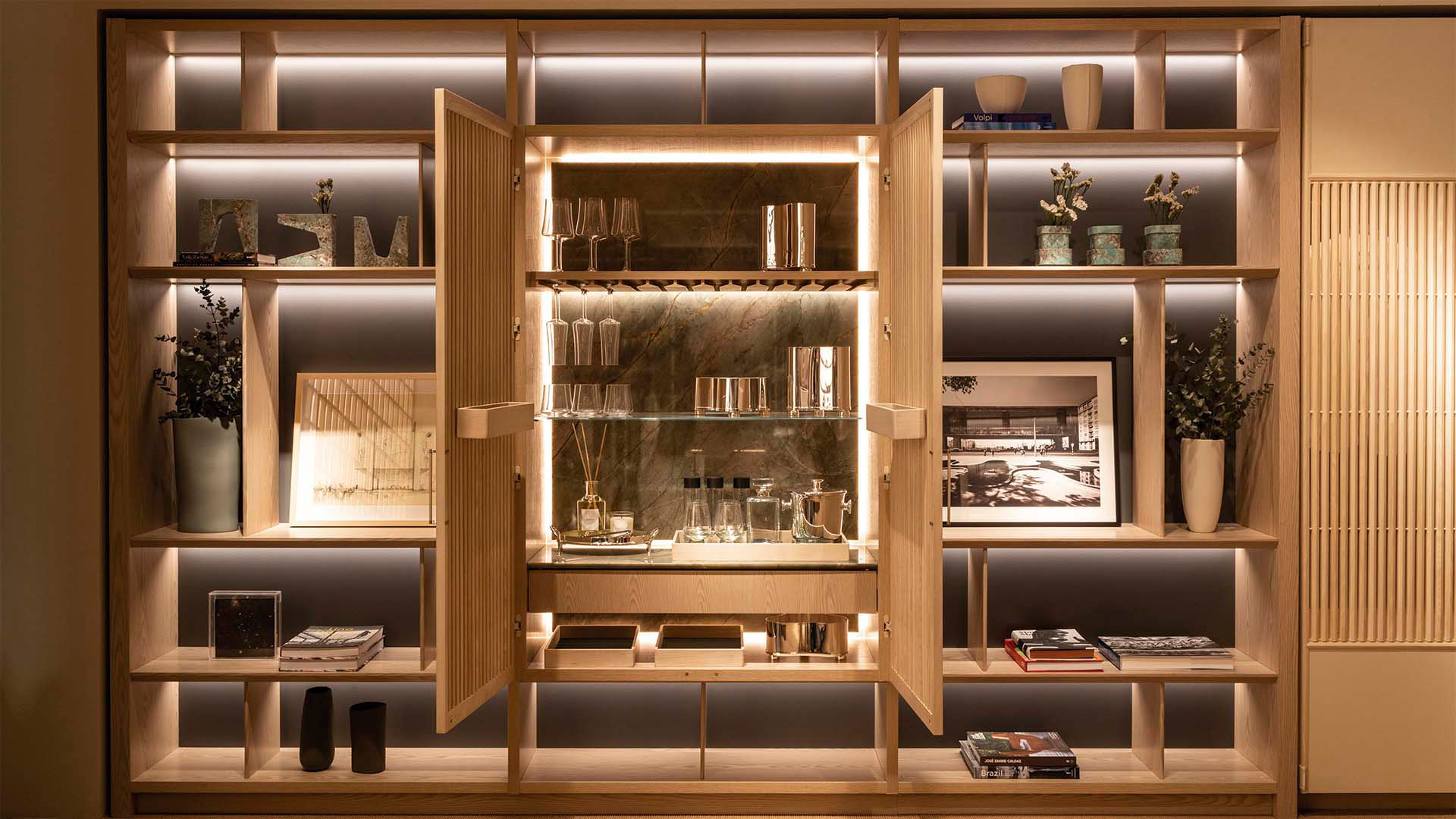
Formal dinnerware, seasonal serving pieces, and extra table linens can be stored in less accessible positions — higher shelves, deeper sections, cabinets that require a step stool or that hold items stacked in a way that requires partial unloading to reach the bottom. These items come out for occasions, not for daily use, and the inconvenience of accessing them is acceptable because it’s infrequent. In Ornare’s dining room wall systems — including the Timeless Bar and Shaker Wall Bar collections — this frequency logic is built into the configuration: the sections at accessible heights are organized for daily use, the sections at less accessible heights handle the occasion-specific storage.
Glassware storage in a dining cabinet: the three decisions that determine how it works
Glassware is the storage category that causes the most problems in dining room cabinets because it’s fragile, varied in size, and used in two distinct ways — some pieces for daily use, others for entertaining only. The three decisions that determine how well glassware storage works are: orientation (upright versus inverted), position (open shelf versus closed cabinet versus hanging rail), and organization (by type versus by frequency of use).
Upright storage — glasses standing right-side up on a shelf — is the most natural orientation but the most problematic for collecting dust inside the bowl. A glass stored upright for three weeks before a dinner party needs washing before use. Inverted storage — glasses upside down on a lined shelf — eliminates the dust problem but risks chipping the rim on a hard shelf surface. A soft liner on the shelf surface resolves this, but it’s a detail that needs to be planned for rather than improvised.
Hanging rails — mounted at the top of a glass-front cabinet section, holding stemware upside down by the base — are the most space-efficient solution for wine glasses and champagne flutes. The glass hangs with its bowl protected from dust, accessible from below with a single hand, without requiring other glasses to be moved. The rail needs to be at a height that provides at least 12 inches of clearance between the hanging glass and the shelf or counter surface below — enough that the glass can be retrieved without tilting it sideways. In an Ornare dining wall system, hanging rail sections are positioned at a height that accommodates the specific glassware in use, not at a default height that may or may not work for the actual glass dimensions.
Linen storage in a dining room cabinet: drawer depth and folding method are design decisions
Table linens in a dining storage cabinet seem like a simple storage problem — until the drawer isn’t deep enough for the tablecloth or the napkins come out of the drawer wrinkled because they were folded incorrectly for the storage configuration. Linen storage works correctly when the drawer depth matches the folded dimensions of the linen and when the folding method used is consistent with the way the linen will be retrieved.
A standard tablecloth for a 72-inch table, folded in thirds lengthwise and then in quarters, produces a rectangle approximately 18 by 24 inches. A drawer that’s 18 inches deep and 24 inches wide holds this tablecloth in a single layer — visible, retrievable without unfolding anything else, and wrinkle-free if the folding is consistent. A drawer that’s 12 inches deep requires a different folding method or different tablecloth dimensions. This is the kind of detail that gets resolved when the linen collection is inventoried before the cabinet is designed — and ignored when the inventory happens after the cabinet is installed.
How dining room storage works differently in an open plan
The dining room in most contemporary homes isn’t a separate room — it’s a zone within an open plan that includes the kitchen and often the living area. This changes the design requirements for the storage cabinet significantly. In an enclosed dining room, the storage wall is seen only from within that room, and its relationship with adjacent spaces is limited. In an open plan, the dining storage wall is visible from the kitchen, from the sofa, and from the entry — which means it has to work visually at multiple distances and from multiple angles simultaneously.
In this context, the finish of the dining storage wall needs to be chosen in relation to the kitchen cabinetry visible on the same sightline, the living room furniture visible beyond, and the overall chromatic palette of the open space. An Ornare dining wall system in a finish that coordinates with the kitchen — same lacquer color, complementary wood tones, consistent hardware — reads as part of a single designed interior rather than as storage furniture placed in a shared zone. This coordination is something that the Ornare design process addresses explicitly: in open-plan projects, the kitchen, dining, and living storage elements are specified together rather than in sequence, which is why the resulting spaces feel cohesive rather than assembled from separately selected pieces.