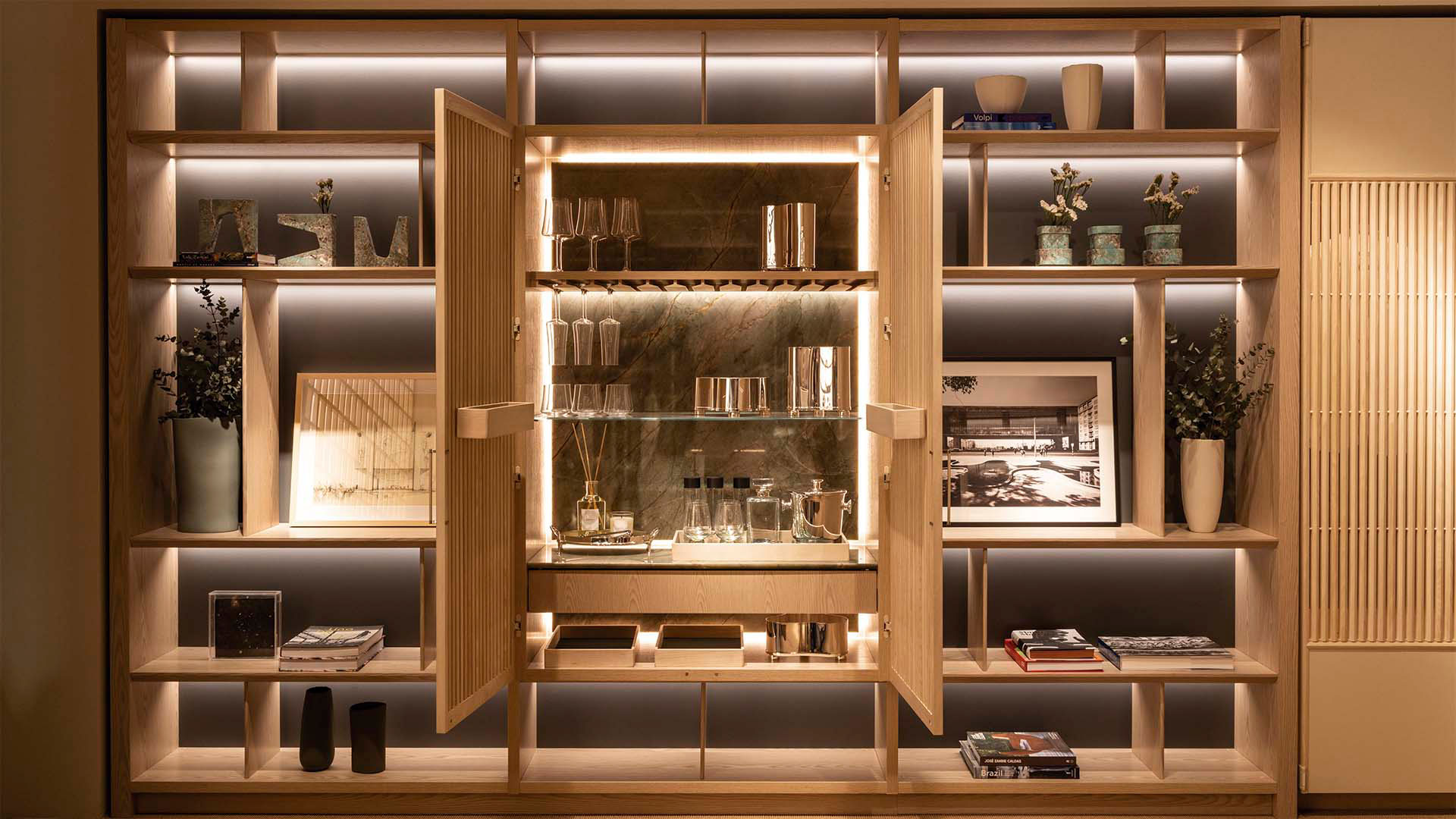
Sideboard buffet cabinet with bar: integrating wine and glassware storage
In most homes that entertain regularly, the bar situation is handled with a workaround. Bottles live on a tray on the kitchen counter. Glassware fills a cabinet that was originally intended for something else. Wine goes in a rack that was placed wherever there was floor space. None of it is wrong exactly, but none of it is designed — and in a dining room or open-plan living space where the sideboard wall is a focal point, the disconnection between the organized furniture and the improvised bar setup is visible to anyone who looks.
The solution isn’t a dedicated bar cabinet placed beside the sideboard. It’s a sideboard buffet cabinet that integrates the bar function from the start — bottles, glassware, wine, and accessories organized within the same wall system as the dining storage, at the same level of quality and with the same design coherence. Ornare’s Timeless Bar and Shaker Wall Bar collections are built specifically for this integration, and the difference between a wall system that includes the bar and one that leaves it as an afterthought is immediately visible in the finished room.
Why the bar belongs in the sideboard wall, not beside it
A freestanding bar cabinet placed adjacent to a sideboard creates a visual and functional problem. Visually, two separate pieces on the same wall read as a collection of furniture rather than a designed system — they’re the same height approximately, in finishes that roughly match, positioned near each other without a designed relationship between them. Functionally, the bar and the dining storage are related — they serve the same occasion, used by the same people for the same purpose — but they’re physically separated in a way that requires moving between two pieces during service.
Integrating the bar into the buffet sideboard wall solves both problems. The bar section is part of the same composition as the dining storage — same finishes, same proportions, designed as a whole. Functionally, wine, glasses, and serving equipment are all accessible from the same position at the wall. During a dinner party, the host doesn’t need to cross the room to retrieve a bottle — everything for the table is organized within the same wall section.
This integration is what makes the Ornare approach different from simply placing a bar cabinet in the same room as a sideboard. The system is designed as a single composition, with the bar section positioned where it makes most functional and visual sense within the overall wall, and with the internal organization of the bar section designed around the specific items — bottle heights, glass types, accessory sizes — that it will actually hold.
Organizing wine storage within a sideboard buffet: what the cabinet needs to hold
Wine storage in a sideboard buffet cabinet with bar has specific requirements that differ from general storage. Standard wine bottles are approximately 12 inches tall and 3.5 inches in diameter. A section designed for twelve bottles needs different dimensions than one designed for twenty-four, and the orientation of the storage — horizontal for wine bottles kept on their sides, vertical for spirits — determines the shelf configuration.
Horizontal wine storage — bottles on their sides — keeps the cork in contact with the wine, which is relevant for wines intended for aging. It requires racks or divided shelves that hold each bottle individually, preventing them from rolling. Vertical storage — bottles upright — is appropriate for spirits and for wines that will be consumed relatively quickly. A wall section that handles both needs separate zones: horizontal racking for wine, vertical shelving for spirits, with heights calibrated to the actual bottle sizes in each category.
The quantity of storage is a practical decision that should be made before the system is designed. A dining room in a Greenwich property that entertains twelve people regularly has different wine storage requirements than a pied-à-terre in New York used for occasional small dinners. Ornare sizes the bar section to the specific hosting patterns of the household, which means the storage quantity is adequate without being oversized — a bar section designed for forty bottles in a household that keeps eight is wasted space, and a section designed for eight in a household that regularly has twelve bottles open during a dinner party is a daily frustration.
Glassware storage in a bar sideboard: display versus protected storage
Glassware presents a choice that wine storage doesn’t: whether to display it or store it behind closed doors. Stemware on open shelves or hanging from rails is visually striking — quality glassware in a well-lit cabinet section contributes significantly to the atmosphere of a dining room — but it accumulates dust and needs washing before use even if it hasn’t been touched. Glassware behind closed doors — opaque or glass-front — stays clean and ready to use but sacrifices the display value.
Glass-front cabinet doors are the most common resolution of this trade-off in a buffet cabinet with bar. The glassware is visible — contributing its display value to the composition — and protected from dust at the same time. The type of glass matters: clear glass maximizes visibility, seeded or lightly frosted glass softens the view of the contents slightly while maintaining overall transparency and adding texture to the cabinet surface.
Hanging rails for stemware — mounted at the top of a cabinet section, allowing glasses to hang upside down by their base — are the most space-efficient solution for wine glasses and champagne flutes. An upside-down hanging glass doesn’t collect dust inside the bowl, doesn’t require washing before use, and can be retrieved with one hand without moving other glasses out of the way. The rail needs to be at a height that allows the hanging glasses to clear the shelf or work surface below by a comfortable margin — typically at least 12 inches for standard wine glasses.
Timeless Bar and Shaker Wall Bar: two collection approaches to the same integration
Ornare produces two collections that address the sideboard buffet bar integration with distinct design registers. Timeless Bar — part of the Timeless family — approaches the bar wall with settled proportions and refined finishes. The composition reads as deliberate and permanent, suited to dining rooms in homes where entertaining has a formal dimension: a primary residence in Palm Beach, a house in the Hamptons used for extended stays, a New York apartment where the dining room is used for significant occasions. The bar section within the Timeless composition includes dedicated wine storage, open shelving for display glassware, and closed lower cabinets — all within a design that doesn’t announce itself as a bar but functions as one.
Shaker Wall Bar takes a warmer approach. The panel detailing of the Shaker vocabulary — applied here with contemporary proportions and finishes rather than traditional ones — produces a bar wall that feels more casual and more residential. It suits dining areas that flow into living spaces without a sharp formal boundary, open-plan homes where the bar wall is visible from the sofa as well as from the dining table, or interiors where the design language mixes contemporary and traditional references. The Ornare showrooms in Dallas, Houston, and Washington D.C. have installations of both collections that demonstrate the difference in register at full scale — worth visiting before deciding which approach fits the specific room and the way it’s used.