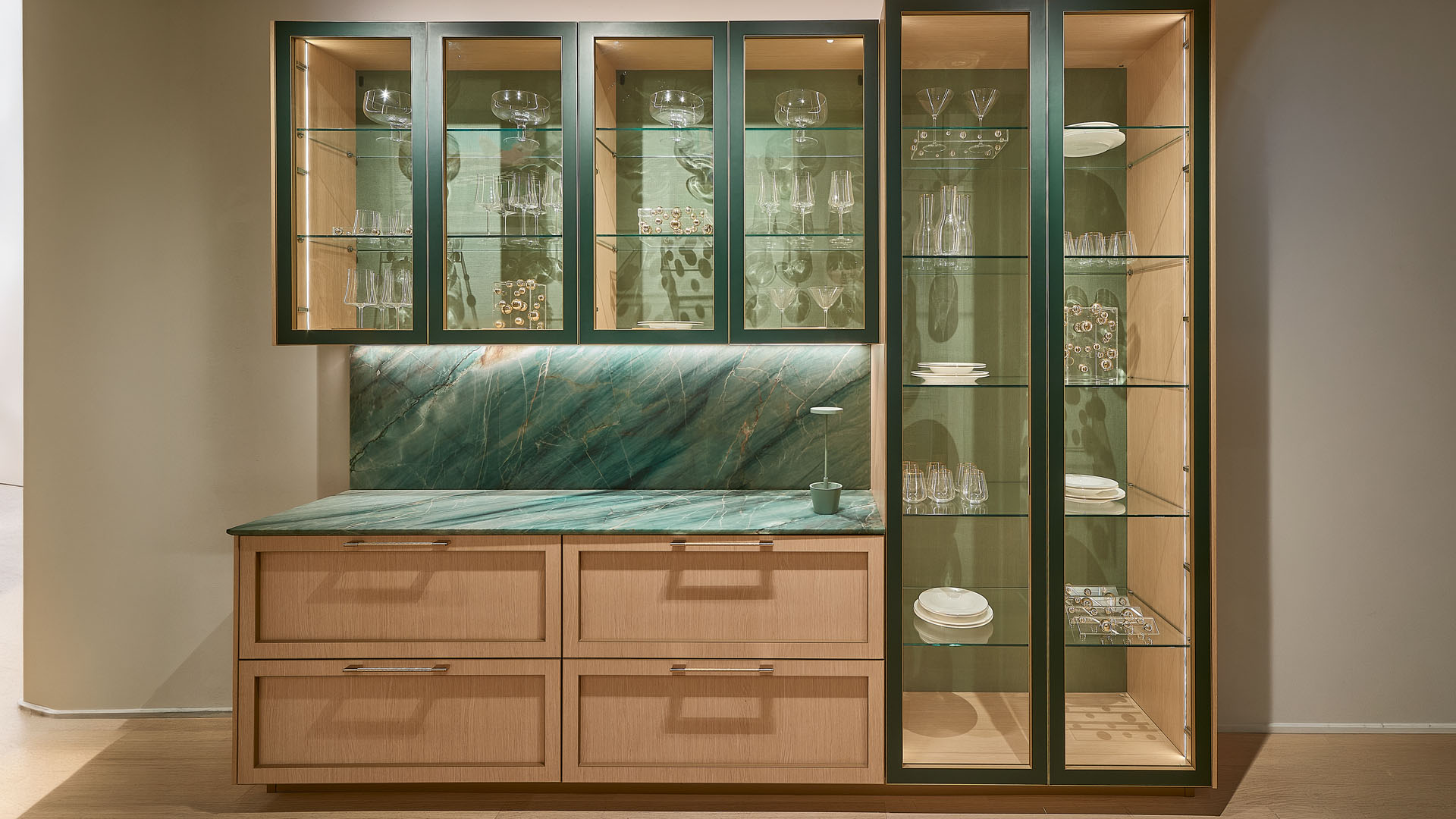
China cabinet with glass doors: display storage that protects and shows
A china cabinet with glass doors solves a problem that open shelving and closed cabinets each solve only halfway. Open shelving displays everything but protects nothing — dust accumulates on every surface, and glassware, ceramics, and serving pieces that aren’t used regularly need regular cleaning just to stay presentable. Closed cabinets protect everything but show nothing — the contents are organized but invisible, and the decorative value of quality tableware, collected objects, or fine glassware is completely lost behind an opaque door.
Glass doors split the difference: the contents are visible, the display value is preserved, and dust stays on the outside of the glass rather than settling on every shelf. This is why glass-door cabinets have been the standard solution for displaying tableware and collectibles for generations — and why the principle still works in contemporary interiors when it’s executed with materials and proportions that belong to the room.
What glass door cabinets actually protect — and what they don’t
The protection that a china cabinet with glass doors provides is specific and worth understanding before designing a storage system around it. Glass doors keep dust off the contents — which is their primary functional advantage over open shelving. In a dining room or living room that gets regular use, dust accumulation on open shelves is a real maintenance burden. Glassware that’s displayed openly needs washing before every use even if it hasn’t been touched. A glass-door cabinet eliminates this: the glass keeps the interior clean, and items stored inside are ready to use without preparation.
What glass doors don’t protect against is humidity variation, temperature swings, or light exposure. In coastal homes in the Hamptons or Palm Beach where humidity levels are consistently higher than in inland properties, items stored behind glass are protected from dust but not from the ambient humidity of the room. For most tableware and decorative objects this isn’t a concern — ceramics, glassware, and silver aren’t meaningfully affected by typical residential humidity levels. For wooden objects, paper, or items with particular sensitivity to humidity, a glass-door cabinet provides the same environmental exposure as open shelving.
Glass types for display cabinets: clear, seeded, and frosted compared
The choice of glass in a china cabinet determines how visible the contents are and how much the glass itself contributes to the visual composition of the cabinet. Clear glass is the most transparent — the contents read exactly as they would on an open shelf, with the glass adding only a slight reflective quality that can actually enhance the display by catching light. It’s the right choice when the contents are genuinely display-worthy and the goal is maximum visibility.
Seeded glass — which has small air bubbles distributed through it — softens the view of the contents slightly while maintaining the overall silhouette and color. The glass itself has a visual texture that contributes to the composition independent of what’s stored behind it. It works well when the contents are less uniformly curated — some items worth displaying prominently, others more utility than decoration — because the slight obscuring effect reduces the visual noise of mixed contents.
Frosted or acid-etched glass obscures the contents to silhouette only. The display function is reduced — specific items aren’t identifiable — but the light-filtering quality of the glass remains, and the cabinet can be used for storage that benefits from protection without requiring full display visibility. This option integrates well into wall systems where the glass-door section is adjacent to fully closed sections, because the frosted glass creates a visual intermediate between transparency and opacity that can unify the composition.
Ornare’s wall systems — including Wall System Living and Timeless Bookshelf — incorporate glass door sections in all three types, with the glass selection made as part of the design process rather than as an afterthought. The showrooms in New York and Miami both have installations with different glass types visible in real light conditions, which is how the difference between clear and seeded glass is most accurately evaluated before a decision is made.
Integrating glass door storage into a wall system: proportions and placement
A china cabinet with glass doors functions differently when it’s part of a wall system than when it’s a freestanding piece. As a freestanding piece, the cabinet has its own proportions, its own base, its own relationship with the floor — and it sits against a wall that wasn’t designed to receive it. As a section within a wall system, the glass-door portion is one element in a larger composition, and its proportions are determined by the wall and by what surrounds it.
The placement of glass-door sections within a wall system follows visual logic. Eye-level sections — between roughly 48 and 72 inches from the floor — are the most effective position for display: the contents are visible without looking up or crouching. Lower sections, closer to floor level, work better as closed cabinets because the downward angle makes display less effective. Upper sections, above eye level, can be glass-front but work better when the contents are less detailed — the display value of fine glassware above 72 inches is limited because the viewing angle is poor.
The ratio of glass-door sections to closed sections is a design decision that depends on how much of the storage is genuinely display-worthy versus functional. A dining room wall that includes quality tableware worth showing, a bar section with glassware, and closed storage for linens and serving equipment might have glass sections in the center where the most curated items live, with closed sections on the sides where the functional storage is handled. This kind of composition — designed around what it holds — is what Ornare’s consultants work through with clients at the Dallas, Houston, Greenwich, and Washington D.C. showrooms before any production decisions are made.
Hardware, lighting, and finish: the details that make glass-door storage a design feature
The visual success of a glass-door cabinet section depends on details that are easy to overlook in the planning phase. The hardware on the glass doors — the pulls, the hinges — needs to be proportioned to the door size and to coordinate with the hardware elsewhere in the wall system. A glass door with hardware that’s mismatched in scale or finish to the adjacent closed doors reads as inconsistently designed, and inconsistency in a wall system is more visible than in individual pieces of furniture because the system invites direct comparison between elements.
Integrated lighting inside the glass-door section transforms it from daytime storage to a nighttime feature. LED strips mounted at the top of the section, inside the cabinet, illuminate the contents from above — creating the pool of warm light that makes glassware and ceramics genuinely luminous in the evening. This effect requires planning before installation: the electrical routing for the LED strips needs to be part of the production specification, not something added afterward. For anyone designing a dining room or living room wall in Palm Beach, the Hamptons, or New Jersey where evening entertaining is a consistent part of how the house is used, specifying the lighting at the design stage rather than as an afterthought is one of the decisions that most consistently produces the result people are actually imagining.