Bookcase ideas: how to turn a wall into a designed system
Most living rooms have at least one wall that isn’t doing enough. It holds a sofa on one side, maybe a piece of art, and then — nothing. The wall exists but doesn’t contribute to the room. The most effective bookcase idea for this kind of space isn’t a freestanding unit pushed against it. It’s a system designed for that specific wall, built to its exact dimensions, configured to handle the actual mix of books, objects, and storage the room requires. That’s the difference between a bookcase and a wall system — and it’s visible from across the room.
Ornare’s Bookshelves & Multimedia collections are built on this premise. Every system starts with the wall, not with a catalog of standard modules. The result is a bookcase that fills the space it was designed for — no filler strips, no awkward gaps, no shelves that end six inches short of the corner.
Bookcase ideas for large walls: how to scale the system to the room
The most common mistake with a large wall is under-scaling the bookcase. A single unit centered on a twelve-foot wall leaves the surrounding space unresolved — the bookcase looks placed rather than designed. The wall reads as too big for the furniture, and no amount of styling on the shelves fixes that imbalance.
A wall-to-wall bookcase system solves the scale problem by treating the entire wall as the unit of design. When shelving runs from one side of the room to the other — and from floor to ceiling — the proportional relationship between the bookcase and the room shifts entirely. The wall becomes a composition. The eye moves across the surface as a whole rather than registering individual pieces and the spaces between them. In rooms in Dallas, Houston, or Los Angeles where living rooms frequently have generous square footage and ceiling heights above nine feet, this approach produces results that no freestanding bookcase can replicate.
Bookcase ideas by collection: six systems that each solve the problem differently
Ornare’s bookcase catalog isn’t variations on one design — it’s six genuinely different answers to what a living room bookcase should do. Square Wall creates a three-dimensional surface through modules of varying depths, producing shadows and relief that change as light moves through the room. It’s the most architectural option: a bookcase that reads as a wall treatment as much as storage. Ikigai Bookshelf works from the opposite premise — an exposed metal frame that filters the wall rather than covering it, keeping the space behind the shelves visible and the room feeling open.
Timeless Bookshelf is for rooms that call for permanence. The proportions are settled, the finishes communicate quality without announcing it, and the result looks like it was always there. Wall System Living is the most configurable: open shelving, closed cabinets, display niches, bar sections, and media components can all be combined in whatever proportion the room requires. Shaker Wall Bar and Timeless Bar integrate the bar function directly into the bookcase wall — bottles, glassware, and bar accessories organized within the same system as books and objects, rather than in a separate piece of furniture nearby.
Bookcase ideas for open and closed storage: getting the ratio right
Every bookcase idea involves a fundamental decision about the ratio of open shelving to closed storage — and this decision has more impact on how the bookcase looks and functions than any material or finish choice. Too much open shelving requires permanent curation: everything on every shelf is always visible, and the bookcase only looks good when every object is worth showing. Too many closed cabinets produces a wall of opaque fronts that contributes little visually to the room.
The most functional and visually interesting configurations combine both. Open sections at eye level for books and selected objects. Closed lower cabinets for items that don’t benefit from visibility — equipment, files, cables, the miscellaneous objects that accumulate in any living room. Display niches with integrated lighting for pieces that deserve to be seen. The proportions between these zones are determined by the specific room and the specific collection it needs to house — which is why Ornare designs every system to the client’s actual requirements rather than offering preset configurations. Visiting the Ornare showroom in New York at the A&D Building on East 58th Street, or the Miami Design District location, is the most effective way to evaluate different open-to-closed ratios at full scale before committing to one.
Bookcase ideas for finish and lighting: what makes the wall work after dark
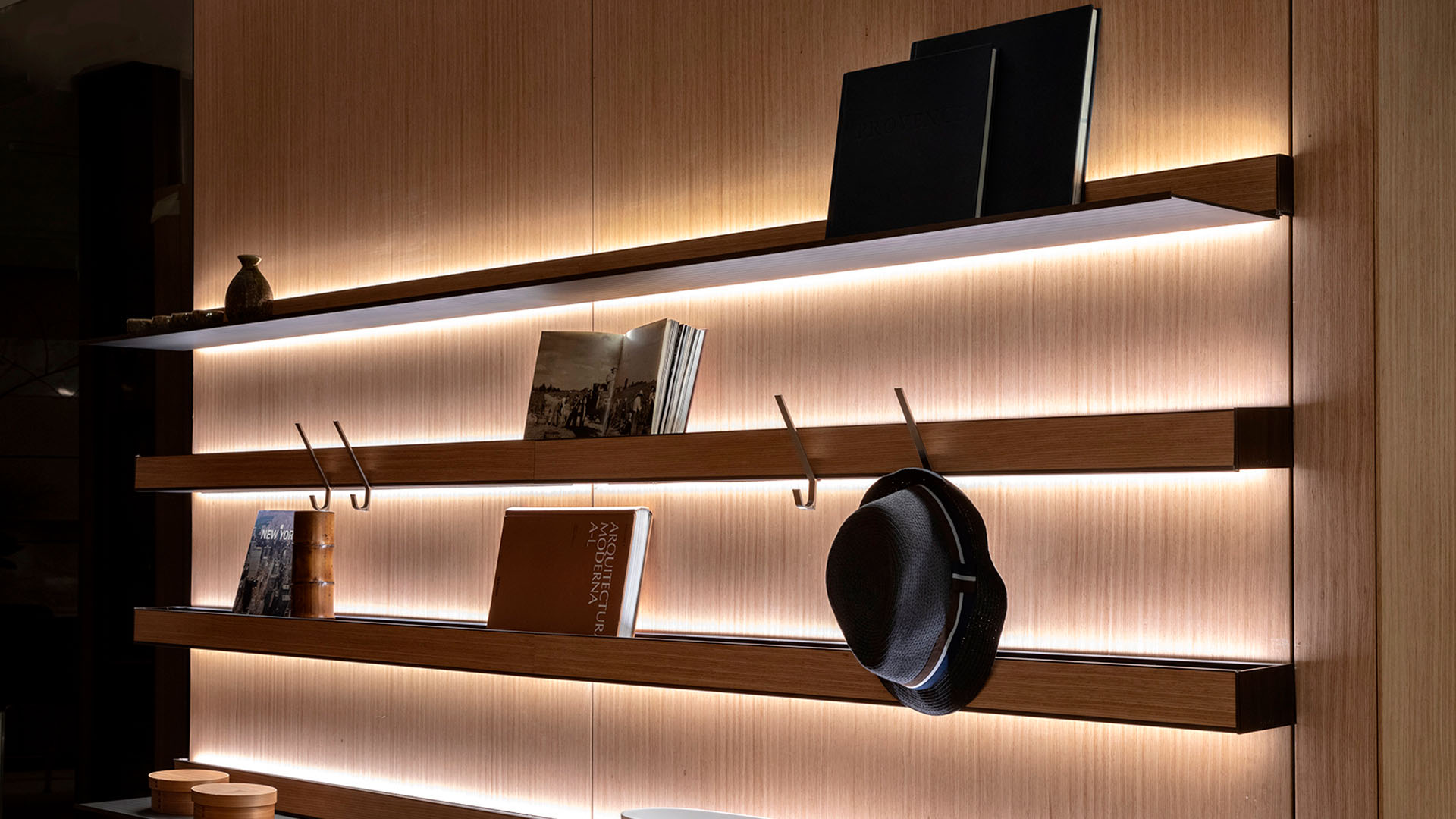
During the day, a bookcase wall is largely about the books and objects it holds. After dark, when artificial light takes over, the finish and the lighting become the dominant visual elements. A matte lacquered bookcase in a warm neutral creates a recessive architectural surface — the wall disappears and the objects come forward. A natural wood veneer bookcase catches evening light differently across its grain, giving the wall a depth and warmth that flat color can’t produce.
Integrated LED lighting shifts the equation further. Strips positioned under shelves or within open sections illuminate books and objects from above, creating pools of warm light that make the wall glow in a way that overhead fixtures can’t replicate. Ornare builds lighting into its bookcase systems as part of the design — not as an afterthought — which means the electrical planning happens before installation rather than after. For anyone designing a living room in Greenwich, the Hamptons, or Washington D.C. where the evening atmosphere of the space matters as much as its daytime character, specifying the lighting alongside the bookcase is one of the decisions that most consistently separates good results from great ones.