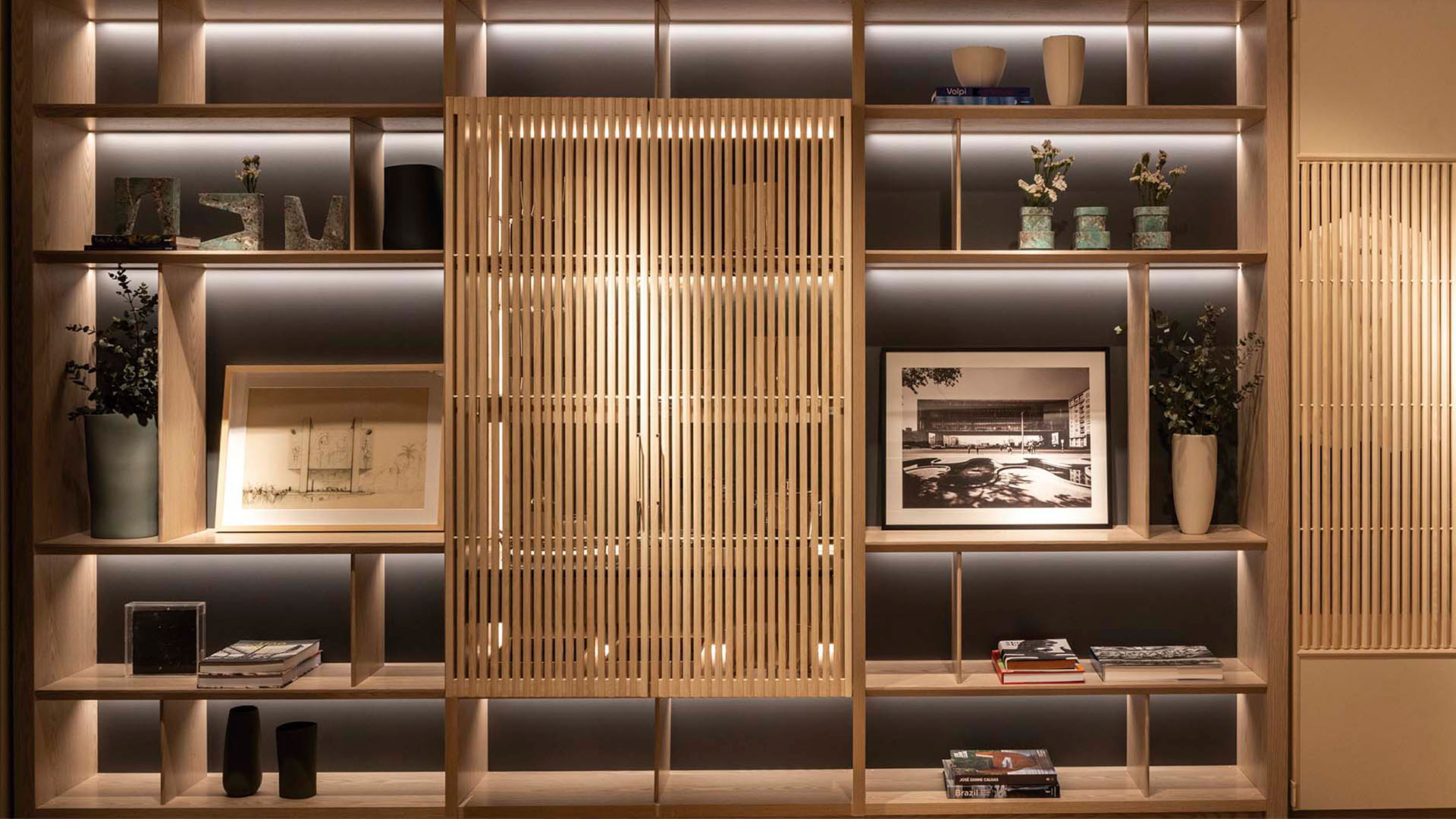
Bar cabinet ideas: how to integrate the bar into your living room wall
The bar cart problem is one that most well-designed living rooms eventually face. The cart works — it holds bottles, it moves around, it’s easy to access — but it looks like what it is: a workaround. It sits in the corner of the room or against a wall that wasn’t designed to receive it, and it never quite belongs to the space. The alternative that most people land on next is a freestanding bar cabinet — a dedicated piece of furniture for bottles and glassware. Better than the cart, but still a standalone unit that ends where it ends, leaving the wall on either side unresolved.
The approach that actually solves the problem is integrating the bar function directly into the living room wall system. Not a cabinet placed against a wall, but a section within a designed wall composition that handles bottles, glassware, and bar accessories alongside books, objects, and closed storage — all in one continuous system.
Why a wall-integrated bar cabinet outperforms a standalone piece
A freestanding bar cabinet, however well designed, has a built-in limitation: it stops. The wall continues on both sides, and whatever fills those flanking sections has to work alongside the cabinet instead of with it. In a room where the bar wall is the focal point — which describes most living rooms where entertaining happens — this creates a compositional problem that styling alone can’t fix.
A bar section integrated into a wall system doesn’t have this problem. It’s part of a larger composition that runs from wall to wall, potentially floor to ceiling, with the bar section positioned where it makes most functional and visual sense. The transition between the bar section and adjacent shelving or closed storage is resolved as a design decision — not a junction between two separate pieces of furniture. In homes in the Hamptons, Palm Beach, or Greenwich where entertaining is a consistent part of how the house is used, this integration is often the detail that separates a room that feels designed from one that feels assembled.
Ornare bar cabinet collections: Timeless Bar and Shaker Wall Bar
Ornare produces two collections specifically designed to integrate the bar function into a living room wall system. They share the same design logic — bar storage as architecture rather than furniture — but produce different results in terms of aesthetic register.
Timeless Bar is the more formal of the two. The proportions are settled and deliberate, the finishes communicate permanence, and the result reads as a feature of the room rather than an addition to it. It suits living rooms with high ceilings, significant square footage, and an overall design language that tends toward the refined. The bar section can include dedicated bottle storage, open shelving for glassware, a work surface for mixing, and closed cabinets for spirits and accessories — all within a system that coordinates with adjacent bookshelf or display sections in the same finishes.
Shaker Wall Bar works through a different vocabulary. The panel detailing references a craft tradition without reproducing it literally, producing a wall bar that feels warm and material-rich rather than formal. It integrates naturally into rooms that mix contemporary and traditional elements — a common design situation in homes in New York’s Upper East Side, in Connecticut, or in established neighborhoods in Dallas and Houston where the architecture itself has period references that the interior echoes. The bar function is handled with the same level of organization as Timeless Bar, but the overall effect is less institutional and more livable.
What a wall bar cabinet needs to hold: organizing bottles, glassware and accessories
The functional requirements of a bar cabinet are more specific than they first appear, and getting the interior organization right before the system is built is the detail that determines whether it actually works in daily use. Bottles vary significantly in height — standard wine bottles are about twelve inches tall, spirits bottles range from twelve to eighteen inches, large-format bottles can exceed twenty inches. A bar section with a fixed shelf height that accommodates standard bottles will be incompatible with anything taller. Adjustable shelving within the bar section solves this, but it has to be specified before production.
Glassware needs a different kind of storage than bottles. Stemware — wine glasses, champagne flutes — is fragile and benefits from dedicated hanging rails or from closed cabinets that protect the glasses from dust without requiring individual retrieval from stacks. Short glasses — rocks glasses, highballs — can be stored on open shelving where they’re visually accessible and easily reached. A well-organized bar wall cabinet typically separates these two categories — stemware handled one way, short glasses another — which requires that the interior configuration is designed around the actual glassware collection before the system is ordered.
Bar cabinet placement in the living room wall: where it works and where it doesn’t
The position of the bar section within a wall system matters for both function and visual balance. A bar section centered on the wall creates a symmetrical composition — appropriate in formal living rooms where the bar is the focal point of the wall. A bar section positioned to one side of a larger composition — flanked by bookshelf sections on the other — creates an asymmetrical arrangement that feels more casual and more contemporary.
What doesn’t work is a bar section positioned at the extreme edge of a wall composition, where it reads as an afterthought rather than a design decision. In Ornare’s wall systems, the position of the bar section is determined during the design phase, in relation to the overall proportions of the wall and the room. The Ornare showrooms in Los Angeles and Miami are both set up with wall installations that demonstrate different bar section configurations within larger compositions — useful reference points for anyone deciding where the bar makes most sense in their specific room before committing to a layout.