Accent cabinet design: what makes a storage piece worth looking at
Most storage pieces in a living room are invisible in the worst sense — they’re present, they hold things, and they contribute nothing to the room visually. An accent cabinet is storage that earns its place by doing something aesthetically, not just functionally. It can be a piece with a material that commands attention, a composition that defines a wall, or a design that creates a focal point where the room previously had none. The distinction between storage that happens to be in a room and storage that makes the room better isn’t about cost — it’s about whether the piece was designed with the room in mind or placed in it as a solution to a storage problem.
Understanding what makes an accent cabinet worth looking at requires thinking about the specific decisions — material, proportion, finish, placement — that determine whether a piece reads as designed or as incidental.
Material as the primary design statement in an accent cabinet
The material of an accent cabinet does more work than any other design element because it determines how the piece reads from across the room. A cabinet in natural wood veneer — particularly in a species with a strong grain like walnut or figured oak — has visual presence at a distance that a lacquered piece in a neutral color doesn’t. The grain catches light differently at different times of day, the surface has depth that flat color can’t replicate, and the material itself communicates quality in a way that’s legible even to someone who doesn’t consciously notice it.
Ornare’s Bookshelves & Multimedia collections work with natural wood veneer at a level of selection that most cabinetry doesn’t reach. Veneer is chosen for grain consistency across adjacent panels — so the surface of the cabinet reads as a continuous composition rather than a collection of panels that happen to be adjacent. In a room in Dallas or Houston where a living room wall needs to function as the primary design feature of the space, this level of material selection is the difference between an accent cabinet that looks considered and one that looks like a good-quality piece of furniture.
Lacquered finishes produce a different kind of presence — more controlled, more architectural. A lacquered cabinet in a deep color — a saturated green, a dark blue, a near-black — reads as a deliberate design decision in a way that a neutral lacquer doesn’t. The color choice positions the cabinet as an element that was selected for that specific room, not interchangeable with something else that would work equally well. When the color is chosen in relation to other elements in the room — the upholstery, the wall paint, the rug — the cabinet starts to feel like part of a designed interior rather than a piece of furniture placed in a room.
Proportion and scale: how the relationship between cabinet and wall determines visual impact
An accent cabinet that’s the wrong scale for its wall reads as undersized or awkward, regardless of how well it’s made or what it’s made from. A low cabinet against a tall wall with nothing above it leaves the wall unresolved — the eye moves to the gap between the cabinet top and the ceiling and stays there, because that gap is the most prominent visual element in the composition. A full-height cabinet on a wall that’s too narrow for it dominates the space in a way that’s oppressive rather than impactful.
The most effective accent cabinets occupy the wall they’re on with enough presence to anchor it without overwhelming it. This usually means extending to or near the ceiling — removing the gap that draws the eye upward — and spanning a meaningful portion of the wall width. In Ornare’s wall systems, the configuration of a storage wall is determined by the specific wall dimensions and the room’s proportions, not by what fits neatly into a standard module. Square Wall, for example, produces a composition that occupies the full wall with a three-dimensional surface — modules of varying depths that create relief and shadow — and the visual weight of that composition is calibrated to the room during the design process. Visiting the Ornare showroom in Miami or Los Angeles is the most direct way to evaluate how different configurations read at full scale before deciding on proportions.
The role of the display zone: why accent cabinets need open sections
A storage cabinet becomes an accent cabinet partly through what it shows as well as what it hides. A composition that’s entirely closed — all opaque doors — reads as storage, not as a designed piece. A composition that includes open sections — for books, objects, or curated display items — reads as a designed wall. The display zone is what makes the cabinet visually legible as a piece of design rather than a piece of utility.
The ratio of open to closed storage in an accent cabinet is a design decision that should be driven by what’s worth showing and what isn’t. A living room wall that holds a curated collection of books, some collected objects, and a bar section has different open-to-closed requirements than one that holds mostly items that don’t benefit from visibility. Ornare’s Wall System Living addresses this directly — the system can be configured with open shelving, closed cabinets, glass-front display sections, and bar elements in whatever proportion the room and the collection require. The display sections are positioned where they’ll be most visible and most effective, not at default locations in a preset configuration.
Hardware, lighting, and finish coordination: the details that complete an accent cabinet
The hardware on an accent cabinet — the pulls, the hinges, the push-to-open mechanisms — is one of the last design decisions and one of the most visible. A cabinet with well-proportioned hardware in a finish that coordinates with other metal elements in the room reads as considered. A cabinet with hardware that’s slightly too large, or in a finish that creates an unintended contrast with the fittings elsewhere in the room, reads as assembled from components rather than designed as a whole.
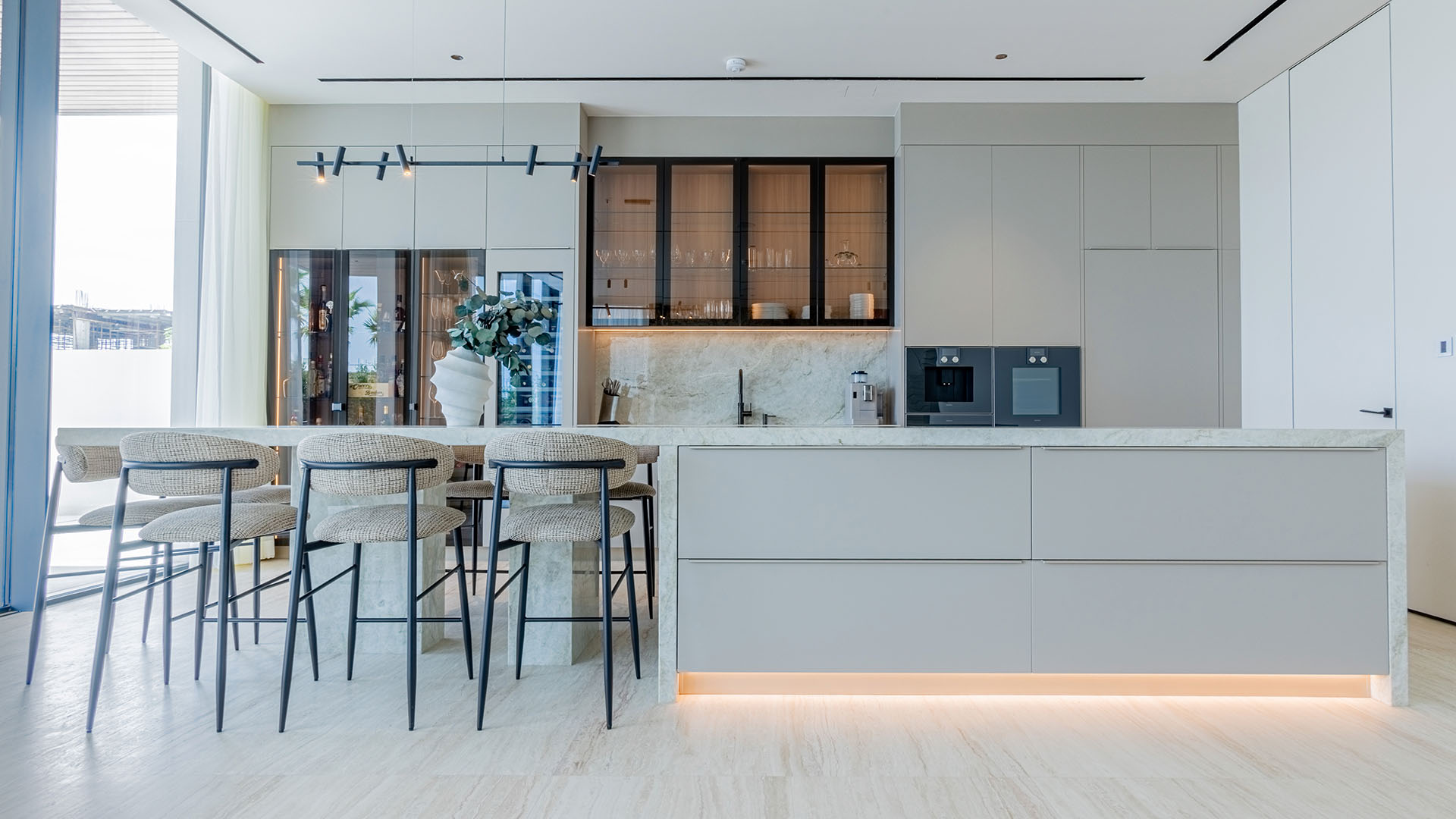
Integrated lighting is the element that most consistently elevates an accent cabinet from a daytime storage piece to a room feature that works equally well at night. LED strips positioned inside open sections or under shelves illuminate books and objects from above, creating pools of warm light that make the wall glow in a way that overhead fixtures can’t replicate. The cabinet becomes a light source as well as a storage surface — which changes the atmosphere of the room in the evening significantly. For anyone in Greenwich, the Hamptons, Palm Beach, or New Jersey where the living room is used primarily in the evening during the week, specifying lighting as part of the cabinet design rather than adding it afterward is one of the decisions with the highest return on attention.