Arched cabinet: how curved silhouettes are changing contemporary storage design
In the United States, “arched cabinet” is searched close to 15,000 times a month, a volume that puts it alongside long-established storage categories. The number reflects something visible in contemporary interiors: after years of strictly rectangular cabinetry, curves are coming back into storage design. An arched cabinet, with a rounded top, arched doors or a curved glass front, softens a room full of straight lines and gives storage the presence of an architectural element. Used well, it becomes a focal point; used carelessly, it looks like a trend piece. The difference lies in proportion, material and placement.
Why the arched cabinet is showing up in contemporary interiors
The appeal of the arch is partly architectural. Arched doorways, windows and niches have always signaled craftsmanship, and bringing that shape into cabinetry gives it the same weight. In a room with flat ceilings, straight walls and rectangular sofas, a single curved form creates contrast without adding ornament.
There is also a practical side. Rounded tops and softened corners remove sharp edges at eye level, which makes tall storage feel less imposing, especially in smaller rooms. In open-plan homes, where long rows of rectangular cabinetry can feel repetitive, one arched element breaks the rhythm and helps define a zone, such as a dining corner or a reading area, without walls.
Types of arched cabinets and what each one does
Not every curved cabinet is the same. The arch can shape the whole silhouette, only the doors or only the openings inside a larger wall, and each approach creates a different effect.
Tall arched cabinet with glass doors
A tall arched cabinet with a rounded top and glass doors is the most recognizable version. It works as a vitrine for glassware, ceramics or books, and the curve frames the contents like a window. Interior lighting along the arch makes it a strong evening feature.
Arched niches within a built-in wall
In a custom wall unit, the arch can appear as niches cut into an otherwise rectangular composition, for example an arched bookcase cabinet section on each side of a fireplace or a TV. The structure stays efficient, while the curves give the wall a softer, more architectural look.
Low cabinets with rounded corners and curved fronts
On sideboards and low storage, the curve often appears as rounded corners or a gently curved front. It’s a subtler expression of the same idea, suited to rooms where a tall arch would be too dominant. It also works well in high-traffic areas, where rounded corners are kinder to hips and knees, and in rooms with other curved elements, such as a round dining table or a sofa with soft arms, where the cabinet continues the same visual language at a lower height.
Where an arched cabinet works best in the house
The dining room is the natural home of the arched china cabinet, where glass doors and an arched top display serving pieces and stemware while echoing the curves of a round or oval table. In the living room, a pair of arched cabinets on either side of a fireplace or media wall creates symmetry and frames the center of the room. In entries and hallways, a single arched piece at the end of a corridor gives the eye a destination. In bathrooms, an arched mirror cabinet or a curved tall unit softens a space usually dominated by tiles and straight lines.
The common rule is restraint. One or two arched elements per room are enough. When every cabinet, mirror and doorway is arched, the curve stops being a detail and starts to feel themed.
Proportions and materials for curved storage
For curved storage to look intentional, the arch has to match the proportions of the piece. A semicircular arch has a radius equal to half the width of the cabinet, so on a 36-inch-wide cabinet the curve rises 18 inches. On tall pieces, around 72 to 84 inches high and 30 to 40 inches wide, a full semicircle works well; on wider, lower pieces, a flatter segmental arch usually looks better. As a general guide, a tall arched cabinet should be at least twice as high as it is wide.
Materials change the cost and the result. Curved doors require bent lamination, shaped solid wood or curved glass, all of which take more time and skill than flat panels, so it’s common to keep the arch at the top and the rest of the doors straight. Lacquer gives the most seamless curves; wood veneer emphasizes the grain as it follows the arc; glass makes the arch read as a window. Lighting completes the effect, and an LED strip that follows the inner edge of the arch is far more effective than a single spot at the top.
How curves appear in Ornare’s collections
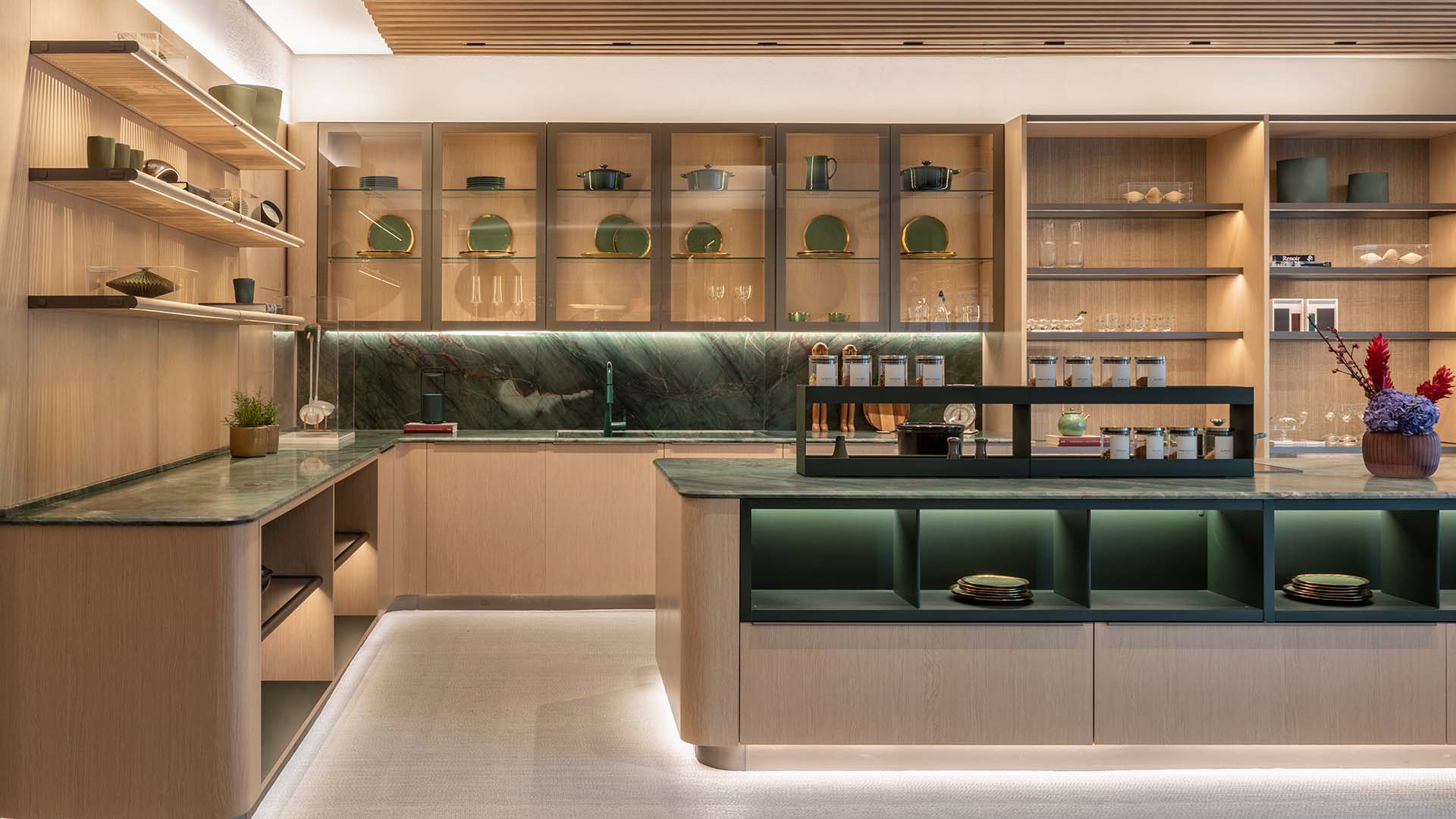
Ornare designs each piece to measure, which makes it possible to introduce curves exactly where a room needs them, from a single cabinet to a full wall. The clearest expression of this language in its catalog is the Round line, inspired by the golden ratio: its curved details and rounded corners soften the straight lines of cabinetry, and the line extends beyond kitchens to walk-in closets, bathroom cabinetry and standalone pieces that can be arranged freely in a space.
For display pieces, two other collections are relevant. Ornare’s Colette collection includes doors with carved frames inspired by French boiseries and a crystal cabinet with interior lighting for porcelain and collectibles, a classic contemporary answer for a dining room. Crystal Case, made with glass and aluminum profiles, shelves with integrated lighting and concealed hinges, offers a lighter, showcase-style alternative.
One mistake is common with tall arched pieces: placing them too close to the ceiling. If the top of the arch nearly touches the ceiling, the curve gets lost and the cabinet looks squeezed into the room. Leaving at least 12 inches between the top of the arch and the ceiling lets the shape read clearly, and in rooms with ceilings below 9 feet, a lower, wider arch is usually the better choice.