Modern bookshelf for home office: storage that works for books and work tools
A home office bookshelf has two jobs that a living room bookshelf doesn’t: it has to look good on camera and function as a working system simultaneously. The books arranged behind someone on a video call are visible to every person in every meeting. The cables running from the monitor to the equipment stored on the lower shelves are not visible on camera but affect whether the office functions without friction every day. A modern bookshelf for a home office has to solve both problems — the visual and the functional — without sacrificing either for the other.
Most standard shelving systems solve one and compromise on the other. Open shelving looks good on camera but provides no cable management and no closed storage for equipment that shouldn’t be visible. Closed cabinets handle the functional requirements but eliminate the visual backdrop that makes a home office look like a professional environment rather than a room with furniture in it. The solution, in almost every home office that works well on both dimensions, is a wall system that combines both — with the proportions and placement of open versus closed sections determined by the specific demands of that room.
The video call problem: what the camera sees and what it doesn’t
In a home office where video calls are a daily or near-daily occurrence, the wall behind the desk is a designed element whether it’s treated as one or not. A wall with a random assortment of shelving, mixed objects, and visible cables communicates something to whoever is on the other end of the call — and what it communicates isn’t professionalism or design intention.
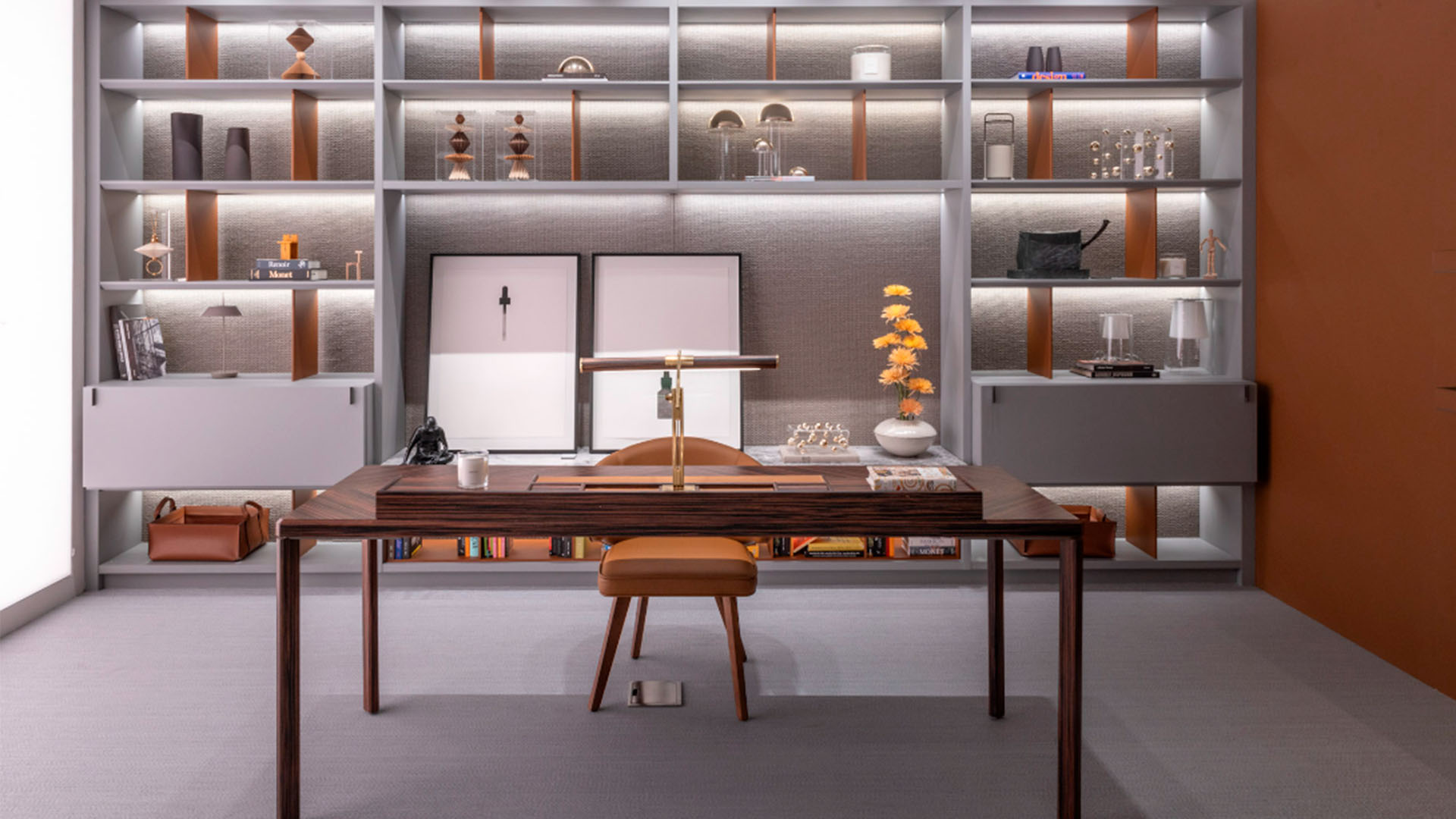
A modern bookshelf wall behind a desk — with books organized by height or color, selected objects at eye level, and closed storage below the camera’s field of view — communicates the opposite. The specific design of the bookshelf matters less than the coherence: a wall that reads as intentional, where the elements relate to each other and the whole reads as designed rather than accumulated, works on camera regardless of the specific collection or finish.
The camera angle determines which sections of the bookshelf are visible. A standard laptop camera positioned at desk height sees approximately the upper two-thirds of the bookshelf wall — from roughly 30 inches above the floor to the ceiling. Everything below 30 inches is below camera frame. This means the lower section of the bookshelf, which is the natural location for equipment, cables, printers, and files, can be designed entirely for function — closed doors, cable management, equipment depth — without affecting the visual backdrop. The upper section, which is in frame, can be designed for appearance while maintaining functional shelving capacity.
Shelf configuration for a working bookshelf: books, files, and equipment in the right zones
A home office bookshelf typically needs to handle three categories of content that have different storage requirements: reference books and professional literature, active files and binders, and equipment including monitors, printers, speakers, and charging stations.
Books are the most straightforward: standard shelves at 10 to 12 inches deep and 12 to 14 inches tall handle most professional libraries adequately. Large-format reference books — architecture, engineering, legal — may require shelves up to 14 inches deep and 16 inches tall. Organizing reference books in the upper sections of the bookshelf puts them in camera view and at a height that makes them easy to retrieve while seated.
Active files and binders require a different shelf configuration. Standard ring binders are typically 3 inches wide, 12 inches tall, and 11 inches deep. A shelf section designed for binders needs at least 12 inches of clear height and 11 inches of depth — which can be designed to match standard book shelf dimensions, simplifying the overall configuration. Binders benefit from being at or slightly below desk height, where they’re easily reached without standing. Positioning them in the lower-middle section of the bookshelf wall — below camera frame but above floor level — places them in the most ergonomically accessible zone.
Equipment is the most variable category and the one that most commonly causes problems in home office bookshelf design. A standard desktop printer is 16 to 18 inches deep — deeper than any standard book shelf — and needs to be accessible from the front for paper loading and output. A section designed for printer storage needs to be at least 18 inches deep and positioned at a height that allows comfortable access without crouching. This section is almost always below camera frame, which means it can be behind a closed door without affecting the visual backdrop.
Cable management in a modern home office bookshelf: the detail that makes the visible part work
The visible portion of a home office bookshelf looks organized only if the cable situation behind the scenes is also organized. Cables running visibly up from the desk to the equipment stored on shelves, or across the surface of shelves to reach outlets, undermine the visual coherence of even the best-designed bookshelf. Cable management in a shelving system requires planning before the system is built, not after.
Ornare builds cable management provisions into its wall systems as part of the design — not as an afterthought. This means pass-throughs between shelf sections for cables to run vertically without being visible from the front, dedicated cable management channels within closed lower sections, and positioning of electrical outlets within the cabinet structure rather than on the exterior wall. The Timeless Edge Desk component — a seated work surface designed to integrate directly into the Timeless system — incorporates cable management as part of its specification, which is why it’s a natural fit for home offices where the desk and the bookshelf wall are being designed together.
Finish and lighting in a home office bookshelf: the visual decisions that affect daily performance
The finish of a modern home office bookshelf affects not just how the room looks in person but how it reads on camera, under different lighting conditions, at different times of day. Matte finishes are more forgiving on camera than gloss — they don’t create reflections that appear as hot spots in the video frame. Natural wood veneer reads warmly on camera without requiring careful lighting to look intentional. Highly saturated colors in the camera’s field of view can affect the white balance of the video feed, which is a technical consideration that most people don’t think about until it’s already causing a problem.
Integrated lighting in the bookshelf — LED strips positioned under shelves or within open sections — serves a double function in a home office. It illuminates the shelf contents for practical use, and it provides fill light that improves the quality of the video image from the camera’s perspective. A bookshelf wall with integrated lighting behind the seated person at a desk creates a more evenly lit frame than a wall with no lighting of its own. For anyone in New York, Washington D.C., or Los Angeles where professional video presence is a consistent requirement of daily work, treating the bookshelf lighting as part of the lighting design of the home office — rather than as a decorative addition — produces a meaningfully better result on both ends of the call.