Bookcase shelf depth: how to choose the right dimension for every type of content
Ten inches. That’s the shelf depth that works for most standard hardcover books — enough to support the book without leaving excessive dead space behind it. Go shallower and paperbacks fit but art books overhang. Go deeper and everything fits, but the back six inches of every shelf becomes a secondary storage zone that fills up with objects that shouldn’t be on a bookshelf at all.
Bookcase shelf depth is one of those specifications that gets decided late in the design process, often by default, and that affects the usability of the bookshelf every day for as long as it exists. Getting it right requires knowing what the shelf is actually going to hold — not in general terms, but specifically: what sizes of books, what types of objects, whether the shelf will ever hold electronics or equipment, and how the contents of each zone will be accessed. Different answers produce different correct depths, and a bookshelf wall that has multiple zones with different depths is almost always more functional than one built to a single standard dimension throughout.
Standard book depths: what the numbers actually mean
Books vary in depth more than most people realize before they start designing a shelf system. Standard paperbacks are typically 5 to 6 inches deep. Hardcover novels and non-fiction run 8 to 9 inches. Coffee table books and oversized art volumes can reach 12 to 14 inches. Technical reference books — architecture, engineering, medical — often exceed 10 inches in both depth and height. A shelf that’s 10 inches deep handles most of a typical book collection adequately, but it won’t accommodate coffee table books without overhang, and it won’t hold oversized art volumes at all.
The practical implication for a bookcase wall system is that zones intended for large-format books need to be designed differently from zones intended for standard-height books. A shelf that’s 14 inches deep and 16 inches tall handles oversized volumes correctly. The same shelf at 10 inches deep and 12 inches tall handles standard hardcovers correctly. Building both depths into the same bookcase — with taller, deeper shelves in the lower sections where large-format books typically live, and shallower, more closely spaced shelves in the upper sections for standard books — produces a system that holds the full collection efficiently without wasted space in any zone.
Ornare designs shelf dimensions as part of the configuration process rather than applying a single standard depth across a wall system. The depth of each zone is specified in the production drawings based on the content type it’s intended to hold — which requires that the content question is answered early in the design process, not assumed.
Display shelf depth: objects require different dimensions than books
Objects on a bookshelf have different depth requirements than books, and mixing them on shelves designed for books often produces an unsatisfying result. A shelf that’s 10 inches deep gives a small sculptural object 4 or 5 inches of empty space behind it — enough to make the object look stranded rather than placed. A shelf that’s 6 to 8 inches deep puts a small object much closer to the front edge, which is visually stronger and more intentional.
Display objects also benefit from shallower shelves for a different reason: when the shelf is deeper than the object, the background of the shelf — the back panel — becomes the dominant visual element behind the object. Reducing the shelf depth reduces the visible background and brings the object forward in the composition. In a bookcase section designed primarily for sculptural objects, ceramics, or art pieces — rather than books — a depth of 8 to 10 inches is usually preferable to the 12 to 14 inches that would accommodate large-format books.
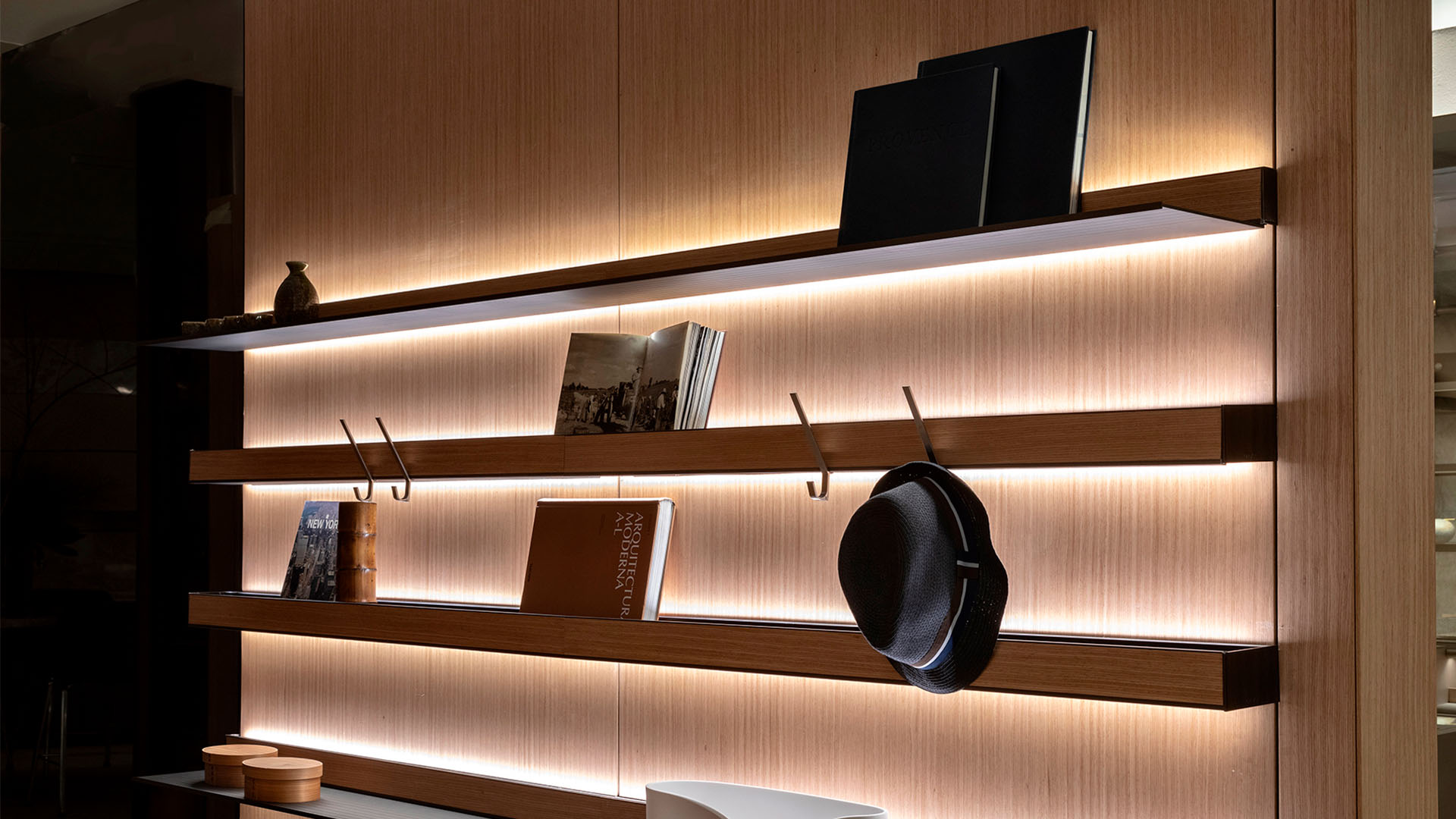
The Ornare showrooms in New York and Dallas have wall installations where different shelf depths are visible across different zones of the same system — which makes the visual difference between depths concrete rather than theoretical. Seeing how a 10-inch shelf and an 8-inch shelf read differently at eye level, with comparable objects on each, is the most efficient way to calibrate this decision before the system is specified.
Equipment and media shelf depth: the dimension that most systems underestimate
The deepest shelves in any bookcase wall system are almost always the ones that hold electronics, media equipment, or speakers. A standard audio receiver is typically 17 to 18 inches deep. A cable box or streaming device runs 8 to 12 inches. Subwoofers and larger speakers can exceed 20 inches. A shelf designed for books — 10 to 12 inches deep — holds none of these adequately. The equipment overhangs the front edge, looks precarious, and requires the cables to run at awkward angles that are difficult to manage.
Media equipment in a bookshelf wall requires shelves of at least 18 to 20 inches — which means the cabinet section containing this equipment needs to be designed differently from the book sections. The deeper section is typically placed at a lower height where the equipment weight is better supported, and the shelf spacing is adjusted for the specific dimensions of the equipment rather than for the height of books. This is one of the configuration decisions that matters most in Wall System Living — Ornare’s most configurable collection — because the system can combine media equipment depth requirements with book-appropriate shelf depths in the same wall, without the equipment section looking like a different piece of furniture grafted onto the bookcase.
Shelf depth and visual projection: how depth changes the appearance of the wall
Shelf depth affects not just function but appearance — specifically, how much the shelves project from the wall and how the depth variation reads visually. A bookcase with shelves at a consistent 10-inch depth projects 10 inches from the wall. A system like Square Wall, which uses modules of varying depths, projects at different distances across the surface — some sections closer to the wall, others further — producing the three-dimensional relief that makes that collection visually distinctive.
This variation in projection creates shadow and depth that a flat-surface bookcase doesn’t have. The relief reads differently at different times of day as the light angle changes. In a room in Los Angeles or Miami with strong directional light for significant parts of the day, this dynamic quality can make the bookcase wall one of the most interesting surfaces in the room. In a room with more diffuse lighting — a north-facing room in New York, for example — the same effect is subtler but still present. Specifying projection depth as a design variable, rather than as an afterthought, is one of the ways Ornare’s wall systems produce results that read as more considered than standard flat-front bookcases of equivalent quality.